
Not everyone spends happy hours and fish fries discussing the finer points of Wisconsin appellate practice, but for those of us lawyers who do, one of the most frequent topics of discussion is how long it takes to get a decision from the Wisconsin Court of Appeals. Depending on the district, anecdotal accounts are that decisions often are issued 12-18 months after briefing is completed. In a show-of-hands poll I conducted at a recent continuing legal education program, roughly half of the litigators in attendance indicated they had at least one active appeal that had been fully briefed and awaiting disposition for longer than a year. As of this writing, I have one appeal that has been fully briefed and awaiting disposition for 16 months.
In this article, I unpack my theory as to why the court of appeals is taking so much longer today to decide cases than it did a quarter-century ago, despite a shrinking caseload. I then describe a few procedural mechanisms attorneys can employ to speed up the appellate process.
Fewer Cases, More Deliberation
In researching this article, I reviewed the annual statistical reports published by the court of appeals between 2001 and 2024, the latest year for which a report was available when I conducted my research. The data shows that the court is deciding cases at the slowest pace on record.[1] In 2001, an authored three-judge opinion issued, on average, 335 days after the filing of a notice of appeal.[2] In 2024, the same opinion took 505 days (51% longer).[3] Per curiam decisions took even longer, going from 329 days in 2001 to 540 days in 2024 (64% longer).[4] One-judge decisions took longer too, climbing from 173 days in 2001 to 260 days in 2024 (50% longer).[5] Table 1 illustrates the steady climb in the number of days to decision for nearly every year since 2001.
Table 1: Days to Decision
Significantly, the increase in the court’s days-to-decision metric is not a function of a growing caseload. Just the opposite. The court’s caseload has fallen significantly since the millennium began. In 2001, there were 3,421 total cases filed at the court of appeals.[6] By 2024, case filings were down to 2,529 (a 26% decrease).[7] The number of decisions issued also fell dramatically. Authored three-judge opinions fell from 453 in 2001 to 112 in 2024 (a 75% decrease).[8] Per curiam opinions fell from 576 in 2001 to 342 in 2024 (a 41% decrease).[9] One-judge decisions fell from 369 in 2001 to 208 in 2024 (a 44% decrease).[10] Summary dispositions fell from 987 in 2001 to 619 in 2024 (a 37% decrease). And memo opinions fell from 891 in 2001 to 750 in 2026 (a 16% decrease). By virtually every metric, the court’s caseload has fallen substantially, even as the time it takes to issue a decision has increased. Table 2 illustrates the steady decrease in the court of appeals’ caseload.
Table 2: Number of Opinions
So far as I can discern, there are two possible culprits for the court of appeals’ lethargic pace.
The first possible culprit is the rise of motion practice – for example, motions for enlargements of time, to dismiss, for summary disposition, to supplement the record, and so on. This is the one area in which the court’s workload significantly increased in the past 25 years. In 2001, the court fielded 9,925 motions.[11] By 2024, that number had risen to 19,463 (a 96% increase).[12] The increase in motion practice appears to be correlated with both the introduction of e-filing in the court of appeals and the nationwide proliferation of litigation by self-represented individuals.
 Caleb R. Gerbitz, Mitchell Hamline 2020, is an associate attorney at
Meissner Tierney Fisher & Nichols S.C., Milwaukee. He is a member of the State Bar of Wisconsin’s Appellate Practice Section board, the Dispute Resolution and Litigation sections, and the Young Lawyers Division. He previously clerked for Justice Brian Hagedorn of the Wisconsin Supreme Court.
Caleb R. Gerbitz, Mitchell Hamline 2020, is an associate attorney at
Meissner Tierney Fisher & Nichols S.C., Milwaukee. He is a member of the State Bar of Wisconsin’s Appellate Practice Section board, the Dispute Resolution and Litigation sections, and the Young Lawyers Division. He previously clerked for Justice Brian Hagedorn of the Wisconsin Supreme Court.
Although the rise in motion practice may explain some of the increase in the time to disposition, I don’t think it’s an especially satisfying explanation. Many motions are resolved or at least initially reviewed by staff attorneys, with relatively less involvement of the assigned judges. This explanation also does not account for the 26% drop in total case filings over the same period. Because motions require substantially less time to resolve than entire cases, that drop likely offsets most or all of the increase in judicial resources devoted to resolving motions.
The second possible culprit is that the court of appeals’ pace of decision-making fluctuates to maintain a stable docket. Despite all the change over the past quarter-century, the size of the court’s docket has remained surprisingly stable, averaging 2,034 pending cases at the end of each year. At the end of 2001, there were 2,013 cases pending at the court.[13] At the end of 2024, the court had 2,124 cases pending.[14] Between 2001 and 2024, the court’s pending cases never fell below 1,882 and never rose above 2,159. The variance from the mean averaged only 4% and peaked at 7%. In short, at the end of any given year, the court of appeals had in the neighborhood of 2,000 cases pending on its docket – regardless of the number of cases filed that year. This steady trend is illustrated in the third column of Table 3.
The more striking metric may be the annual statistics for “average filings per judge” and “average terminations per judge.” No matter which year, the number of average case filings per judge roughly equals the average number of case terminations per judge. For example, in 2001, there was an average of 214 filings per judge and an average of 220 terminations per judge.[15] More than two decades later, the numbers were much lower but still highly correlated. In 2024, there was an average of 158 case filings per judge and an average of 155 terminations per judge.[16] As demonstrated in the third and fourth columns of Table 3, average filings and terminations per judge have steadily fallen in tandem. When data from all available years is compiled, the coefficient of correlation between average filings per judge and average terminations per judge is +0.97. That’s nearly perfect correlation between case arrival and case termination.
If the rate of case arrival has equaled the rate of case termination for the past quarter-century, how is it that the time to decision has grown so substantially? The answer appears to be that, although the court of appeals has fewer cases, it simply spends more time on the cases it does have – and, in the process, maintains a stable caseload of about 2,000 pending cases.
This theory is supported by the strong inverse correlation between the average filings per judge and days to disposition. The coefficient of correlation between average filings per judge and days to decision is -0.77, a fairly strong inverse correlation. For authored three-judge opinions, the coefficient of correlation is even stronger, at -0.83. And for one-judge decisions, it is stronger still, at -0.88. These numbers demonstrate a strikingly strong inverse relationship between the number of cases filed in any given year and the average number of days the court of appeals takes to decide a case.
If this theory is correct – that a diminishing caseload is tied to an increase in days-to-decision – the explanation for this phenomenon is more difficult to pin down. I think an analogy may explain some of what is going on here. I grew up as the oldest of eight children. On occasion, someone would say to my parents, “I don’t know how you do it,” or something to that effect. On one occasion, I recall my dad responding in jest, “Whether you have one kid or eight kids, they’ll take all your time and all your money.” So too, it would seem, with appeals. Whether the court has 3,421 case filings (as it did in 2001) or 2,529 case filings (as it did in 2024), the court will issue its decisions at whatever pace allows it to maintain an overall caseload of around 2,000 cases. (Of course, the court loves all of its 2,000 cases equally.)
This is essentially a variation on Parkinson’s Law, which posits that work expands to fill the time allotted for its completion. Here, however, it’s not the work expanding to fill the time, but rather the time expanding to maintain a stable caseload. It’s like a to-do list that is always a page long, no matter how busy you are.
To be clear, none of this should draw into question the court’s work ethic. By all accounts, the judges and their staff attorneys are extremely busy – more so even than when caseloads were substantially higher. Days to decision also varies district-to-district, suggesting there is some correlation between the number of judges in a district and the speed at which that district can turn out decisions. What I offer here is simply one theory about what could be going on. The full story may be more complicated and require further discussion. I hope this article serves to jump-start those discussions. For now, though, it’s time to move on to more practical insights.
Speeding Up the Appellate Process
The court of appeals generally considers cases in the order in which they are received. Thus, speeding up the appellate process requires either getting into the decision queue faster or jumping to the front of the decision queue. The following are three procedural mechanisms that accomplish one or both of these goals.
Self-Help Advancement. There are several ways attorneys can shave weeks or even months off an appeal simply by acting promptly in the early stages of the case – what Michael Heffernan termed “self-help advancement.”[17] The most obvious way to speed up an appeal is to start early. Typically, a notice of appeal must be filed within either 45 or 90 days after entry of a final judgment, depending on whether a notice of entry of judgment is filed.[18] Straight away, an appellant can shave anywhere from one-and-a-half to three months off an appeal by promptly filing a notice of appeal.
Next, many appeals hit a snag in the early going, waiting for court reporters to prepare the transcripts needed to compile the circuit-court record. Court-reporter shortages throughout the state have caused months-long delays in the preparation of transcripts. Because briefing schedules are keyed off assembly of the circuit-court records, delayed receipt of transcripts leads to delayed appellate briefing schedules. In many instances, this can be avoided by anticipating which transcripts will be required for an eventual appeal and ordering those transcripts while the case is still pending in the circuit court. If you do find yourself waiting for a court reporter to prepare one last transcript before the record can be finalized, inquire with the court reporter about options to expedite the transcript order and politely encourage the court reporter to prioritize the missing transcript.
Better yet, consider skipping the record altogether. Wisconsin’s rules of appellate procedure permit the parties to jointly file “an agreed statement of the case in lieu of the record on appeal.”[19] Such a statement must 1) “[s]how how the issues presented by the appeal arose and were decided by the trial court,” and 2) “[r]ecite sufficient facts proved or sought to be proved as are essential to a resolution of the issues presented.”[20] Although this approach is not used often today, a quick Westlaw search reveals that it was put to effective use in the 1980s and 1990s.[21]
Finally, once briefing begins, a party can shave up to a month-and-a-half off an appeal by filing briefs early. For most cases at the court of appeals, the appellant’s brief is due 40 days after the filing of the circuit court record, the respondent’s brief is due 30 days after the appellant’s brief, and the reply is due 15 days after the response brief.[22] Because each deadline keys off the prior filing, filing a brief early effectively shortens the briefing schedule – and, in turn, hastens the submission of the case to the judges. Unfortunately, there’s little an attorney can do about opposing counsel requesting extensions of briefing deadlines.
Also of Interest
Get the Gold Standard for Your Next Appeal
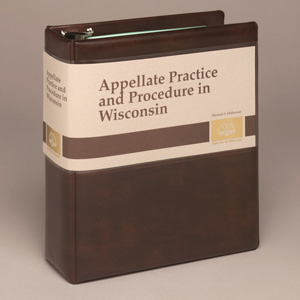
If you plan to appeal a case to the Wisconsin Court of Appeals or the Wisconsin Supreme Court, turn to
Appellate Practice and Procedure in Wisconsin, the standard reference on practice in both courts. The book’s 28 chapters provide basic information on appellate procedures, as well as sophisticated commentary on expedited appeals, briefing, oral argument, one-judge appeals, and other important topics.
Several appendices provide additional resources, including a “Standards of Appellate Review” outline, prepared by the Hon. Thomas Hruz of the Wisconsin Court of Appeals, District III, and the Hon. Nathan Petrashek, of the Wisconsin Court of Appeals, District I; numerous appellate court forms, prepared by the Clerk of the Wisconsin Supreme Court and Court of Appeals; and the full text of the Wisconsin Rules of Appellate Procedure. Both the print and Books UnBound versions include a complete set of fillable, unannotated forms via download.
To give your client the best representation possible on appeals, make
Appellate Practice and Procedure in Wisconsin your key resource.
wisbar.org/AK0023
Expedited Appeals Program. If you ask a judge in three of the state’s four appellate districts how best to receive a prompt disposition of an appeal, the judge will most likely direct you to the expedited (also known as “fast-track”) appeals program. Wisconsin’s rules of appellate procedure provide that “the court of appeals may develop an expedited appeals program,” which “may involve mandatory completion of docketing statements by appellant’s counsel and participation in presubmission conferences.”[23] However, by rule, “participation in the court’s accelerated briefing and decision process is voluntary.”[24] That means all parties to the appeal must consent to the expedited procedure to take advantage of it.
As currently constituted, the expedited-appeals program proceeds in two stages.[25] In the first stage, the case is evaluated for fast-track eligibility and voluntary participation.[26] This occurs primarily through the docketing statement, a questionnaire filed with the notice of appeal, in which appellants provide high-level information about the case and state whether they wish to participate in the expedited-appeals program.[27] In general, cases are eligible for fast-track consideration if 1) no more than three issues are raised, 2) the briefs will not exceed 15 pages, and 3) the briefs can be filed on a compressed timeline.
If the appellant expresses a willingness to participate in the expedited-appeals program, the court will inquire with the other parties whether they also consent. In Districts II and III, this occurs via a confidential presubmission conference with a staff attorney.[28] During that brief conference, the staff attorney leads a discussion to determine whether all parties consent to participate in the expedited-appeals program and to determine a briefing schedule. In District IV, a staff attorney communicates with the parties in writing to determine their willingness to participate.[29] Under either approach, if all parties consent, the court enters an order placing the case on the fast-track docket and setting the briefing schedule.
The second stage of a fast-track appeal is the litigation of the appeal itself. In general, briefs filed in an expedited appeal will be half the length of the briefs filed in an ordinary appeal (hence the judges’ favorable view of the expedited-appeals program).[30] The briefing deadlines will also be roughly half as long as for a regular appeal, shaving more than a month off the ordinary time to disposition. But the real benefit of the expedited-appeals program is that, once briefing is complete, fast-track appeals go to the front of the queue for the court’s consideration.[31] For most cases, this cuts between three and six months off the time to disposition.
The data demonstrates that fast-track appeals are decided much faster than ordinary appeals. In 2024, fast-track appeals were decided, on average, 190 days after the filing of a notice of appeal.[32] Recall that a standard three-judge decision took 505 days, meaning that, on average, a fast-track appeal was decided more than two-and-a-half times faster than a regular appeal.[33]
Depending on the district, an expedited appeal can move even faster. In the Madison-based District IV, fast-track appeals were decided at the staggeringly fast pace of 116 days.[34] Districts II and III took a little longer, at 219 and 236 days respectively, but still provided substantial time savings.[35] As Table 4 shows, in 2024, ordinary three-judge decisions took 521 days in District II and 651 days in District III.[36] For a relatively straightforward case in Districts II, III, or IV, opting into the expedited-appeals program is an easy call.
Table 4: Days to Decision
As for District I, the Milwaukee-based district does not currently offer an expedited-appeals program, and, according to the court’s annual reports, it has not offered a fast-track option since before 2001. Unfortunately, that leaves little recourse for advocates hoping to short-circuit District I’s average of 583 days-to-decision for three-judge opinions.[37] My hope is that District I might one day join the other three districts in offering a fast-track option, but for now, it’s not available.
Motion to Advance. Sometimes, in an appropriate case, judicial intervention is needed to hasten the disposition of an appeal. In that situation, the judicial mechanism to speed up an appeal is the aptly named “motion to advance.”
As previously noted, the court of appeals ordinarily reviews cases in the order in which briefing is completed – meaning a case will sit for between three and six months after briefing is complete before the judges even review the briefs or meet to discuss the case. In an appropriate case, a party may bring a motion under Wis. Stat. section (rule) 809.20 to advance the court’s review of the case. That rule provides, “A party may file a motion to advance the submission of a case either before or after the briefs have been filed.” A motion to advance will be granted only upon a showing of extenuating circumstances: “The motion should recite the nature of the public or private interests involved, the issues in the case and how delay in submission will be prejudicial to the accomplishment of justice.”[38] Motions to advance are subject to the standard appellate motion procedures in Wis. Stat. section (rule) 809.14.
It has been observed that “as a practical matter, only exceptional cases will be advanced,” if for no other reason than “the advancement of one case means the delay of another case.”[39] However, when a case truly warrants special treatment, the motion to advance is an appropriate mechanism to hasten its consideration. The court of appeals has even chided a party for failing to bring a motion to advance to prevent an appeal from becoming moot.[40]
Motions to advance are most successful when time-sensitive issues such as competency,[41] public-records requests,[42] or elections are involved.[43] On occasion, the court of appeals has accelerated cases based on the significance of the issues to the public interest.[44] Of course, the court of appeals will not take kindly to motions to advance that are filed as a matter of course or filed in cases that do not involve a true exigency, so careful consideration is advised before filing such a motion.
Conclusion
In Wisconsin, appeals are taking longer, even as there are fewer of them. In this article, I’ve suggested that the increase in days-to-disposition is tied to the diminishing number of appeals filed with the court. Based on the data available, the trend of lengthy appeals will likely continue, even as the court’s caseload continues to fall. That being the case, the procedural mechanisms described in this article – self-help advancement, the expedited-appeals program, and (when appropriate) the motion to advance – are the best ways to ensure timely disposition of your appeal.
Endnotes
[1]
https://www.wicourts.gov/other/appeals/statistical.jsp.
^
[2] Court of Appeals Annual Report 2001 (hereinafter 2001 Report), at 2.
^
[3] Wisconsin Court of Appeals 2024 Annual Report (hereinafter 2024 Report), at 3. Between the time this article was drafted and its publication, the court of appeals issued its 2025 Annual Report. The data and commentary in this article do not take the 2025 Annual Report into consideration.
^
[4] 2001 Report, supra note 2, at 2; 2024 Report, supra note 3, at 3. ^
[5] 2001 Report, supra note 2, at 2; 2024 Report, supra note 3, at 3. ^
[6] 2001 Report, supra note 2, at 1. ^
[7] 2024 Report, supra note 3, at 2. ^
[8] 2001 Report, supra note 2, at 3; 2024 Report, supra note 3, at 2. ^
[9] 2001 Report, supra note 2, at 3; 2024 Report, supra note 3, at 2. ^
[10] 2001 Report, supra note 2, at 3; 2024 Report, supra note 3, at 2. ^
[11] 2001 Report, supra note 2, at 4. ^
[12] 2024 Report, supra note 3, at 5. ^
[13] 2001 Report, supra note 2, at 4. ^
[14] 2024 Report, supra note 3, at 5. ^
[15] 2001 Report, supra note 2, at 1. ^
[16] 2024 Report, supra note 3, at 2. ^
[17] See generally Michael S. Heffernan, Appellate Practice and Procedure in Wisconsin § 15.2 (State Bar of Wis. 10th ed. 2025).
^
[18] Wis. Stat. § 808.04.
^
[19] Wis. Stat. § (Rule) 809.15(5).
^
[20] Id.
^
[21] E.g., Chang v. State Farm Mut. Auto. Ins. Co., 182 Wis. 2d 549, 554, 514 N.W.2d 339 (1994);
Kehl v. Economy Fire & Cas. Co., 147 Wis. 2d 531, 533, 433 N.W.2d 279 (Ct. App. 1988);
Crawford Cnty. v. Meister, No. 84-1718, at *1 (Wis. Ct. App. May 16, 1985) (unpublished slip opinion);
State v. Capitol Times, No. 83-2259, at *1 (Wis. Ct. App. Dec. 16, 1983) (unpublished slip opinion). Note that the
Crawford County and
Capitol Times opinions would not be citable in a brief, per Wis. Stat. section (rule) 809.23(3).
^
[22] Wis. Stat. § (Rule) 809.19.
^
[23] Wis. Stat. § (Rule) 809.17(1).
^
[24] Wis. Stat. § (Rule) 809.17(1).
^
[25] Heffernan, supra note 17, § 15.7. ^
[26] Id. § 15.9.
^
[27]
https://www.wicourts.gov/formdisplay/AP-027.pdff?formNumber=AP-027&formType=Form&formatId=2&language=en.
^
[28] Heffernan, supra note 17, § 15.10. ^
[29] Id.
^
[30] Heffernan, supra note 17, § 15.11. ^
[31] Id.
^
[32] 2024 Report, supra note 3, at 2. ^
[33] Id.
^
[34] Id.
^
[35] Id.
^
[36] Id.
^
[37] Id.
^
[38] Wis. Stat. § (Rule) 809.20.
^
[39] Heffernan, supra note 17, § 15.2 (capitalization altered); see also State v. Morgan, No. 2024AP1405, at *1 n.1 (Wis. Ct. App. Feb. 4, 2026) (unpublished order) (“Based upon the release of this opinion in the ordinary course of appellate practice, we deny the motion as moot.”);
State v. Marshall, No. 2013AP169-CRNM, at *1 n.1 (Wis. Ct. App. June 12, 2013) (unpublished order) (“There was no need to advance submission.”).
^
[40]
Milwaukee Cnty. v. Jacqualine S.W., No. 02-0435, ¶ 8 (Wis. Ct. App. Jul. 23, 2002) (unpublished slip opinion) (“Furthermore, had Jacqualine anticipated that these time-sensitive issues may eventually become moot, she could have alerted this court and attempted to preserve the issues for appeal by filing a motion pursuant to Wis. Stat. § 809.20.”).
^
[41]
State v. Helmbrecht, No. 2025AP315-CRAC, ¶ 2 n.1 (Wis. Ct. App. Jan. 13, 2026) (unpublished slip opinion).
^
[42]
Keen v. Frueh, No. 2018AP1251-AC, at *1 n.1 (Ct. App. May 19, 2020) (unpublished order);
Hagen v. Board of Regents of the Univ. of Wis. Sys., No. 2017AP2058-AC, ¶ 1 n.2 (Ct. App. Jun. 20, 2018) (unpublished slip opinion).
^
[43]
League of Women Voters of Wis. Educ. Network Inc. v. Walker, 2013 WI App 77, ¶1 n.1, 348 Wis. 2d 714, 834 N.W.2d 393 (voter ID);
ARD v. Board of Canvassers, No. 2018AP1924-AC, ¶ 1 n.1 (Wis. Ct. App. Apr. 30, 2019) (unpublished slip opinion).
^
[44]
Lincoln v. Whitehall, 2018 WI App 33, ¶ 1 n.1, 382 Wis. 2d 112, 912 N.W.2d 403, rev’d on other grounds, 2019 WI 37, 386 Wis. 2d 354, 925 N.W.2d 520 (municipal annexation);
S.R. v. Circuit Ct. for Winnebago Cnty., 2015 WI App 98, ¶ 1 n.1, 366 Wis. 2d 134, 876 N.W.2d 147 (adoption by same-sex partner);
Ryan v. Huebsch, No. 2014AP2250-AC, at 1 n.1 (Wis. Ct. App. Dec. 22, 2014) (unpublished order).
^
» Cite this article:
99 Wis. Law. 20-26 (May 2026).
