In 2025, the State Bar of Wisconsin’s
Legal Assistance Committee – through a series of articles – assessed the dire need for civil legal aid services and solutions for how Wisconsin attorneys can fulfill both this need and their pro bono obligations under Wisconsin Supreme Court Rule (SCR) 20:6.1. A survey of our readers revealed that 47.9% perceive that lack of time is the most significant barrier to pro bono participation in Wisconsin, distantly followed by lack of interest at 16.2%.
In this article, I invite you to join me for a day in the life of a full-time civil legal aid provider to visualize how you can make a part-time difference and, I hope, have your interest piqued along the way. The need for civil legal aid services will continue in 2026 and beyond.
Setting the Scene
I work on the EvictionFree MKE (EFM) team at the Legal Aid Society of Milwaukee. EFM represents tenants facing eviction in Milwaukee and Waukesha Counties who would otherwise lack access to legal counsel. The Legal Aid Society and other Wisconsin legal aid service providers depend on federal grants (which unfortunately are diminishing) and private donations to operate.
Our project currently employs seven attorneys and three support staff, including a resource liaison dedicated to wraparound services. There is great demand for services, and pro bono volunteers are a vital asset to help address that need.
Legal aid organizations exist in a competitive funding environment with grants awarded for particular projects. Rural areas experience unique challenges in providing counsel for vast geographic areas with smaller populations. Accordingly, there are many gaps in the system, particularly given the great demand. Furthermore, legal aid service providers, like all law firms, frequently have conflicts of interest that prevent representing people who need assistance.
The fact is, the greater an individual’s need, the more likely they have interacted with the legal system for a variety of reasons, often resulting in a conflict with established providers. We need pro bono attorneys to fill these gaps.
In Milwaukee County, eviction first-return dates are always held at 1:30 p.m., adjourned hearings at 2:30 p.m., and second and third cause (rent and damages) hearings at 3:00 p.m. Three commissioners hear cases simultaneously; some days, there are as many as 80 hearings scheduled for 1:30.
This gives our days a kind of rhythm and creates manageable opportunities for pro bono attorneys to get involved. This “day-in-the-life” is a Monday, when the court schedules eviction hearings for self-represented landlords, with around 80 return dates scheduled among the three commissioners for the 1:30 p.m. time slot.
8:30 a.m.: Client Meeting
The day begins with an in-person meeting with an older-adult client who lacks technological and financial literacy and needs to review payment history in detail. I take the client through their lease, ledger, and pile of paper receipts to confirm how much they owe. Once that’s settled, we review their monthly finances to determine what kind of payment plan they can offer to try and settle with their landlord in court later this week and what their backup plan is if they have to move.
9:15 a.m.: Call Clients with Hearings Today
I have eight return-date hearings scheduled for 1:30 this afternoon, and I’m waiting for updates from my clients for half of them: two are supposed to be moving out and bringing their keys to court; one is a single parent who qualifies for emergency assistance to get an automatic stay[1]; and one is supposed to provide evidence that they paid for major plumbing repairs.
Only one of the tenants who are moving out answers the phone and confirms they will have the keys in court. The tenant who qualifies for emergency assistance confirms they applied but needs help preparing the proof for court. The person who paid for repairs thanks me for the reminder and sends me the evidence but lets me know they could not get off work for court and ultimately is looking for three weeks to move out. I assure them I can present the defense to the commissioner on their behalf today, but that they will need to be at the trial.[2]
10:30 a.m.: Field Client Complaints and Concerns
Once I’ve finalized today’s cases, I turn to any urgent communications from other clients. Two clients have sent me evidence of bad conditions in the units where they formerly lived that arguably entitle them to abated rent at their upcoming rent-and-damages hearings. I update their case files and make a note to conduct an abatement analysis before the upcoming hearings.
Another client left a voicemail asking for help suing a landlord for loss of income and personal injury. I send an email reminding the client that alleged torts are not defenses to nonpayment of rent and that I can only represent on the eviction issue.
I have a voicemail from a former client whose case was resolved by payment plan; now there is an issue with the person’s Supplemental Security Income (SSI) that may prevent the person from following through with the next payment. Having already resolved the case and lacking any legal defense for nonpayment, I call the person back and suggest they try mediating with their landlord and refer them for assistance with the SSI issue.
Finally, another client with a money judgment on a closed case wants to know whether there is any way to clear his rental history if he pays what he owes. I refer him to our monthly Free Eviction Sealing Clinic,[3] at which he can receive help filling out the appropriate motion once the judgment is paid.
11:15 a.m.: Assess New Cases
In the last 24 hours, I have been assigned three new cases: two for eviction defense and one for advice on a termination notice that has not been filed as an eviction yet.
I look at the termination notice first, in case the tenant has received a 5-Day Notice and needs urgent advice within that time. It is a 28-Day Notice terminating without cause, and two weeks have already passed. I call the tenant to advise right away that 28-Day Notices terminating month-to-month tenancies are generally proper, so the best course of action is to try to move out as soon as possible or to negotiate or mediate with the landlord.
I let them know that if an eviction is filed before they can move, they can reapply for our representation to make sure the notice was filed properly and reassess for any available defenses.
I then finish opening the two new eviction cases I’ve been assigned and conduct a brief initial assessment. One of them is a tenant of the largest landlord in Milwaukee, which makes the same general offer to all tenants facing eviction for nonpayment, so I am able to call this tenant right away to see whether that will work for them. It will, but the person does not think they can handle the court appearance by themselves or will understand the details. I agree to represent them.
The second is a tenant of the Housing Authority of the City of Milwaukee and receives a Section 8 voucher. I make a note that this case will require a more careful review of the pleadings before calling the client.
12:00 p.m.: State Bar of Wisconsin Legal Assistance Committee Meeting
This committee develops and monitors State Bar programs to expand support for legal services to low-income residents, including this column to encourage pro bono participation.
I also meet monthly with the Milwaukee Housing Coalition and quarterly with the Coalition for Access to Legal Resources to stay up to date on Wisconsin’s network of services.
1:30 p.m.: Court
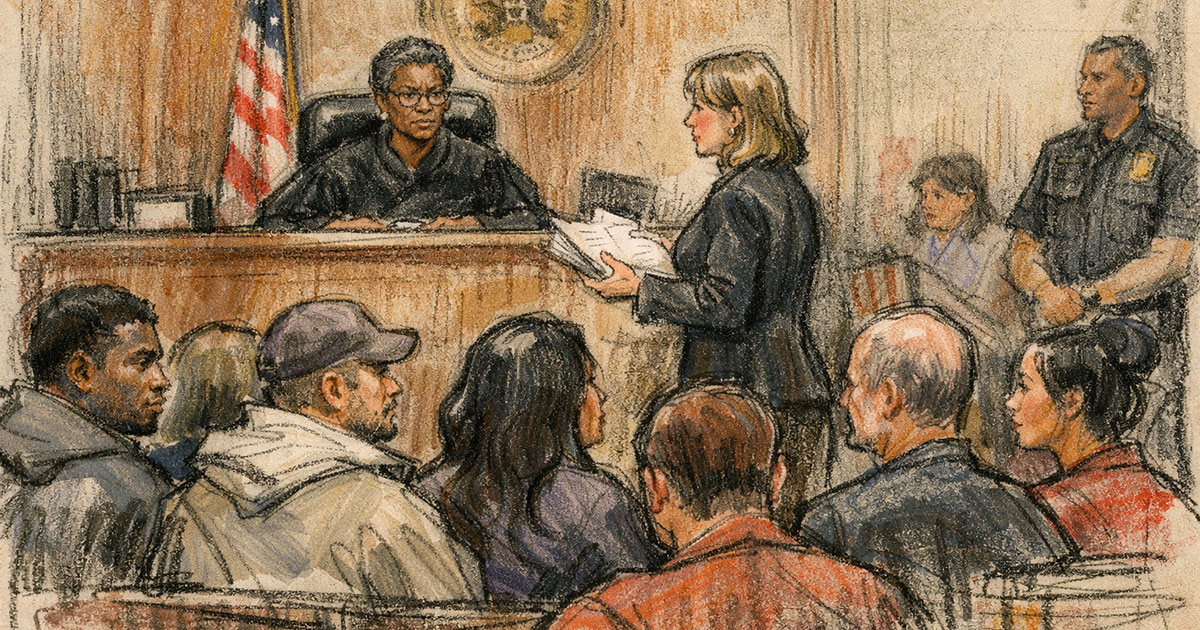
Room 400 is a chaotic environment teeming with landlords, tenants, and attorneys. I check in with the clerk on my eight cases and locate my clients who are expected to appear.
Over the next few hours, I resolve two cases by stipulation to vacate; two are dismissed for vacating and scheduled for rent and damages; one is adjourned for emergency assistance; three are scheduled for trial within 30 days. I expect one of those cases to eventually proceed to trial and the other two cases to settle.
Eviction Defense Project (EDP) volunteer attorneys through Legal Aid Society are here today to represent eligible tenants who did not apply to Legal Aid’s EFM in advance. Each volunteer typically takes one or two cases per afternoon. The EDP provides same-day services with volunteers on Mondays, Wednesdays, and Fridays; EFM does the same with our staff attorneys on Tuesdays and Thursdays.
5:00 p.m.: Case Follow-up and Closing After Court
After court, I follow up with my clients with a written summary of what happened in court today, and I update and close case files accordingly. All clients benefit from a plain-language explanation of what happened in court, even if they were at the hearing. Finally, I review and prioritize the tasks I can accomplish tomorrow morning before attending court to provide same-day services.
How YOU Can Make a Difference
Here are some ways that attorneys who don’t work for Legal Aid Society of Milwaukee or another legal aid organization can help.
Find opportunities to take cases in rural areas to fill a major service gap. Urban pro bono service coordinators[4] can provide expertise and resources to expand services to your area.
Bring your area of expertise in the form of limited-scope representation. Low-income clients often have intersecting needs for legal advice and representation. Attorneys who are hesitant to practice outside their area of expertise can volunteer to provide brief legal answers and limited representation on familiar or simple contractual issues.
Offer intake meetings or informative consultations. Short meetings provide opportunities to provide straightforward, practical advice that helps a low-income client in crisis move forward proactively.
Assist with form completion. Many clients simply need advice or assistance with redactions and terminations notices, which do not require representation. The
Marquette Volunteer Legal Clinics are one such example, operating in person in Milwaukee and statewide on Zoom so you can volunteer from anywhere.
Get involved with your local bar association. Local committees and organizations can help you find a convenient and productive pro bono practice area, for example, through the State Bar of Wisconsin’s Paladin
Pro Bono Portal.
Rely on systems already in place. Many pro bono opportunities to litigate are strictly scheduled by the court and so are relatively easy to work into your schedule. The need is endless, and representation is supported by civil legal aid organizations such as Legal Action of Wisconsin’s
Volunteer Lawyer Project to provide training and reasonably limit representation.
Everything you do counts. Merely attending and explaining court can make all the difference to a low-income client. Be a difference maker.
Endnotes
1 Wis. Stat. § 799.40(4): Stay of proceeding. (a) The court shall stay the proceedings in a civil action of eviction if the tenant applies for emergency assistance under s. 49.138….
2 Wis. Stat. § 799.206(3): When all parties appear in person or by their attorneys on the return date in an eviction, garnishment, or replevin action and any party raises valid legal grounds for a contest, the matter shall be forthwith scheduled for a hearing, to be held as soon as possible before a judge and in the case of an eviction action, not more than 30 days after the return date. Wis. Stat. § 799.209(1): The court or circuit court commissioner shall conduct the proceeding informally, allowing each party to present arguments and proofs and to examine witnesses to the extent reasonably required for full and true disclosure of the facts.
3
Legalaidmke.com/events.
4 Abrielle R. Newman,
Behind the Scenes: Coordinating Pro Bono Projects and Empowering Lawyers to Serve, 98 Wis. Law. 43 (Sept. 2025).
» Cite this article:
99 Wis. Law. 37-39 (February 2026).
