
Recently, I conversed with some judges about their experience with family law dockets and family law attorneys.
One opinion that was shared seemed rather disparaging. It related to the lack of familiarity with the rules of evidence by attorneys in this area of practice. It was felt that family law attorneys assume they don’t have to follow the rules of evidence and that family court trials were some sort of informal process.
Ironically, less recently but not so long ago, I was conversing with some family law attorneys who bemoaned the fact that judges simply refuse to apply the rules of evidence in family matters. They would say things such as “this is family court, the rules of evidence don’t apply.” Attorneys felt that some judges simply viewed family court trials as some sort of informal process. Truly an unfortunate state of affairs, but one which creates great opportunity and a basis for reflection.
There is an old adage regarding the presentation and credibility of evidence: cross-examination is “the most perfect and effectual system for the unraveling of falsehood ever devised by the ingenuity of mortals.”[1] There is a great deal of truth in this statement, and family law litigants are in as much need of “truth-finding” as litigants in any other area of practice.
In the Anglo-American system of justice, skillful cross-examination is effective because of the rules governing the admission of evidence, that is, the proponent of the witness generally cannot lead the witness whereas the cross-examiner can.[2] Further, the cross-examiner can object and enlist the help of the court if the witness prevaricates and won’t answer (absent some privilege of course).[3]
All of this procedure is governed by the rules of evidence, which also provide other tools for revealing the truth and unraveling falsehood.
This article discusses the importance of the rules of evidence, and to a certain extent the rules of civil procedure, in family court trials, and why this issue deserves special attention by judges and lawyers in the family law context.
The Purpose of the Rules of Evidence
When looking at the applicability of evidentiary rules to family law, it is important to look at the purposes behind the rules of evidence. In Wisconsin, these purposes are clearly set forth in Wis. Stat. section 901.02: “Chapters 901 to 911 shall be construed to secure fairness in administration, elimination of unjustifiable expense and delay, and promotion of growth and development of the law of evidence to the end that the truth may be ascertained and proceedings justly determined.”
 Thomas J. Walsh, Hamline 1992, is a Brown County Circuit Court judge and editor of The Wisconsin Journal of Family Law (WJFL). This article originally appeared in the January 2026 WJFL and is reprinted with permission. The WJFL is accessible to members of the State Bar’s Family Law Section. For information about the section and to join, visit the Family Law Section.
The rules of civil procedure have a similar purpose: “Chapters 801 to 847 shall be construed, administered, and employed by the court and the parties to secure the just, speedy and inexpensive determination of every action and proceeding.”[4]
Thus, it is clear that rules of evidence and procedure are established to, inter alia, increase just and fair resolutions and decrease costs to litigants. That certainly makes sense for family law litigants.
Applicability to Family Court Cases
General Applicability. In assessing the applicability of these rules to family court matters, it is important to review Wis. Stat. section 901.01, which is the “general provisions” section of the rules of evidence. This section indicates that “[c]hapters 901 to 911 govern proceedings in the courts of the state of Wisconsin except as provided in ss. 911.01 and 972.11.”[5] Nothing in sections 911.01 or 972.11 suggests that the rules of evidence do not apply in family court matters. In fact, section 911.01(1) states:
(1) Courts and court commissioners. Chapters 901 to 911 apply to the courts of the state of Wisconsin, including municipal courts and circuit, supplemental, and municipal court commissioners, in the proceedings and to the extent hereinafter set forth except as provided in s. 972.11. The word “judge” in chs. 901 to 911 means judge of a court of record, municipal judge, or circuit, supplemental, or municipal court commissioner.
Similarly, and more specifically, the rules of civil procedure apply to family court cases by statutory directive. Section 767.201 indicates that “(e)xcept as otherwise provided in the statutes, chs. 801 to 847 govern procedure and practice in an action affecting the family. Except as provided in this chapter, chs. 801 and 802 apply to the content and form of the pleadings and summons in an action affecting the family.”[6]
Clearly, the laws of this state require the rules of evidence and civil procedure to be applied in family court proceedings.
Family Court-Specific Rules of Evidence. It is also important to recognize that the Wisconsin Legislature has enacted some very family-law-specific exceptions to the rules of evidence. For example, the family court is permitted to receive into evidence hearsay statements outlining “[t]he wishes of the child, which may be communicated by the child or through the child’s guardian ad litem or other appropriate professional.”[7] This permits hearsay to be communicated to the court about the child’s placement preferences, but does not necessarily cover each and every other statement the child made to the guardian ad litem.[8]
In addition, hearsay is also welcomed by the family code when it asserts the following:
“The guardian ad litem shall investigate whether there is evidence that either parent has engaged in interspousal battery, as described in s. 940.60 or 940.61(1) or s. 940.19, 2023 stats., or s. 940.20(1m), 2023 stats., or domestic abuse, as defined in s. 813.12(1)(am), and shall report to the court on the results of the investigation.”[9]
This provision does not say how this “report” is to be made or what can be included therein. Can the report include hearsay, and is that report written or oral? If written, is it automatically admitted into evidence by virtue of this provision?
Furthermore, a guardian ad litem “shall review and comment to the court on any mediation agreement and stipulation made under s. 767.405(12) and on any parenting plan filed under s. 767.41(1m).”[10] Although the statute does not say specifically what “comment to the court” means, this generally violates the principle that communication regarding mediation and what occurred therein should not be allowed into evidence.[11]
While virtually all the family-law-specific rules of evidence relate to children and the guardian ad litem, these exceptions can create problems with the admission of evidence.
The best illustration of these problems is Hollister v. Hollister.[12] In that divorce case, the guardian ad litem filed a report with the court pretrial and then made an oral recommendation to the court at the close of evidence. The mother opposed the guardian ad litem’s recommendation and ultimately appealed the trial court’s decision awarding sole custody and primary placement to the father. The mother argued, inter alia, that the trial court should be reversed and the case remanded because she had not had the opportunity to call to the stand and cross-examine the guardian ad litem regarding his report and recommendation.
As an aside, but important in this conversation, is the notion that trial courts have been advised by our appellate courts that a circuit court is permitted to weigh a “guardian ad litem’s recommendation more heavily than the other statutory factors. But it cannot rewrite the statute to create a fixed hierarchy of factors.”[13]
Ironically, a guardian ad litem’s recommendation is not even one of the statutory custody and placement factors listed in the family code. Thus, the meaning of this appellate court directive is unclear. However, if such a recommendation relies primarily on inadmissible evidence, then there are even greater problems.
Thus, the mother in Hollister pushed right at this issue, that is, the court is getting important recommendations from someone who cannot be cross-examined regarding their work product. The court of appeals in Hollister determined, for various reasons, that “a guardian ad litem appointed under sec. 767.045, Stats., may not be called as a witness in a custody proceeding, and therefore may not be cross-examined.”[14]
While Hollister may seem like an opening of the floodgates to all forms of hearsay (and hence a reason to dispense completely with the evidentiary rule against hearsay), it is not. While a guardian ad litem can base their opinion on evidence that might not otherwise be admissible, the court cannot. If a guardian ad litem cannot properly offer and have admitted a piece of evidence upon which they have relied in making a recommendation, then the court should not consider it.[15] At least, this should be the experience of a litigator in family court.
This principle is contained within some of the statutory factors for addressing placement. For example, when addressing placement, the court may consider reports of appropriate professionals. However, the statute (Wis. Stat. section 767.41) requires that these reports may be considered only under specific circumstances: “[t]he reports of appropriate professionals if admitted into evidence.”[16] Thus, a hearsay report is not admissible from experts unless properly received under the rules, for example, qualifications, Daubert, and authentication. The same would apply to anything else the guardian ad litem chooses to offer.
This does not, however, mean that the rules of evidence only apply in family court if the judge says they do and that judges have discretion to simply ignore them.
Applicability Summary. From the above statutory provisions and case law, it is clear that the rules of evidence and procedure are to govern cases in family court. Neither advocate nor judge should be confused about the applicability of these provisions (including the family-law-specific rules) to actions under Wis. Stat. chapter 767, also known as the Wisconsin family code. Lawyers’ and judges’ failure to understand that and to familiarize themselves with the rules of evidence is inconsistent with our duties to litigants and to our profession as a whole.
It is true, of course, that the final word on the admission of evidence at trial belongs to the judge, subject to review by the appellate courts. Nonetheless, it is important to understand that under the rules of evidence in this state, “[e]rror
may not be predicated upon a ruling which admits or excludes evidence unless a substantial right of the party is affected.”[17] Meaning, of course, that appellate courts will allow trial judges broad discretion on what to receive into evidence in a family court trial.
This does not, however, mean that the rules of evidence only apply in family court if the judge says they do and that judges have discretion to simply ignore them.
When looking specifically at the purposes and applicability of the Wisconsin rules of evidence, the question really is not whether the rules of evidence should apply in family court cases, but rather whether the rules of evidence make family court outcomes more fair or less fair and whether they reduce costs. If the answer is “yes,” then certainly judges and advocates need to get on the same page about the conduct of family court trials – they do not seem to be in many cases. If the answer is “no,” then steps should be taken to change the law rather than simply dispense with it on a circuit-by-circuit basis.
The Pushback Against the Rules of Evidence
Conversations about the rules of evidence in family court often occur in the context of the lack of trial by jury, where juries cannot be trusted to sift through the quality of evidence.
That is, there are no jury trials in family court, so judges should receive all offered evidence because judges are trained to sift through speculative evidence. In addition, debates about the rules of evidence in family court often focus on evidentiary rules being more important in criminal matters because in those trials there are more important rights at stake, that is, liberty interests, and mistakes on evidence take on greater significance.
Juries Versus Judges. The concept of the rules of evidence being more important in cases involving juries than in cases tried to the court is not new. The following discussion of the rule against hearsay is illustrative:
“In most of the Continental States, the Judges determine upon the facts in dispute as well as upon the law; and they think there is no danger in their listening to evidence of hearsay, because when they come to consider of their judgment on the merits of the case, they can trust themselves entirely to disregard the hearsay evidence, or to give it any little weight which it may seem to deserve. But in England, where the jury are the sole judges of the fact, hearsay evidence is properly excluded, because no man can tell what effect it might have upon their minds.”[18]
This is certainly a good argument for why the rules of evidence should be left out of family court. In Wisconsin, however, it is a good argument for why the system should be changed and not a good argument for failure to apply the rules of evidence in a Wisconsin circuit court.
Our system is designed to have advocates (or the parties themselves if they are not represented). Those advocates conduct their investigation, bring information to the court, and engage in an adversarial process to assist in revealing the truth to a passive judge who then renders a decision.
This is where the rules of civil procedure dovetail with the rules of evidence. The rules of civil procedure govern how parties are to gather information, both admissible and inadmissible, to ensure that no one arrives in court subjected to trial by ambush. Further, they ensure that the advocates are able to present all relevant evidence to the judge. Having rules as to how this adversarial process and presentation of evidence is to occur makes the process more predictable and thereby more cost effective to litigants.
As long as the process of investigation is delegated to the litigants and the task of passive decision-making is given to the judge, rules governing the submission of evidence are essential for predictability. The rules of civil procedure need to be applied for those trying to gather information (including sanctions for violation), and rules for admissibility of evidence are needed to govern the process of submission.
The issue of trial by ambush is not as serious in some continental systems because the judges often do the investigation, and information can be submitted over a period of time.[19] In our country and the state of Wisconsin, allowing everyone to simply show up on the trial date, which is usually on one specific day or a series of days after discovery is cut off, and submit whatever suits them would amount to trial by ambush and the very real possibility that the judge would be receiving conflicting statements of witnesses without the opportunity to see them in court and assess credibility. This is a serious impediment to a passive decision-maker if not allowed to conduct an independent investigation.
State law requires the rules of evidence and civil procedure to be applied in family court. It is not a matter of discretion for judges or optional for attorneys. Failing to do so would not be fair to those who expect them to be applied.
The Importance of the Stakes. This argument is relatively easy to address. Although no one is at risk of imprisonment in a family court matter, there are very important interests at stake: children, money, real estate. Beyond a person’s freedom and liberty, there are few things more important than a person’s children, their money, and their real estate.
A parent’s right to engage in the raising and upbringing of their own children is, in fact, a constitutional right.[20] Actions seeking to remove or modify those rights are also governed by the rules of civil procedure and evidence, for example, termination of parental rights and dependency cases. The Wisconsin Supreme Court has also set forth the principle that the same rights exist in family court cases.[21] It would seem that watching your custodial rights or your interest in your real estate slip away due to evidence that would not otherwise be admissible in a criminal trial or other civil trial would be unfair if it happens in a family court trial.
The significance of the rights at stake, therefore, does not seem to justify failure to apply the rules of evidence or civil procedure in family court.
Trial Practice. Finally, there is one other aspect of “evidence” that deserves brief comment. Perhaps it is the most important aspect. When a trial attorney is plying their trade in the courtroom, it is important that they understand and apply the basics of trial practice.
In fact, often when attorneys and judges complain about applying the rules of “evidence” in family court, they seem more focused on trial practice, that is, familiarity with the concepts of trial practice. For example, how to go about laying foundation for expert witnesses such as psychologists, physicians, accountants, business evaluators, and appraisers under Wis. Stat. chapter 907. How to authenticate the documents they use or produce under Wis. Stat. chapter 909. How to refresh recollection under Wis. Stat. section 906.12 versus impeaching the witness under Wis. Stat. section 906.07. How to impeach using a deposition transcript under Wis. Stat. section 906.07. How you can get the judge to take judicial notice of something under Wis. Stat. chapter 902.
These are tools of the trade of a civil litigator, and divorce attorneys are civil litigators. Judges should expect these skills from the attorneys, and self-represented litigants, trying family cases in their courts, and attorneys should be prepared to utilize those skills if they want to practice in this area of the law. Our law schools should also be expected to extensively train our attorneys in trial practice.
Conclusion
Changing the manner in which we resolve family dissolutions may certainly have some merit. Maybe society would be better served by having this type of case decided by a panel of psychologists or social workers or therapists or a combination of those trained professionals rather than by a judge. Further, maybe it would make more sense to eliminate the responsibility of the parties to conduct the investigation in family court and place that task on the magistrate or magistrates assigned to make the decision. However, the notion that we believe this to be the case does not simply give us license to do so.
State law requires the rules of evidence and civil procedure to be applied in family court. It is not a matter of discretion for judges or optional for attorneys. Failing to do so would not be fair to those who expect them to be applied.
At the same time, the judge has certain flexibility regarding how rulings on evidence will unfold. This is a principle inherent in all aspects of trial practice across disciplines.
Of greatest importance to courts and advocates is to be absolutely clear, pretrial, regarding rulings on various issues. Again, failure to do so would be unfair. Resolving evidentiary concerns pretrial serves all interested parties and improves the experience at trial.
Also of Interest
Hone Your Understanding of Evidence Before Trying a Family Law Case
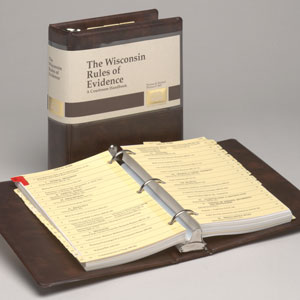
The application of the rules of evidence in any trial requires a basic knowledge of long-standing evidentiary rules and the history of cases that have interpreted them. Wisconsin Rules of Evidence: A Courtroom Handbook, published by State Bar of Wisconsin PINNACLE®, compiles concise annotations of the key evidentiary opinions as a handy, single-volume reference. In addition, the book reprints the text of the complete Wisconsin Rules of Evidence, along with judicial council commentary that provides additional guidance. Various finding tools, including topical tabs, a table of cases, and an index, serve as useful methods for quickly pinpointing relevant cases and rules during trial.
wisbar.org/ak0050
Endnotes
1 Of Disqualification of Parties as Witnesses, Legal Register 1857, 5 Am. Legal Reg. 257, 263-64 (1857).
2 Wis. Stat. § 906.11.
3 Wis. Stat. § 905.01.
4 Wis. Stat. § 801.01(2).
5 Wis. Stat. § 901.01.
6 Wis. Stat. § 767.201.
7 Wis. Stat. § 767.41(5)(am)2.
8 For a more in-depth discussion of communicating the wishes of children to the court and children testifying in court, see generally Thomas J. Walsh, Child Testimony in Family Law Cases: Justifying a Decision, 98 Wis. Law 16 (Jan. 2025).
9 Wis. Stat. § 767.407(4).
10 Wis. Stat. § 767.407(4).
11 Wis. Stat. § 904.085(3).
12 173 Wis. 2d 413, 496 N.W.2d 642 (Ct. App. 1992).
13 Goberville v. Goberville, 2005 WI App 58, ¶ 12, 280 Wis. 2d 405, 694 N.W.2d 503. In fact, in upholding the trial court’s reliance on a GAL report, the appellate court cited these comments from the trial judge: “The lawyers know it takes an awful lot to persuade me that the guardian ad litem is wrong.” Id. The concept that a guardian ad litem recommendation is similar to “another factor” under the statute is difficult to grasp given that a guardian ad litem is to be treated simply like any other advocate for a litigant and giving their recommendation more weight than another litigant because of their status seems contradictory.
14 Hollister v. Hollister, 173 Wis. 2d 413, 419, 496 N.W.2d 642 (Ct. App. 1992).
15 This concept, rendering opinions to the court that are partially based upon inadmissible evidence, is similar to, although distinct from, the rule as outlined in Wis. Stat. section 907.03 that physicians may rely on inadmissible evidence in formulating their opinions: “If of a type reasonably relied upon by experts in the particular field in forming opinions or inferences upon the subject, the facts or data need not be admissible in evidence in order for the opinion or inference to be admitted.” Nonetheless, the inadmissible evidence does not transform into admissible evidence just because the expert uses it in rendering an opinion: “Facts or data that are otherwise inadmissible may not be disclosed to the jury by the proponent of the opinion or inference unless the court determines that their probative value in assisting the jury to evaluate the expert’s opinion or inference substantially outweighs their prejudicial effect.” The same would seem to apply to opinions offered by a guardian ad litem.
16 Emphasis added.
17 Wis. Stat. § 901.03(1).
18 4 Camp. 401, 415, 171 Eng. Rep. 128, 135 (H.L. 1811) (Mansfield C.J.C.P.) (advisory opinion).
19 For a more complete discussion of the roles played by judges and lawyers in civil law traditions, see generally Mary Ann Glendon, Michael W. Gordon, & Christopher Osakwe, Comparative Legal Traditions (1994). Judges have a more active role in such courts: “Although the questioning is typically done by the judge, the questions are often submitted by the parties’ counsel who sometimes are permitted to question a witness directly. As the action proceeds, the judge may inject new theories, and new legal and factual issues, thus reducing the disadvantage of the party with the less competent lawyer.” Id. at 92.
20 See Troxel v. Granville, 530 U.S. 57, 65 (2000). “The liberty interest at issue in this case – the interest of parents in the care, custody, and control of their children – is perhaps the oldest of the fundamental liberty interests recognized by this Court. More than 75 years ago, in Meyer v. Nebraska, 262 U.S. 390, 399, 401 (1923), we held that the ‘liberty’ protected by the Due Process Clause includes the right of parents to ‘establish a home and bring up children’ and ‘to control the education of their own.’”
21 Barstad v. Frazier, 118 Wis. 2d 549, 348 N.W.2d 479 (1989). This Wisconsin Supreme Court case was commenced under Wis. Stat. section 767.02(1). The court stated: “We conclude that in the absence of compelling reasons the principles followed in cases involving termination of parental rights should be followed where a request for a custody change from a parent to a third party is presented to a court.” Id. at 556.
» Cite this article: 99 Wis. Law. 18-24 (February 2026).
