
IBM’s Simon, considered to be the first smartphone, was released on Aug. 16, 1994. That means that, while this article is turning 12 this year, smartphone technology has been available for over three decades. Phones now hold more computing power and technology than I ever thought possible, except in the fantastical science fiction stories I read growing up. I love living in the future.[1]
This will be the final “Pick Your Winner” article for Wisconsin Lawyer. Smartphone technology is so ubiquitous that, aside from the minor changes each company tries to introduce annually and whichever new directions artificial intelligence (AI) takes the industry, other technology topics warrant this space.
In this year’s article, I review the top models from each of the three top brands: Apple, Google, and Samsung. AI, although it had a big push last year, has even more implications for smartphones this year, and we look at those, too.
I also dig into how tariffs and other geopolitical factors are affecting phone availability and pricing and how the big three companies are adapting. Finally, I look at Trump Mobile, the potential new player in the 2025 market, which has faced issues consumers should consider before investing.
The Contenders
This year’s lineup of phones includes the Apple iPhone 17 series, the Samsung Galaxy S25 series, and Google’s Pixel 10 series. I compare the models based on key features such as camera quality and improvements, screen size, battery life, and performance and look at how each is implementing AI.
Trump Mobile is not part of the lineup. Despite being announced earlier this year and having already begun accepting deposits, it has missed its announced release dates and is currently unavailable.[2]
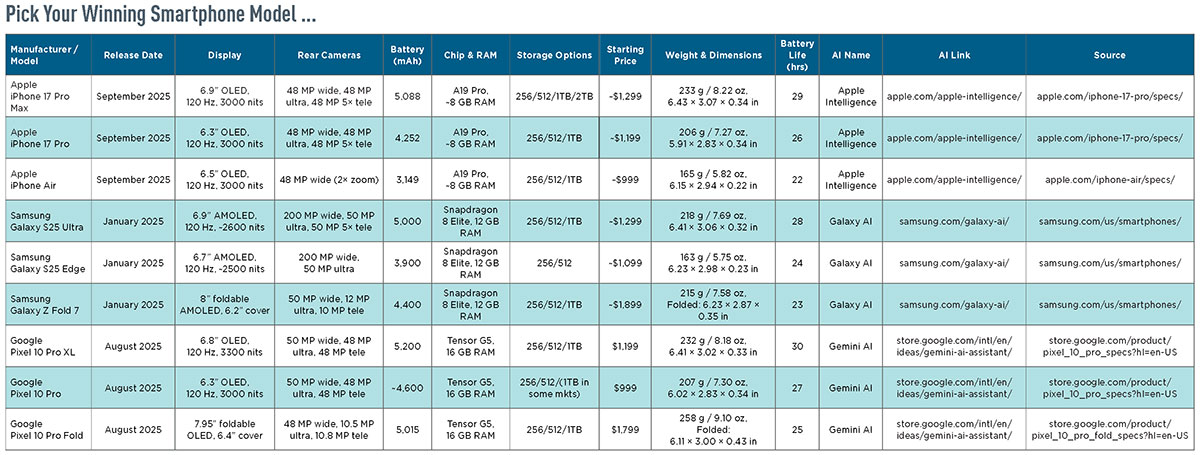
Click to expand table.
Cameras
In past years, I’ve conducted informal surveys of attorneys regarding phone features, and cameras rarely came up as something important. Yet, I bet you have plenty of photos on your phone, from family vacations to case-related images. I have more pictures of computers than of my kids. Moreover, AI services now include image recognition and require higher image-quality levels than ever before.
 James Pearson owns the Computer Center, Janesville. He is a Microsoft Certified Professional and a frequent author and speaker on cybersecurity and safety topics. thelawyersgeek.com
Alongside Apple, which continues to try to be “Hollywood in your pocket” year after year, all manufacturers keep improving the quality and capabilities of their phone cameras. The iPhone Pro 17 from Apple has the same cameras as the Pro Max, but they are housed in a smaller chassis. I suspect that as AI’s ability to extrapolate data improves, these cameras will continue to shrink in size and rely on AI software as much as, if not more than, the hardware, to produce better quality images than we have ever seen.
Samsung’s Galaxy S25 Ultra is a perfect example of ramping up image quality by combining hardware and software. Its new 10 MP 5× periscope telephoto and 10 MP 3× telephoto cameras include software that crops images to achieve higher optical quality. Samsung’s AI-driven Space Zoom software employs image processing to digitally boost images for clearer results at higher zoom levels. Samsung’s next model down, the S25 Edge, sacrifices the periscope telephoto lens for a slimmer design, unlike Apple, which kept the same camera in the 17 Pro.
Google also is leveraging AI software to improve image quality. The Pixel 10 Pro and the Pixel 10 Pro XL share the same camera set (which hasn’t changed significantly since the Pixel 8 Pro). But this year, Google introduced “Pro Res Zoom,” which, with its high-resolution sensors and generative AI upscaling, allows up to 100× zoom on the Pro models. While the 100× zoom is primarily digital – similar to Samsung’s Space Zoom – Google employs its AI models to add detail during the zoom process.
Performance & Battery Life
Battery life took a jump this year as Apple introduced 500-mAh batteries to its phones. This gives the Pro Max nearly two days of usage. The Galaxy and Pixels have similar batteries and generally last all day. All companies sacrificed battery life for slim designs in their smaller, thinner phones, such as the Apple Air and the Samsung Edge. Given the amount of processing power AI requires, I envision that all manufacturers will continue to find ways to increase phones’ capabilities while maintaining or improving battery life.
Storage Capacity & Screens
Apple increased its capacity to 2TB on the Pro Max, but almost everything else remains capped at the 1TB size. There’s just room for photos. Time will tell, however, whether AI tagalongs will consume much space, especially if the information may be stored locally on the device for extra security.
While only the Samsung Z-Fold series saw an increase in screen size, all the other contenders held their ground. Compared to last year’s Galaxy Z Fold 6’s cover display, this year’s model adds .2 inches, increasing it to 6.5 inches in this year’s release. Further, the main display, when the phone is completely open, measures 8 inches this year, compared to last year’s 7.6 inches.
Artificial Intelligence
The AI race is on, and thanks to it, smartphones are quickly going to be smarterphones. Apple Intelligence, Samsung Galaxy AI, and Google’s Gemini AI assistant share a similar set of features. These include real-time translation; improvements to their current voice assistants, such as Siri; and corrections and improvements to users’ writing and communications. All the interfaces are now capable of complex, conversational-style commands and instructions.
Apple’s Visual Intelligence, Galaxy AI, and Gemini Live make phones even smarter. All these applications can “see” what a user is seeing, analyze it, and respond to questions about it. Need to identify a plant? Just point your camera at the image and talk to your AI assistant, and it will analyze the image and respond, just as if it were standing there.
Another area in which AI is being leveraged on smartphones is for on-the-spot image editing and enhancement. This will let users quickly touch up photos, alter them, and even work with video, all on the same device on which the images were recorded.
Although AI has benefits, and I’m not yet disconnecting from the world and moving off the grid, I do believe we all still need the option to have a little control. This brings us to our next topic.
Opting out of AI. For as long as I’ve been talking about cybersecurity and privacy, my conclusion is that privacy is dead, monthly subscriptions will take over everything, and AI will be integrated everywhere, whether we like (or want) it or not.
The benefits of AI are many, as are the potential downfalls, and better left to another article on another day. But, for now, let’s find out how to maintain as much control as is possible.
The good news is that, for now, users can opt out of Apple and Google’s AI relatively easily. For Apple, there’s a single on/off setting to disable it across the board.[3]
Google’s Pixel is a little more complicated in that a user must turn off all the individual apps. It appears that nine steps are needed to completely remove Gemini from a Pixel 10 phone. This includes disabling Gemini in each app, such as Screenshot, Journal, Google Photos, and Messages; reverting to the old Google Assistant app; and finally, uninstalling Gemini.[4]
Another option, and one that I believe many frugal lawyers are likely to choose by default, is to continue using older phone models that don’t support AI. While this isn’t a long-term solution (because eventually all manufacturers stop supporting old phones), typically refurbished models from the previous year and the previous year’s models are available at a lower price. Not only are the phones less costly, but also they won’t run AI. The obvious drawback is that you’re working with an already older phone that won’t be supported for more than a few years.
Current Availability and Pricing
In early 2025, I would have guessed that phone prices would skyrocket and there would be supply chain issues, given tariffs and geopolitical events. However, none of the three major phone manufacturers showed any trouble adapting quickly, and many had already begun moving all their eggs from one basket, finding alternative production facilities.
Apple and Google took early action, moving production away from high-tariff countries such as China to countries like India, where over 44% of the use smartphones were exported in the second quarter of 2025 versus 25% from China. However, Samsung kept its production in Vietnam, which then proceeded to get hit with a 46% tariff. However, phone manufacturers got some exemptions, which helped.[5]
Despite all the turbulence, phone companies have maintained supply by using existing inventory and shifting manufacturing strategies. They have either defensively cut production costs as much as possible during these turbulent times or absorbed many of those costs. Either way, there were minimal hikes in phone prices in 2025. However, the effects of tariffs and supply chain issues remain subject to change.
Trump Mobile
Trump Mobile is a phone company that doesn’t exist. According to a recent report from NBC News, the company has been accepting $100 deposits since July 2025, but no phone has materialized.[6]
Although the company’s goal was to make a “100% USA” phone, it has become more of a challenge than the company anticipated because of the inability to manufacture the needed parts in the US. The Trump Organization will not manufacture the phones, as Apple and other phone companies do, but will outsource manufacturing and then license the phone.
“Trump Mobile, its products and services are not designed, developed, manufactured, distributed or sold by The Trump Organization or any of their respective affiliates or principals. T1 Mobile LLC uses the Trump name and trademark pursuant to the terms of a limited license agreement which may be terminated or revoked according to its terms.”[7]
The Smartphone Wrap-Up
I’ll leave you this year, the final year of this article, with a quick summary of each of the big three manufacturers’ top three phones. All prices are manufacturers’ suggested retail prices. If it’s time for an upgrade, now’s the time to do it if you’re not afraid of accepting AI into your life, as prices and availability remained steady this year despite all the political and economic turbulence. Also, if your current phone is three or more models behind, know that it won’t be long before it’s obsolete.
Apple
iPhone 17 Pro Max, 6.9” screen, 29 hrs, $1,299
iPhone 17 Pro, 6.3” screen, 26 hrs, $1,199
iPhone Air, 6.5” screen, 22 hrs, $999
Where to get product specifications and AI information:
Samsung
Galaxy S25 Ultra, 6.9” screen, 28 hrs, $1,299
Galaxy S25 Edge, 6.7” screen, 24 hrs, $1,099
Galaxy Z Fold 7, 8.0” screen, 23 hrs, $1,899
Where to get product specifications and AI information:
Google
Pixel 10 Pro XL, 6.8” screen, 30 hrs, $1,199
Pixel 10 Pro, 6.3” screen, 27 hrs, $999
Pixel 10 Pro Fold, 7.95” screen, 25 hrs, $1,799
Where to get product specifications and AI information:
Endnotes
1 Doug Aamoth, First Smartphone Turns 20: Fun Facts About Simon, TIME (Aug. 18, 2014), https://time.com/3137005/first-smartphone-ibm-simon/.
2 Brian Cheung, The Trump Mobile Phone Is Nowhere to Be Found After Months of Delay, NBC News (Nov. 24, 2025, 4:00 AM CST), https://www.nbcnews.com/tech/tech-news/trump-mobile-phone-customers-left-waiting-months-delay-rcna245035; Trump Organization, Trump Mobile, Trump.com, https://www.trump.com/lifestyle/trump-mobile (last visited Nov. 30, 2025).
3 Kaycee Hill, How to Turn Off Apple Intelligence on your iPhone, Tom’s Guide (Mar. 4, 2025), https://www.tomsguide.com/phones/iphones/how-to-opt-out-of-apple-intelligence (last visited Nov. 30, 2025.)
4 Blake Stimac, How to Remove or Disable AI From Your Pixel Phone, CNET (Oct. 15, 2025, 3:00 a.m. PT), https://www.cnet.com/tech/services-and-software/how-to-remove-or-disable-ai-from-your-pixel-phone/ (last visited Nov. 30, 2025).
5 Julia Shapero, Apple’s Shift to India Boosts Smartphone Exports, The Hill (July 29, 2025, 5:13 PM ET), https://thehill.com/policy/technology/5426445-apple-shifts-production-india-vietnam/; Jin Eun-soo, Samsung Faces Galaxy Price Conundrum as Vietnam Hit with 46% Tariff by U.S., Korea JoongAng Daily (Apr. 3, 2025), https://koreajoongangdaily.joins.com/news/2025-04-03/business/industry/Samsung-faces-Galaxy-price-conundrum-as-Vietnam-hit-with-46-tariff-by-US/2277214.
6 See Cheung, supra note 2.
7 See Trump Organization, supra note 2.
» Cite this article: 99 Wis. Law. 47-51 (January 2026).
