
As anyone who deals with commercial contracts knows, indemnification provisions are ubiquitous. Contractual indemnification is a risk allocation device that assigns the risk for a potential loss as part of the parties’ bargain,[1] shifting it from an indemnified party to an indemnifying party. The trigger for indemnification is typically a claim by or against the indemnified party.
This article examines the conditions under Wisconsin law in which a contractual indemnification provision applies not only to claims by a nonparty to the contract against the indemnified party (third-party claims) but also to claims between parties to the contract (first-party claims). A contracting party who expects an indemnification provision to apply only to third-party claims may be unpleasantly surprised if another party successfully invokes that provision to cover a first-party claim.
Introduction to Indemnification
If the language of an indemnification provision explicitly addresses and clearly answers the question of whether it covers first-party claims, the issue is neither difficult nor very interesting. Interpretation of an indemnification agreement, like any other written contract, begins with the language of the agreement; when the terms of a contract are unambiguous, a court will construe it according to its literal terms.[2] Consider the following example:
 Charles H. Barr, Harvard 1977, is of counsel to Health Sciences Law Group LLC in Mequon, focusing on arbitration, litigation, and support of the firm’s health care practice. He is a member of the State Bar of Wisconsin’s Nonresident Lawyers Division.
“Company agrees to protect, defend, hold harmless, and indemnify ABC, its subsidiaries, and its and their respective successors, assigns, directors, officers, employees, agents, and affiliates from and against all claims, demands, actions, suits, damages, liabilities, losses, settlements, judgments, costs, and expenses of or by a third party [or] whether or not involving a claim by a third party, including but not limited to reasonable attorneys’ fees and costs, actually or allegedly, directly or indirectly, arising out of or related to (1) any breach of any representation or warranty of Company contained in this Agreement; (2) any breach or violation of any covenant or other obligation or duty of Company under this Agreement or under applicable law; and (3) any negligent act or omission of Company related to this Agreement.”[3]
Now reconsider the foregoing example without either version of the italicized language. Many contractual indemnification provisions similarly fail to address or clearly answer the question of whether they apply only to third-party claims or also to first-party claims.
The concept of indemnification originated in insurance law.[4] Indemnification is the central function of insurance contracts; the business of insurance carriers is to indemnify their insureds against covered loss and collect premiums for doing so. The triggering event for liability coverage is a third-party claim – a claim by a stranger to the insurance contract – against the insured.
Perhaps because liability insurance is a prominent feature of modern commercial life,[5] most contracting parties expect an indemnification provision outside the insurance context to protect the indemnified party against third-party claims. As one court put it, “Indemnification agreements ordinarily relate to third party claims.”[6] As another stated, “it is axiomatic that a claim for indemnification, whether contractual or common law, must be based on the indemni[fied party’s] claim to obtain recovery from the indemni[fying party] for liability incurred to a third party.”[7] The latter statement, however, is an overstatement, and a dangerous one.[8] In the absence of a provision’s explicit limitation of indemnification to third-party claims, two first-party-claim possibilities exist.
Claims by Indemnifying Parties
One possibility is that the indemnification provision covers – that is, blocks – claims by the indemnifying party against the indemnified party. This converts the provision pro tanto into an exculpatory agreement. In Wisconsin, exculpatory agreements are generally valid and not against public policy but are strictly construed when the claim is based on the indemnified party’s negligence.[9]
The Wisconsin Supreme Court has articulated a rule to effectuate that strict-construction approach: “The court will not allow an indemni[fied party] to be indemnified for his own negligent acts absent a clear and unequivocal statement to that effect in the agreement.”[10] But in the next breath the court pivoted to an exception that threatens to swallow the rule: “However, even in the absence of such specific language the court will construe the agreement to provide such indemnity if that is the only reasonable construction.”[11] Because a contract provision “susceptible of just one reasonable interpretation” is by definition “unambiguous,”[12] any unambiguous exculpatory agreement appears to be prima facie enforceable under Wisconsin law.
There are exceptions, however, to the validity of exculpatory agreements. Indeed, the Wisconsin Supreme Court has often stated in personal injury and wrongful death cases that exculpatory agreements in the form of prospective waivers of liability are disfavored and has established exceptionally stringent standards for their validity.[13] Such waivers may or may not contain typical indemnification language, but first-party indemnification is their intended effect. For indemnification provisions outside that context, however, such as those found in contracts between businesses, Wisconsin courts have not as clearly delineated exceptions to their validity as exculpatory agreements.
Maryland’s highest court has provided a useful overview of the generally recognized exceptions: 1) indemnification against a party’s intentional conduct or for “the more extreme forms of negligence, i.e., reckless, wanton, or gross”; 2) when the agreement is “the product of grossly unequal bargaining power”; and 3) “in transactions affecting the public interest.”[14] The court characterized the public-interest exception as both narrow, so as to minimize interference with freedom of contract, and nebulous.[15]
Most states have by statute singled out contracts in the construction industry as transactions affecting the public interest. Those “anti-indemnity” statutes declare that some or all exculpatory agreements in that industry are void and unenforceable as against public policy.[16] The purposes of such statutes are “to promote construction and building safety by requiring each of the parties involved in construction to bear the costs for their own negligence” and to prevent “prime contractors or other construction entities with leverage over subcontractors from using that leverage to force subcontractors to indemnify prime contractors and others for their negligence.”[17]
Wisconsin has a statute applicable to the construction industry that superficially resembles the anti-indemnity statutes in other states but does not include any form of the word “indemnity” and instead proscribes “[a]ny provision to limit or eliminate tort liability.”[18] The Wisconsin Court of Appeals has construed that statute narrowly so as not to preclude an exculpatory agreement between contractors, or between a contractor and property owner, because it does not limit or eliminate the indemnified party’s “tort liability to third parties.”[19] The court relied on dictum in a Wisconsin Supreme Court opinion suggesting that the statute does not outlaw indemnification agreements but rather “intends only to forbid contracts which anticipatorily extinguish causes of action for tort ….”[20] That suggestion was based on legislative history that the word “indemnify” appeared in the bill request to the Legislative Reference Bureau but not in the bill passed by the Wisconsin Legislature.[21]
Wisconsin thus appears to be in the small minority of states that gives free rein to exculpatory agreements in the construction industry.[22] In 1958, however, the supreme court invoked the public-interest doctrine to void an exculpatory agreement in another field of endeavor – the animal-feed industry.[23] In that case a buyer of adulterated mink feed, which killed the buyer’s mink, was permitted to pursue damages from the seller notwithstanding the fact that under the parties’ contract the buyer had agreed “to hold defendant harmless from liability from the use of defendant’s products ….”[24] The trial court had held that “‘the sale of mink food is not a business wherein the seller is charged with a duty of public service,’” but five members of the supreme court disagreed because a state statute “forbade the sale of adulterated feed [and] declared the performance of the forbidden act to be a criminal offense and imposed a penalty.”[25] That fact, according to the court, rendered “the public interest in the subject ... manifest and public policy declared.”[26] Sale of adulterated feed was a misdemeanor even if the adulteration occurred without the seller’s fault, which the court acknowledged was a “harsh result.”[27] The current version of the statute criminalizes only the knowing sale of adulterated feed, and strict liability now merits only a modest civil forfeiture.[28] It is far from clear that a Wisconsin court would hold the same exculpatory agreement to be void in light of the current statute.
What is the appropriate balance between freedom of contract and public policy that counsels against enforcement of exculpatory agreements in particular industries or under particular circumstances? Wisconsin case law needs more development on this topic, especially in the absence of public-policy legislation that most other states have adopted.
Also of Interest
Find Answers to Essential Questions About Contracts
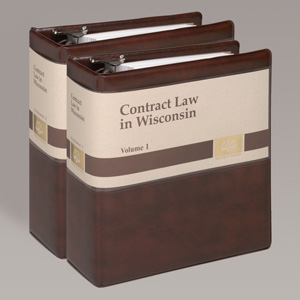
Contract Law in Wisconsin covers key aspects of contracts. Topics include formation of contracts, statutes of frauds, contract interpretation, warranties, disclaimers, and limitations of remedies; modifications; third-party beneficiaries; joint and several contracts; conditions; performance, breach, and excused nonperformance; remedies; electronic transactions; and drafting principles.
The book is divided into six sections, each thoroughly covering a distinct area of contracts fundamentals and practice, allowing you to instantly locate solutions. To make it even easier to find information, each section also comes with its own detailed table of contents, highlighting that section’s chapters.
Contract Law in Wisconsin is packed with tips, examples, and practice advice. Find numerous practice tips and points to consider when drafting or reviewing a contract. Plus, the book is filled with examples based on hypothetical facts to help you understand a variety of contract-law scenarios. Draft airtight contracts confidently and more efficiently with the help of Contract Law in Wisconsin.
wisbar.org/AK0040
Claims by Indemnified Parties
The other first-party possibility under a contractual indemnification provision is a claim by an indemnified party against an indemnifying party. Indemnifying against claims by the indemnified party may seem superfluous at first glance because the indemnified party can, without relying on the indemnification clause, claim against the indemnifying party for breach of contract and breach of any contractual warranty. That kind of first-party indemnification, however, can augment in several respects the remedies otherwise available to the indemnified party. Most indemnification provisions provide for recovery of the indemnified party’s attorney fees and costs incurred in connection with the claim, which are usually not recoverable in a claim for breach of contract or warranty unless the contract otherwise contains a fee-shifting provision. That is the context in which the issue of whether an indemnification provision applies to first-party claims typically arises.[29]
But there is a subtler and arguably more potent way in which an indemnified party can benefit if the indemnification provision extends to first-party claims. The description of claims covered by the provision frequently includes claims by the indemnified party that the economic loss doctrine would otherwise bar – that is, tort claims for economic loss between parties to a contract. The economic loss doctrine is “a judicially-created remedies principle that operates generally to preclude contracting parties from pursuing tort recovery for purely economic or commercial losses associated with the contract relationship.”[30] If an indemnification clause covers such a claim, however, the economic loss doctrine should not preclude the indemnified party’s recovery because the indemnification provision in effect transforms a tort claim into a contract claim.[31]
A trio of cases applying Wisconsin law have construed contractual indemnification provisions, which did not state expressly either that they applied only to third-party claims or also to first-party claims, to determine whether they applied to claims by an indemnified party against an indemnifying party. None of those cases is precedential, however, and their results have been divergent.
In Business Park Development Co. v. Molecular Biology Resources Inc.,[32] the Wisconsin Court of Appeals held in an unpublished, one-judge opinion that a landlord could not rely on an indemnification provision in a commercial lease to recover its reasonable attorney fees from the tenant in an eviction action. Given the fee-shifting context in which the indemnification issue arose, the court invoked as the rule of decision that it would “not construe an obligation to pay attorneys’ fees contrary to the American Rule” – the general rule against fee-shifting – “unless the contract provision clearly and unambiguously so provides.”[33] Thus, if there were no clear and unambiguous fee-shifting applicable to a first-party claim – that is, if the indemnification provision did not clearly and unambiguously apply to first-party claims – the court would default to the narrower construction of that provision to encompass only third-party claims, rather than resolving the ambiguity so as to adopt either the narrower or the broader construction. If the issue arises in a context other than fee-shifting,[34] arguably there should be no such default effect. As noted, however, indemnification provisions typically include recovery of an indemnified party’s attorney fees and issues regarding their construction frequently arise in that context.
The Business Park court held that the fee-shifting indemnification provision in that case was ambiguous and therefore fell back upon the narrower, third-party-claim-only construction of that provision. It acknowledged that a broad reading of the term “indemnify” as equivalent to “compensate,” which would encompass first-party claims, was one reasonable construction of that term, but concluded it was not the only one.[35] To counterbalance the broad construction of “indemnify” and thereby to find ambiguity, the court relied in significant part on the definition of “indemnify” in Black’s Law Dictionary: “To reimburse (another) for a loss suffered because of a third party’s act or default ….”[36] (While it is possible to indemnify against a third party’s “default” that damages an indemnified party, under the traditional indemnification scenario based on liability insurance the triggering event is a third party’s “act” – namely, the third party making a claim against the indemnified party.)
A federal court in New York applying Wisconsin law employed the same rule of decision as in Business Park and also relied on the Black’s Law Dictionary definition of “indemnify” but reached the opposite conclusion. In Bobrow Palumbo Sales Inc. v. Broan-Nutone LLC,[37] a manufacturer’s representative sued the manufacturer for compensation due under an alleged oral modification of their contract. The manufacturer counterclaimed under a contractual indemnification provision for its expenses in defending the suit, including its attorney fees.[38] The representative’s claim failed, and the counterclaim succeeded.[39] The court cited Business Park but did not analyze it beyond noting that it “has no precedential value under Wisconsin law.”[40]
The court then cited the Black’s Law Dictionary definition of “indemnify,” but it cited to a later edition than did Business Park. Lo and behold, the definition had changed materially: “[t]o reimburse (another) for a loss suffered because of a third party or one’s own act or default ….”[41] Based on that updated definition, along with a broad definition of the term in Merriam-Webster Dictionary (“to make compensation to for incurred hurt, loss or damage”),[42] the court concluded “that the plain and ordinary meaning of ‘indemnify’ is to make payment to another for damage incurred, whether by the fault [or act] of the paying party or a third party.”[43] The change in the definition from one edition of Black’s Law Dictionary to the next presumably signifies increased awareness and acceptance of the proposition that an indemnification provision can apply to first-party claims.
In AVL Powertrain Engineering Inc. v. Fairbanks Morse Engine,[44] the parties cited Business Park, Bobrow Palumbo, and the Black’s Law Dictionary definitions of “indemnify.” The party advocating that an indemnification provision covered only third-party claims relied on Business Park, and the party advocating that the provision also covered first-party claims countered with the more recent Bobrow Palumbo case and criticized Business Park because “it applied an outdated definition of indemnity.”[45] As one might expect, the counter-volley won the point. But it did not win the match.
In AVL Powertrain, a company that conducted environmental-emissions testing sued a testing facility for breach of contract in the U.S. District Court for the Western District of Wisconsin.[46] The testing facility moved for partial summary judgment on the ground that the parties’ contract contained a provision that, with irrelevant exceptions, “[u]nder no circumstances” would it “be liable for claims of special, indirect or consequential damages.”[47] It so happened that this damages-limitation provision was part of an indemnification provision and was effective for purposes only of that indemnification provision.[48] Thus, in a strange twist, the testing facility, which was the indemnifying party, argued that the indemnification provision applied to first-party claims, while the emissions testing company, the indemnified party, argued for the narrower construction limited to third-party claims.[49]
Judge Conley declined to follow Bobrow Palumbo, in part because the indemnification provision in that case, unlike the one before the AVL Powertrain court, did not expressly require the indemnifying party to “defend” the indemnified party against covered claims.[50] An indemnifying party cannot defend an indemnified party against the latter’s own claim.[51] Likewise, the concomitant provision requiring the indemnified party to notify the indemnifying party of any claim subject to the indemnification provision would be superfluous in the context of a claim by the indemnified party against the indemnifying party.[52] If an indemnification provision expressly limits the duties to defend and notify to third-party claims, that is a strong signal that the provision as a whole also applies to first-party claims, but the indemnification provision in AVL Powertrain did not make that distinction.[53]
Due in part to the parties’ respective undifferentiated duties to defend and to provide notice of a claim subject to indemnification, Judge Conley held the indemnification provision to be ambiguous with respect to whether it covered first-party claims, although his analysis appeared to lean toward coverage of third-party claims only.[54] Because the party advocating for such coverage was not attempting to recover attorney fees, however, the American Rule placed no “thumb on the scale” causing default to the narrower, third-party-claims-only interpretation. Rather, the court denied partial summary judgment on the issue of whether the emission testing company could recover consequential damages and reserved it for the jury.[55]
It is commonplace, if not quite universal, for contractual indemnification provisions to include the indemnifying party’s duty to defend the indemnified party from covered claims and the indemnified party’s duty to notify the indemnifying party of such claims so as to invoke the duty to defend.[56] Thus, those duties and the manner in which an indemnification provision frames them loom large for the issue of whether indemnification extends to first-party claims brought by indemnified parties when the provision fails expressly to say so.
Wisconsin jurisprudence would benefit from more and precedential case law on that issue, as well. It is too late in the day to deny that indemnification provisions can extend to first-party claims. Therefore, a rule that, when such a provision does not expressly so provide, a court must automatically construe it to cover only third-party claims seems antiquated and arbitrary, although it is the law in some jurisdictions.[57] And a rule requiring that result when the issue presents in the context of fee-shifting, as in Business Park and as is frequently the case, allows the tail (fee-shifting) to wag the dog (indemnification). Instead, courts should employ traditional contract-construction methodology to resolve ambiguities, or interpretive disputes in the absence of ambiguity, concerning the scope of indemnification provisions.[58] Because most indemnification provisions include duties to defend and notify, construction of such a provision to apply only to third-party claims or also to first-party claims ordinarily should depend on whether it expressly restricts those duties to third-party claims. If not, as in AVL Powertrain, the provision should apply only to third-party claims.
Conclusion
Given the prevalence of indemnification provisions in commercial contracts of all stripes, the lack of authoritative Wisconsin case law on application of such provisions to first-party claims is surprising. Lawyers who draft or review commercial contracts should be aware of this doctrinal gap and ensure that every indemnification provision clearly and expressly indicates whether it applies to first-party claims.
Endnotes
1 Estate of Kriefall v. Sizzler USA Franchise Inc., 2012 WI 70, ¶ 34, 342 Wis. 2d 29, 816 N.W.2d 853 (internal citation omitted).
2 Fabco Equip. Inc. v. Kreilkamp Trucking Inc., 2013 WI App 141,
¶ 6, 352 Wis. 2d 106, 841 N.W.2d 542 (internal citations omitted).
3 Adapted from Bloomberg Law, Indemnification Clauses in Contracts, Aug 9, 2023, https://pro.bloomberglaw.com/insights/-contracts/indemnification-clauses-in-contracts.
4 Rahul Kapoor & Katrina Slack, ‘Indemnify, Defend, and Hold Harmless’: What Does It Really Mean? Morgan Lewis (Jan. 12, 2024), https://www.morganlewis.com/blogs/sourcingatmorganlewis/2024/01/indemnify-defend-and-hold-harmless-what-does-it-really-mean.
5 The general liability insurance market was estimated to be $338.82 billion in gross written premium in 2025. Statista, General Liability Insurance – Worldwide, https://www.statista.com/outlook/fmo/insurances/non-life-insurances/general-liability-insurance/worldwide (last visited Dec. 4, 2025).
6 Carr Bus. Enters. Inc. v. City of Chowchilla, 166 Cal. App. 4th 14, 20, 82 Cal. Rptr. 3d 128 (2008) (internal citation omitted).
7 Travelers Indem. Co. v. Dammann & Co. Inc., 592 F. Supp. 2d 752, 766-67 (D.N.J. 2008), aff’d 594 F.3d 238 (3rd Cir. 2010).
8 See Travelers Indem., 594 F.3d at 255 (affirming district court decision on a narrower ground: “we cannot hold that first-party indemnification claims … are categorically barred as a matter of law in New Jersey absent direct authority to that effect”).
9 Barrons v. J. H. Findorff & Sons Inc., 89 Wis. 2d 444, 452, 278 N.W.2d 827 (1979) (internal citations omitted).
10 Id.; Mikula v. Miller Brewing Co., 2005 WI App 92, ¶ 34, 281 Wis. 2d 712, 701 N.W.2d 613.
11 Barrons, 89 Wis. 2d at 452-53; Mikula, 2005 WI App 92, ¶ 35, 281 Wis. 2d 712. Wisconsin courts have applied the “only reasonable construction” rule to contracts that require the indemnifying party to purchase liability insurance in addition to indemnifying the indemnified party. See Mikula, 2005 WI App 92, ¶ 36, 281 Wis. 2d 712; Hast-reiter v. Karau Bldgs. Inc., 57 Wis. 2d 746, 749, 205 N.W.2d 162 (1973); Herchelroth v. Mahar, 36 Wis. 2d 140, 147, 153 N.W.2d 6 (1967). But see Dueco v. Terex-Telelect Inc., No. 73A01-0809-CV-436, 2009 WL 153201, *5 (Ind. Ct. of App. Jan. 23, 2009) (unpublished) (applying Wisconsin law and holding “only reasonable construction” rule not applicable when indemnity and insurance obligations are in different contractual provisions and indemnity provision makes no reference to insurance provision); Sutton v. A.O. Smith Co., 165 F.3d 561, 564 (7th Cir. 1999) (reading Hastreiter and Herchelroth narrowly).
12 Buchholz v. Schmidt, 2024 WI App 47, ¶ 24, 413 Wis. 2d 308, 11 N.W.3d 212.
13 See Alexander T. Pendleton, Enforceable Exculpatory Agreements: Do They Still Exist? 78 Wis. Law. 16 (Aug. 2005), and cases cited therein. See also Alexander T. Pendleton, Enforceable Exculpatory Agreements, 70 Wis. Law. 10 (Nov. 1997).
14 Wolf v. Ford, 335 Md. 525, 531-32, 644 A.2d 522 (1994) (internal citations omitted).
15 See id. at 532.
16 See Matthiesen, Wickert & Lehrer, S.C., Anti-Indemnity Statutes in All 50 States, www.mwl-law.com/wp-content/uploads/2013/03/Anti-Indemnity-Statutes-In-All-50-States-00131938.pdf (last updated Dec. 22, 2021) (“Forty-five (45) states have enacted anti-indemnity statutes that limit or prohibit enforcing indemnification agreements in construction settings.”); see also, e.g., Arthur v. State Dept. of Hawaiian Home Lands, 138 Hawai’i 85, 93, 377 P.3d 26 (2016) (discussing Hawaii statute that voids indemnification agreement that construction contractor assume liability for negligence of others); Travelers Indem. Co. of Conn. v. Lessard Design Inc., 321 F. Supp. 3d 631, 635-39 (E.D. Va. 2018) (discussing similar Virginia statute).
17 Travelers Indem. Co. of Conn., 321 F. Supp. 3d at 635.
18 Wis. Stat. § 895.447(1).
19 Gerdmann v. United States Fire Ins. Co., 119 Wis. 2d 367, 373-74, 350 N.W.2d 730 (1984).
20 Dykstra v. Arthur G. McKee & Co., 100 Wis. 2d 120, 130 n.4, 301 N.W.2d 201 (1981).
21 Id.
22 The state survey cited in note 16, supra, counts Wisconsin as an anti-indemnity state by virtue of Wis. Stat. section 895.447(1), but as discussed in this article, that is not the case.
23 Metz v. Medford Fur Food Inc., 4 Wis. 2d 96, 100, 90 N.W.2d 106 (1958).
24 Id. at 98.
25 Id. at 100.
26 Id.
27 See id. at 99.
28 See Wis. Stat. § 94.17(8)(a), (14)(a).
29 See, e.g., Gerdmann, 119 Wis. 2d at 375 (holding defendant to be entitled to costs and attorney fees under indemnification provision construed to apply to first-party claim); Bobrow Palumbo Sales Inc .v. Broan-Nutone LLC, 549 F. Supp. 2d 249, 272-74 (E.D.N.Y. 2008) (to same effect, applying Wisconsin law), discussed infra at text accompanying notes 37-43.
30 Tietsworth v. Harley-Davidson Inc., 2004 WI 32, ¶ 23, 270 Wis. 2d 146, 677 N.W.2d 233.
31 See, e.g., Board of Managers of Hester Gardens v. Well-Come Holdings LLC, 10 N.Y.S.3d 72, 74 (2015) (economic loss rule does not bar contractual indemnification) (internal citations omitted).
32 Business Park Dev. Co. v. Molecular Biology Resources Inc., No. 03-3100, 2004 WL 1631619 (Wis. Ct. App. July 22, 2004) (unpublished).
33 Id. ¶ 15 (quoting Hunzinger Constr. Co. v. Granite Res. Corp., 196 Wis. 2d 327, 340, 538 N.W.2d 804 (Ct. App. 1995)); accord, NevadaCare Inc. v. Department of Hum. Servs., 783 N.W.2d 459, 471 (Iowa 2010) (analyzing split of authority, but finding that “a party to a contract cannot use an indemnity clause to shift attorney fees between the parties unless the language of the clause shows an intent to clearly and unambiguously shift the fees”).
34 For an example of that scenario, see AVL Powertrain Engineering Inc. v. Fairbanks Morse Engine, 178 F. Supp. 3d 765 (W.D. Wis. 2016), discussed infra at text accompanying notes 44-55.
35 See Business Park, 2004 WL 1631619, ¶ 18.
36 Id. ¶ 20 (quoting Black’s Law Dictionary 772 (7th ed. 1999)).
37 549 F. Supp. 2d 249, 252 (E.D.N.Y. 2008).
38 Id.
39 See id. at 274.
40 Id. at 272; see also Wis. Stat. § 809.23.
41 Bobrow Palumbo, 549 F. Supp. 2d at 272 (quoting Black’s Law Dictionary (8th ed. 2004)). See also Edward E. Gillen Co. v. United States, 825 F.2d 1155, 1157 (7th Cir. 1987) (construing indemnification provision to cover first-party claim under admiralty law, based in part on following definition of “indemnity” in yet another edition of Black’s Law Dictionary: “A collateral contract or assurance, by which one person engages to secure another against an anticipated loss or to prevent him from being [damnified] by the legal consequences of an act or forbearance on the part of one of the parties or of some third person. Term pertains to liability for loss shifted from one person held legally responsible to another person” (quoting Black’s Law Dictionary 692 (5th ed. 1979)); contra, Sundance Cruises Corp. v. American Bureau of Shipping, 799 F. Supp. 363, 377-78 (S.D.N.Y. 1992) (“the rule in this Circuit is that ‘indemnity agreements are generally designed only to protect against liability for damage to third parties’” (internal citation omitted)), aff’d 7 F.3d 1077 (2nd Cir. 1993).
42 Bobrow Palumbo, 549 F. Supp. 2d at 272 (quoting Merriam-Webster Dictionary).
43 Bobrow Palumbo, 549 F. Supp. 2d at 272.
44 178 F. Supp. 3d at 780-81.
45 Id. at 781.
46 See id. at 768-69.
47 Id. at 780 (emphasis supplied by court removed).
48 See id.
49 See id. at 781.
50 See id.
51 See id. (citing Travelers Indem. Co., 594 F.3d at 255).
52 See id. at 782 (citing Hooper Assocs. Ltd. v. AGS Computs. Inc., 74 N.Y. 2d 487, 492-93, 548 N.E.2d 903 (1989)). The notice provision in AVL Powertrain was bilateral (see 178 F. Supp. 3d at 781), but that fact does not affect the court’s point.
53 See id. at 782 (citing Promuto v. Waste Mgmt. Inc., 44 F. Supp. 2d 628, 651 (S.D.N.Y. 1999)).
54 See AVL Powertrain, 178 F. Supp. 3d at 783; see also id. at 780-83. But see Balcor Real Est. Holdings Inc. v. Walentas-Phoenix Corp., 73 F.3d 150, 153 (7th Cir. 1996) (fact that provision recited party’s obligation to “defend” did not imply that action by third party was required).
55 See AVL Powertrain, 178 F. Supp. 3d at 783.
56 See Cal. Civ. Code § 2778, subd. 4 (implying duty to defend in indemnification agreement unless agreement requires otherwise).
57 See UIRC-GSA Holdings Inc. v. William Blair & Co., 264 F. Supp. 3d 897, 904 & n.3 (N.D. Ill. 2017) (discussing split of authority).
58 Gerdmann, 119 Wis. 2d at 375, implies that Wisconsin courts should employ that approach but does not discuss the issue in depth.
» Cite this article: 99 Wis. Law. 32-38 (January 2026).
