
As Wisconsin’s population ages, lawyers are increasingly called upon to advise clients and their families about efficient and effective methods of post-death administration. According to state demographic data, the proportion of Wisconsinites over age 65 is growing at one of the fastest rates of Midwestern states. This demographic trend underscores the importance of understanding the full range of post-death transfer mechanisms beyond traditional probate proceedings. Transferring assets out of a decedent’s name, paying final expenses, dealing with creditors, and transferring what remains to intended beneficiaries can be straightforward or complicated and expensive.
Proper planning and familiarity with various administration options allow attorneys to minimize costs, delays, and conflicts for clients and their heirs. This article reviews key techniques available in Wisconsin, including the use of funded revocable trusts, beneficiary designations, joint tenancy, transfer-on-death instruments, Washington will transfers, and summary and simplified court procedures, as well as informal and formal probate.
Wisconsin’s marital property system can complicate ownership and beneficiary rights. Lawyers should be familiar with the Wisconsin Marital Property Act’s default rules and whether there is a pre- or post-marital agreement that modifies the rules. Lawyers should confirm whether spousal consent or partition agreements are necessary to ensure the intended disposition.
This is the first in a series of articles focusing on post-death administration. Future articles will be on the following topics: 1) a step-by-step guide to Wisconsin probate; 2) problematic administrations (part I) – undue influence and incapacity; 3) problematic administrations (part II) – scriveners’ errors, problem beneficiaries, penalty clauses, and so on; 4) estate and income tax issues; and 5) ethical issues confronting lawyers in post-death administration.
Funded Revocable Trusts
A revocable trust is the most versatile tool for avoiding probate in Wisconsin. To fund a revocable trust, the grantor, before the grantor’s death, retitles the grantor’s assets, such as real estate, bank and investment accounts, and business interests, into the name of the revocable trust. When properly funded, the trust serves as a substitute for the court-supervised probate process.
Wisconsin law, specifically Wis. Stat. chapter 701 (sometimes referred to as the Wisconsin Trust Code), governs trust administration, imposing duties of notice, accounting, and potential obligations to provide copies of the trust instrument to qualified beneficiaries. Attorneys should be familiar with the Wisconsin Trust Code’s default rules and whether the trust document modifies them.
Upon the death of the grantor, the successor trustee assumes control of trust assets. The trustee must:
Obtain a copy of the death certificate,
Notify beneficiaries and interested parties,
Inventory and value trust assets,
Pay outstanding debts and taxes, and
Distribute assets according to the trust terms.
The process is private, avoiding the public nature of probate proceedings, and generally results in faster asset distribution.
 Jennifer R. D’Amato, U.W. 1989, is a shareholder at Reinhart Boerner Van Deuren s.c., Milwaukee. D’Amato is the chair of the firm’s Trusts and Estates Practice and co-chair of the Fiduciary Litigation Service Group. She is an author of Wisconsin Probate System: Forms and Procedures Handbook and a member of the State Bar of Wisconsin’s Real Property, Probate & Trust Law Section.
Revocable trusts can be particularly helpful for clients with real property in multiple states because, without any planning, the client could have probate proceedings in each individual state.
During the grantor’s lifetime, revocable trusts do not necessitate a separate income tax return, nor do they offer creditor protection.
Advantages. Use of a revocable trust has several advantages. 1) It avoids probate: Assets titled in the name of the trust do not require probate proceedings, which saves filing fees, attorney fees, and time. 2) Continuity in administration allows the successor trustee to take immediate action upon the grantor’s death. 3) Revocable trusts are relatively private; unlike probate, trust administration is not a matter of public record. 4) The trustee can manage assets continuously if the grantor becomes incapacitated.
Practice Tip. Coordinating all assets with the revocable trust is crucial – a trust that remains unfunded is ineffective for probate avoidance. Clients need assistance with updating deeds, changing account titles, and coordinating beneficiary designations for life insurance and retirement assets.
Joint Tenancy and Survivorship Marital Property
Assets titled “jointly with right of survivorship” or held as “survivorship marital property” pass automatically to the surviving owner at death. For example, a home or a bank account titled jointly by spouses will automatically transfer without probate to the surviving spouse on the first death.
Under Wis. Stat. sections 700.17(2) and 766.60(5) and related provisions, the surviving joint tenant becomes the sole owner by operation of law. Documentation of death (often through an affidavit of survivorship and death certificate) generally is sufficient to retitle the asset. There is no probate involvement unless disputes arise or the asset was improperly titled.
Advantages. These arrangements offer simplicity and speed, but lawyers must ensure proper titling and documentation.
Practice Tip. Though straightforward, joint titling (including survivorship marital property) can complicate overall estate planning. Joint ownership may expose assets to the co-owner’s creditors or unintentionally disinherit other heirs. Attorneys should counsel clients about these risks before relying solely on joint tenancy as a probate-avoidance tool.
Beneficiary, Transfer on Death, and Payable on Death Designations
Beneficiary designations, transfer on death (TOD) designations, and payable on death (POD) designations are non-probate methods for transferring assets directly to named beneficiaries upon death. Common assets include life insurance policies, retirement accounts, bank accounts, brokerage accounts, real estate, and private securities.
Wisconsin law honors valid designations, which supersede will or revocable trust provisions for the designated asset. The asset transfers directly to the beneficiary upon the decedent’s death, bypassing probate.
Insurance companies and retirement plans provide beneficiary designations. Banks and other custodians sometimes provide customers with TOD or POD forms to designate after-tax accounts directly to specified beneficiaries.
Pursuant to Wis. Stat. section 705.15, an owner can record a TOD deed that names a beneficiary who will succeed to title of the real property only upon the owner’s death. The transfer is revocable during life and requires only recording a new deed or revocation to change the designation.
Pursuant to Wis. Stat. section 705.10, clients can direct that closely held business interests (corporations and partnerships) pass directly to designated beneficiaries.
Upon death, the beneficiary must:
Provide a death certificate to the financial institution or insurance company or register of deeds;
Complete claim forms as required; and
Receive the asset directly, with no court involvement.
Advantages. Beneficiary, TOD, and POD designations provide immediate, private, and efficient asset transfer. However, they can lead to complications if designations are outdated or conflict with the estate plan. Lawyers must counsel clients on coordinating designations with overall estate planning strategies.
Practice Tip. Because outdated designations override inconsistent will provisions, lawyers should regularly review forms and encourage clients to name alternates to avoid reversion to probate. Beneficiary designations should align with the client’s overall estate plan to prevent unequal or unintended distribution. And lawyers should keep in mind income tax consequences, particularly with IRAs and qualified plans.
“Washington Will” Transfers
Wisconsin residents can incorporate probate-avoidance directives under Wis. Stat. section 766.58(3)(f). These often are referred to as “Washington will transfers”[1] or as “will-substitute agreements.”
Washington wills can be extremely effective with real estate, custodians of banks and brokerage firms in Wisconsin, and in a variety of other circumstances. They are typically incorporated in premarital or postmarital agreements but can also be drafted as stand-alone, catch-all designations at death, and typically name the clients’ revocable trust as beneficiary.
In 2006, in response to the Wisconsin Supreme Court’s decision in Maciolek v. City of Milwaukee Employees’ Retirement System Annuity & Pension Board,[2] the Wisconsin Legislature enacted Wis. Stat. section 854.23, which facilitates the use of Washington will provisions as a nonprobate transfer device.
This expansion of the protections might make financial institutions and other custodians more willing to make transfers pursuant to Washington will provisions without requiring the use of summary confirmation procedures under Wis. Stat. section 867.046(1m) or (2). Nevertheless, a custodian can still require the use of summary confirmation procedures.
This process also allows the authenticated foreign probate documents to be filed in a Wisconsin court for recording and title transfer, avoiding a full ancillary probate proceeding.
Advantages. This mechanism is particularly helpful when a nonresident owned Wisconsin real estate (for example, a vacation property) and probate has already occurred in the owner’s state of residence.
Practice Tip. Every Wisconsin resident should incorporate a Washington will as part of their estate plan as a probate-avoidance device.
Summary and Simplified Procedures
Wisconsin Statutes sections 867.01-.046 outline summary and simplified probate procedures. They are designed for estates valued under a statutory threshold or when the decedent is survived by a spouse or minor children. These procedures include the following:
Transfer by affidavit: used when the estate is valued at $50,000 or less. An heir can submit an affidavit to financial institutions to collect assets without probate.
Summary assignment: allows for assignment of assets to creditors and heirs when the estate is insolvent or minimal.
Summary settlement: permits settlement when the decedent leaves a surviving spouse or minor children and the estate qualifies under statutory limits.
These procedures require filing appropriate documents with the court and might involve minimal hearings.
Advantages. Summary procedures are efficient and inexpensive, making them ideal for modest estates. Lawyers should carefully assess eligibility and ensure compliance with statutory requirements.
Practice Tip. These methods offer quick resolution but might not be suitable for estates with complex assets or creditor issues.
Wisconsin Probate Administration
Probate is a court-supervised process. It is necessary if there are assets in a decedent’s name or payable to the decedent’s estate and none of the techniques outlined above can effectively avoid the need for a court order known as “domiciliary letters” (when the decedent had a valid will) or “letters of administration” (when the decedent died intestate). This court order authorizes a court-
appointed personal representative to access and control (and ultimately distribute or sell) a decedent’s assets.
Informal Probate
Informal probate is governed by Wis. Stat. chapter 865. The process is initiated by filing an application with the probate registrar, who appoints a personal representative without a hearing unless objections arise.
Steps include:
Submitting the will and application to the probate registrar,
Appointment of a personal representative,
Notification to heirs and creditors,
Inventory and distribution of assets, and
Closing the estate with a final accounting.
The process is faster and less expensive than formal probate, with minimal court involvement unless disputes occur.
Advantages. Informal probate allows for unsupervised administration under the guidance of the probate registrar. It is appropriate when 1) the will (if any) is uncontested, 2) no party demands formal supervision, and 3) the nominated personal representative is qualified and capable of handling duties. The process is efficient and typically requires less court involvement.
Practice Tip. This is generally the preferred probate method but is not available for contested matters.
Formal Probate
Formal probate involves the appointment of a personal representative by the circuit court.[3] The court oversees the administration, ensuring compliance with statutory requirements, creditor claims, and proper distribution.
The lawyer initiates formal probate by filing a petition with the probate court. Steps include the following:
Filing the decedent’s will (if any) and death certificate;
Appearing at a court hearing;
Notifying heirs, beneficiaries, and creditors;
Inventorying and appraising assets;
Paying debts, taxes, and administration expenses;
Distributing assets per the will or intestacy laws; and
Submitting reports and obtaining court approval for final distributions.
Formal probate involves judicial supervision. It is necessary when 1) there is a will contest or uncertain heirship, 2) fiduciary disputes exist, or 3) complex or insolvent estates require court oversight.
Advantages. Formal probate provides maximum court oversight, which is useful in contested cases or when significant creditor claims are present. It offers protection for the personal representative and ensures transparency. However, it can be time consuming, costly, and public. Lawyers should assess whether formal probate is necessary or if less formal alternatives are available.
Formal proceedings ensure judicial approval of actions and distribution before closing the estate.
Practice Tip. It is possible to begin informal probate proceedings and transition to formal probate if it becomes appropriate.
Conclusion
Advising estate planning clients requires integrating all these techniques to ensure harmony among marital property classification, the overall estate plan and titling, beneficiary designations, and will or trust provisions. Conflicting designations often lead to disputes or unintended outcomes. Key best practices include:
Comprehensive asset inventory and coordination;
Review of marital property implications;
Regular review of titling and beneficiary designation, TODs, PODs and joint authority tenancy arrangements;
Documentation of intent, especially for marital property; and
Post-death counseling: guiding fiduciaries through their statutory duties and timing obligations
As the number of older adults in Wisconsin grows, understanding the range and interplay of postdeath transfer techniques is fundamental for estate planning lawyers. Whether through funded revocable trusts, beneficiary, TOD, and POD designations, joint ownership, Washington will provisions, or summary probate alternatives, well-informed counsel can ensure clients’ estates are administered efficiently, privately, and in accordance with their wishes.
Also of Interest
Find All Key Forms & Procedures for Probate Matters in Wisconsin
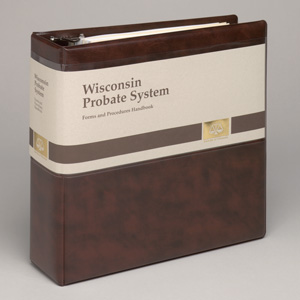
Whether you’re new to probate practice or an experienced attorney hoping to refine your skills, you’ll find the answers you seek in Wisconsin Probate System: Forms and Procedures Handbook. The Handbook is a comprehensive summary of Wisconsin probate law along with the sample forms, letters, checklists, and other tools you need to successfully probate an estate – and everything is kept up to date through regular supplementation.
You’ll deftly navigate this complex area of law by taking advantage of the Handbook’s straightforward approach and fact-based hypothetical scenario. The Handbook lists all the steps to take and reproduces all the required forms – easily downloaded and printed from your myStateBar profile.
To help ensure that you won’t miss important tax considerations, all the material dealing with estate and income taxes is gathered into one chapter.
Wisconsin Probate System is an indispensable resource for all Wisconsin attorneys who handle estate planning and probate matters.
wisbar.org/AK0076
Mark your calendars for probate seminar.
Plan to attend Build Your Practice: Handling a Basic Probate 2026 on Tuesday, June 2, with replays through November. And two excerpted sessions from that full program – specifically about claims against an estate – will replay beginning in August. Registration details will be posted to marketplace.wisbar.org.
Endnotes
1 The term “Washington will” comes from a comparable statutory provision in the state of Washington.
2 2006 WI 10, 288 Wis. 2d 62, 709 N.W.2d 360.
3 The statutes that control formal probate are in Wis. Stat. chapters 856-879.
» Cite this article: 99 Wis. Law. 24-28 (April 2026).
