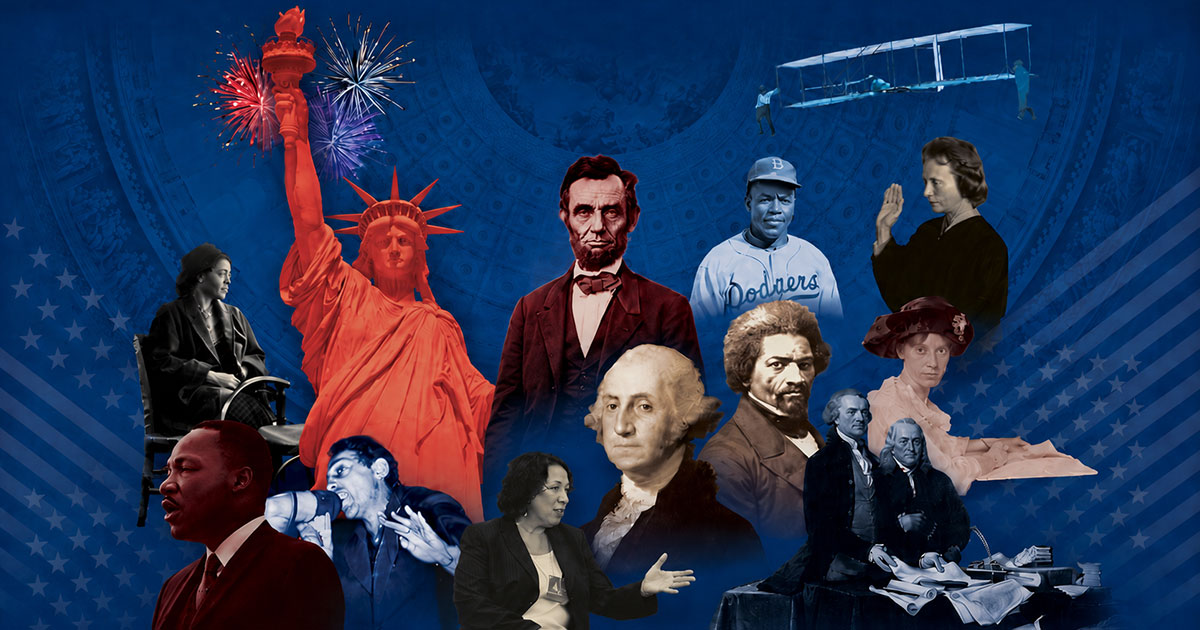
Cover and image designs by Jane Malm Design.
On July 4, 1776, delegates from the 13 colonies adopted the Declaration of Independence, a critical moment in the American Revolution and separation from the British Empire. Americans have celebrated the Fourth of July ever since with fireworks, parades, anthems, and baseball.
As the nation approaches the 250th anniversary of the Declaration of Independence, we are reminded that this remarkable document is not simply a relic of history – it is a living statement of ideals. Its promise of liberty, equality, and self-governance continues to challenge and inspire Americans as we work to more fully realize those principles today.
Lawyers were central to the drafting and adoption of the Declaration 250 years ago, translating philosophical vision into a framework that would guide a new nation. That legacy endures.
Today, attorneys remain stewards of the rule of law and guardians of the democratic values set forth in the Declaration. Our profession is uniquely positioned at the intersection of principle and practice, where abstract ideals meet the realities of justice.
To mark this milestone in my presidential year, I invited members of the bar to reflect on what the Declaration of Independence means to them – as lawyers and as citizens. I am pleased to report that our membership has responded to this invitation with essays that we are proud to publish in this edition of our Wisconsin Lawyer.
Each contributor offers a distinct perspective shaped by their experiences, their practice, and their understanding of the law’s role in advancing the common good.
Together, these essays form a rich and varied conversation – one that underscores the enduring relevance of the Declaration and the continuing responsibility of the legal profession to help bring its ideals closer to reality.
I issued this invitation with the understanding that we are living in highly divided times. My goal in this project is to give all members of our profession an opportunity to address these times and their opinions with a goal of promoting civility and respectful discourse. Even if we cannot agree, we can still treat each other’s opinions with respect, and hopefully understanding.
Unfortunately, we couldn’t publish all of them in print – there are more at wisbar.org/USA250. And it’s not too late to join the conversation.
Revisit my emailed invitation to the membership and submit your essay to USA250@wisbar.org. We’ll post them all year. Thank you to those who submitted one and to those who will help us keep the conversation going.
– Dan Gartzke, President, State Bar of Wisconsin
Michelle A. Behnke
“We hold these truths to be self-evident, … that all men are created equal.”
Thinking about the founding of our country and where we are today, I don’t read words like “all men are created equal” with disdain. Rather, I see this as an example of how we can change and grow over time to be more inclusive. I am glad to see the progression we’ve made in 250 years. We recognize that all people can contribute to bringing about those unalienable rights that we sought so long ago.
I am very proud to be part of a profession that had a significant hand in bringing our country into being (even though doing so would have been considered treason for them). I often wonder if we would have the same courage today to sign on to the Declaration of Independence, knowing the stakes. I’d like to think we would, but I’d also like to think we’d be better and use language that recognizes the value of all people in our country.
Hon. Maria S. Lazar
“The pursuit of Happiness…” One of the most iconic phrases, and the true definition of what it means to be an American, was almost never written. The pursuit of property was considered in lieu of the pursuit of Happiness as one of our three self-evident and unalienable Rights. As a member of the judiciary, interpreting documents is second nature to me.
But there is something so pure and beautiful that our Nation was founded not only to support life and liberty, but to encourage that rugged individualistic adventurism that beats in every American heart.
I believe that without that pursuit, our lives and liberties would be just a little dimmer. Without the human quality of seeking, of moving forward (especially as Wisconsinites), of striving more each and every day to do better, to make ourselves and others happy, we lose that unique quality of being truly American. We all need to take time to just reflect on what we have accomplished so far, be grateful for our efforts to date, and smile deep to our souls as we plan how to continue to pursue Happiness each and every day.
Ronald W. Tusler
The American Dream is our nation. It is a foreigner’s dream. A dream forged in scarcity and oppression. That dream is a prayer that somewhere a shining “City on a Hill” exists. A place where “We the People” are in charge. A place where their families are warmly welcomed. A place where their God-given rights are respected.
The United States is blessed like no other place in human history. The U.S. has welcomed more foreigners than any country ever. The U.S. has protected the world from the greatest evils in history. The United States continues to strive to expel those who treat foreigners poorly.
I thank God that I was born in such a place. There might not be a better blessing anyone has received. Simultaneously, I believe we can continue to be better. There is significant room to grow. We can harness technology, respect diverse cultures, and honor our Christian tradition. I believe that humble American hard work and self-sacrifice can make a better life for our children.
Daniel P. Tokaji
The United States was founded on the ideal of equality. The Declaration’s opening sentence cites the “separate and equal station” of the people of America and Great Britain. The next sets forth the “self-evident” truth that “all men are created equal,” which we now understand to mean all people.
It’s one thing to assert the equality of all human beings, and quite another to make that a reality. The Declaration’s principal author, like many of the Founders, was a slaveholder. It would take a bloody civil war to end slavery. Five years after the war, the Fifteenth Amendment prohibited race discrimination in voting, but that basic right – and with it, all other rights – was systematically denied to African Americans for most of the next century.
Today, a chasm remains. Race and gender disparities persist. The gap between rich and poor has widened. The American dream seems out of reach to many of our fellow citizens.
Should we despair that America has never fully lived up to the Declaration’s promise? I think not. We should instead understand the Declaration as a statement of principles to which each generation must rededicate itself. The fact that equal opportunity has never been our reality does not relieve us of the responsibility to keep pursuing this ideal. On the contrary, it should make us recommit to fulfilling the Declaration’s promise.
Anne Thomas Sulton
The Preamble is a clarion call to purposefully pursue the highest ideals. It provides a launchpad to the Constitution – the roadmap showing the rule-of-law route leads to the highest ideals. This is America’s promise.
While growing up as an African American during the 1950s and 1960s in Racine, I knew then the Preamble words rang hollow in too many neighborhoods, including working-poor neighborhoods like mine. After all, we then were a mere three generations beyond 14 consecutive generations of enslavement – well within the era the Preamble was first announced.
Despite the lingering adverse effects of race-based discrimination, reading the Preamble taught me that if given an equal opportunity to obtain the tools needed to chart a course, then I too could navigate the complexities of a hyper-competitive global marketplace and experience some of America’s promise. During the 1970s and 1980s, I was blessed to obtain the navigation tools needed (including a generous scholarship from S.C. Johnson), chart my course, and realize much of America’s promise.
Since childhood, I have known that the Preamble’s words still ring hollow in too many neighborhoods. America’s promise is still too distant for too many in too many neighborhoods across this great country. Therefore, I spent the past 40 years litigating civil rights cases nationwide, arguing that the Preamble and the Constitution’s words should guide us.
Although the Preamble’s launchpad was constructed 250 years ago, much work remains to ensure all have equal opportunities to realize America’s promise. Let’s get to work!
Lisa M. Lawless
The Declaration of Independence eloquently declared reasons for severing ties with Great Britain, striking a path for a new nation. The “consent of the governed” language declares that our government will be based on the consent of the people, not monarchical rule. This consent is achieved through active participation by voting. Through regular elections, we hold our representatives accountable, and we speak through the ballot box. This consent is confirmed in each election when we elect our representatives. As Federalist No. 49 (1788) stated, “the people are the only legitimate fountain of power.” With each election, we embrace the principle of popular sovereignty.
“[A]ll men are created equal … [and] … endowed by their Creator with certain unalienable rights” rejected the divine right of kings and hereditary aristocracy. As written in 1776, this concept of equality narrowly applied to white, land-owning men. However, these words were later seized upon and advanced “to extend the Revolution’s promise of freedom” (Professor Pauline Meier). In his “I Have a Dream” speech (1963), Dr. Martin Luther King, Jr. proclaimed that the U.S. had not yet fulfilled this promise, and “defaulted” on the “promissory note” of equality for citizens of color. Since then, the adoption of voting rights laws, civil rights laws, and other measures has extended and enhanced the promise of equality. But where do we stand today? This is a question that we should regularly ask ourselves: are we delivering on the promise of equality? If we are not, how can we do better?
Jeffrey A. Mandell
In grade school, we memorized the Declaration of Independence’s most salient lines. We contrasted the Declaration’s soaring rhetorical flourishes with the more practical-minded text of the U.S. Constitution and the ways in which it – and we, as a nation and a people – have fallen short of the foundational ideals on which our independence was asserted. We continually seek a more perfect union but remain far from it. The Declaration reminds us of how elusive it has been to live – and live up to – our professed common values.
Rereading the Declaration today, I see the building blocks for Article I, Section 1 of the Wisconsin Constitution. Courts have interpreted that provision to guarantee due process and equal protection, though the text mentions neither. These key principles, essential to the rule of law, are mere facets of the broader, deeper, richer ideas that our framers mined directly from the Declaration to construct our state constitution’s opening provision: freedom, independence, equality, just power derived from the consent of the governed, and the inherent rights of life, liberty, and the pursuit of happiness.
Article I, Section 1 begins our Declaration of Rights; it’s a guarantee to every Wisconsinite. Our state constitution’s framers, unlike their federal counterparts, aimed to actualize the Declaration’s core values, transforming abstract ideas into enforceable rights and emphasizing the centrality of those particular rights by placing them first among all provisions. It falls to each of us, as Wisconsin lawyers, to implement the framers’ vision and bring these promises to life.
Jill M. Kastner
As a child growing up in the 1980s, I had zero doubt that the United States was the greatest nation in the world. The Cold War was ending, with our democratic ideals standing tall as the clear winner. Now, on the 250th anniversary of the Declaration of Independence, we stand at a crossroads between the ideals of that Declaration and a troubling erosion of public trust in our government, its elected leaders, and our courts.
This lack of confidence in the very institutions designed to provide stability and justice constitutes one of the most significant challenges to our democracy since its founding. Facing these challenges requires more than a celebration of the past; it demands a renewed commitment to civic duty and the willingness to defend our highest ideals.
Two and a half centuries ago, our founders – many of them lawyers – risked their lives to support the radical notion that all people are created equal and endowed with unalienable rights. Today, I still believe in those founding principles. I also believe that, as lawyers, it is our civic duty to defend those principles just as our founders did.
As the architects and defenders of the rule of law, lawyers are essential to safeguarding personal liberties and the stability of our legal system. To remain the world’s leading democracy, we must ensure the next 250 years see a restoration of faith in the law and in those who have sworn to uphold it.
Dean R. Dietrich
As the foundation of our freedoms and our governing principles, the Declaration of Independence reminds us that “all men are created equal,” and everyone is endowed with inalienable rights, including “life, liberty, and the pursuit of happiness.” These words have given direction to our government and our elected officials for 250 years and should continue to be the guiding light for our work as lawyers.
The Preamble to the Rules of Professional Conduct helps us understand our responsibilities as lawyers to protect these rights. The Preamble reminds us of our special role as lawyers within our justice system when stating:
“As a public citizen, a lawyer should seek improvement of the law, access to the legal system, the administration of justice and the quality of service rendered by the legal profession. … In addition, a lawyer should further the public’s understanding of and confidence in the rule of law and the justice system because legal institutions in a constitutional democracy depend on popular participation and support to maintain their authority. … Therefore, all lawyers should devote professional time and resources and use civic influence to ensure equal access to our system of justice for all those who because of economic or social barriers cannot afford or secure adequate legal counsel.”
The professional obligations noted in the Preamble should be a reminder of our special responsibilities to support the legal profession and the guarantees that are envisioned in the Declaration.
Mark W. Rattan
Due to the failures of our education system, law schools included, there is a myth that the Declaration of Independence is a legal document that bestows legal rights courts can enforce. Not only do large swaths of our population believe this myth, but sadly, lawyers and judges as well, who derive legal rights from the Declaration, nowhere stated in the text, and not consistent with its purpose. The document that conveys legal rights is the Constitution.
The Declaration of Independence is not a legal document. It is a political document tantamount to a declaration of war on the British Crown (although war had already started). The text contains suggestions of war throughout: “the intention to be totally to suppress the exercise of every kind of authority under the British crown,” “it is [our] duty, to throw off [the British] Government,” the King was “waging war against us,” the colonies “would have the full power to wage war,” the colonists “mutually pledge[d] to each other [their] lives.” Many of the brave signers met a grim fate: capture, torture, death, imprisonment, and loss of property.
As a declaration of war, the document teaches us that our nation, and all nations, whether democratic or despotic, were founded and are sustained at the point of a gun. For the Declaration of Independence to survive, and for the signers’ sufferings not to have been in vain, our guns must be bigger than our enemies’.
Michael R. Haas
It takes everyone to build and sustain democracy by actively participating in the functions and institutions that are its foundation. For almost 20 years, I have been heavily involved in the practice of law related to the administration of Wisconsin elections, including a brief stint as the State’s chief election official. In celebrating our 250th year of independence, I would like to recognize the efforts of attorneys and election officials at the state, county, and local levels who ensure that each eligible individual is able to vote and that their vote is counted.
Wisconsin has 1,850 municipal clerks, 72 county clerks, and tens of thousands of poll workers, our neighbors, who conduct elections. Each of them relies on attorneys to interpret and apply our increasingly complicated election statutes and rules. The right to vote and the promise of self-governance are the basis for all other rights. That right and that promise require constant nurturing, hard work, and legal expertise. Continued attention to those ideals reflects the values and the inspiration of the Declaration of Independence.
Election officials are prime examples of the women and men who comprise our government and use their skills, creativity, and leadership to serve the public. Government officials, including governmental attorneys, not only help all aspects of our society to function, but do so in a way that honors the consent of the governed. I am thankful and inspired each day to work alongside and with such dedicated professionals.
Brynne D. McBride
The approaching Declaration of Independence anniversary offers an opportunity to reflect on how lawyers honor the self-evident truths of life, liberty, and the pursuit of happiness.
A simple, popular fiction comparison cautions that by losing sight of the ideals of our forefathers, the lawyer can easily slide from a moral archetype of a human rights defender to a totalitarian tool of a state authority. Consider the portrayal of the lawyer from Harper Lee’s To Kill a Mockingbird to Suzanne Collins’ The Hunger Games. It requires a mere fragile transition in our cultural imagination to move from “Mockingbird” to “Mockingjay.”
In “Mockingbird,” lawyer Atticus Finch represents the legal exemplar of the “Great Leveler.” A moral defender relentlessly striving to make the courtroom a sanctuary of equity, he is steadfast in pursuit of justice through determined, diligent advocacy.
In contrast, the “Mockingjay” emerges in a dark, dystopian world with a weaponized legal system. Here, the law is used for subjugation, replacing fair trials with televised shows and summary punishment. Society is ripe with state control, distracting propaganda, wealth inequality, and the erosion of due process.
The brief literary journey from “Mockingbird” to “Mockingjay” is just one illustration of how the self-evident truths of 1776 are never guaranteed. To honor our founding ideals, lawyers must remain independent advocates for the governed. We can choose to protect the law as a shield for the vulnerable, innocent mockingbirds rather than a sword for the powerful, before silencing the Mockingjay becomes our reality.
Scott Idleman
Before its memorable assertion that “all men are created equal,” the Declaration invokes “the Laws and Nature and of Nature’s God.” While our modern sensibilities might overlook this text entirely or view it as Jefferson’s quaint nod to Deism, that would be mistaken. For it’s a clear invocation of the Western natural law and rights tradition, rooted in Greco-Roman thought (from Aristotle to Cicero), finding new life in Christianity (e.g., Aquinas), and then reinvigorated during the Enlightenment (e.g., Locke and Blackstone).
This genealogy is important because it underscores an expectation that the new nation would develop amid a people embracing this tradition. Did the Declaration and eventually the Constitution thus create a Christian nation? No, not formally, because by law, we’re not a Christian state and the First Amendment prohibits a national religion. By history and culture, however, America is informally and largely Christian in worldview – not necessarily as a matter of profession but rather based on habits, demographics, and premises, what some call “cultural Christianity.” At a minimum, the Declaration presupposes a God to whom both the people and their government are subordinate and accountable.
This is no minor presupposition. It explains why citizens have a right to establish and even overthrow their government and why government fundamentally exists to serve them and uphold their inalienable rights. Whether a nation so founded can endure without a citizenry embracing this tradition is uncertain. It was experimental then and remains so today, but we depart from this tradition at our own peril.
Shohreh Kananizadeh
When I read the words “all men are created equal,” I do not read them as an American by birth. I read them as an Iranian-American, a woman from the Middle East who has practiced law under two very different legal systems.
What moves me most is not the familiarity of the phrase, but its audacity. In 1776, hierarchy was ordinary. Gender, class, origin, and power defined one’s place in much of the world. Yet this sentence began with equality. Not cautiously. Not conditionally. Boldly.
I did not grow up inside this promise. I encountered it later, first as an Iranian lawyer, then as a foreign student retraining in a new legal language. I had to earn my place again. And yet the system allowed it. It allowed me to sit for the bar exam. It allowed me to practice. It allowed me to stand in court not as a visitor, but as an officer of that court.
That is not a small thing.
America has not always fulfilled its declaration. No nation perfectly embodies its founding ideals. But what distinguishes this country is that its promise remains actionable. It can be argued. Invoked. Demanded.
I am, in many ways, a beneficiary of its unfinished work. Its strength is not that it was once written. Its strength is that it still makes room for someone like me.
Maria Sobrido
When I read these words now, what stands out most is how radical they still are, and how fragile. “Self-evident truths” were never meant to be slogans. They were commitments: to equality under the law, to rights that precede government, and to institutions that exist only by the consent of the governed.
Our country has flourished when it has taken these words seriously. We dismantled legalized segregation, strengthened civil rights, and built institutions meant to restrain power rather than worship it. The rule of law, imperfectly applied and often delayed, has nevertheless been the engine of progress. Our judiciary has made it possible for peaceful change to occur.
But this is also where we are now falling dangerously short. The rule of law has never meant so little to so many in power. Judicial institutions are openly attacked, ignored, and degraded when their decisions are inconvenient. Laws are treated as optional. Truth is framed as partisan. Consent of the governed is hollowed out by disinformation, intimidation, and indifference to constitutional restraint.
I am proud of the ideals in these words and of the generations who fought, often at great cost, to bring reality closer to them. But pride without accountability is empty. As we look to the next 250 years as a nation, that future requires something harder than celebration: a recommitment to institutions, to limits on power, and to the uncomfortable truth that no one, no leader, no movement, no cause, is above the law.
Richard G. Niess
To appreciate the abiding relevance of our Declaration of Independence 250 years after it was signed in Philadelphia on July 4, 1776, look no further than the January 31, 2026 “Opinion and Order of the Court” in Adrian Conejo Arias, et al. v. Kristi Noem, et al., SA-26-CV-415-FB 9 (Western District of Texas). Therein United States District Court Judge Fred Biery ordered the release of five-year-old Liam Conejo Ramos from illegal and otherwise tyrannical imprisonment by federal immigration officials. Although Judge Biery’s entire three-page decision merits reflection – not to mention a Pulitzer Prize nomination for judicial writing – the following excerpt highlights the Declaration’s persisting status as the indispensable lodestar for American democracy.
“The case has its genesis in the ill-conceived and incompetently-implemented government pursuit of daily deportation quotas, apparently even if it requires traumatizing children. This Court and others regularly send undocumented people to prison and orders them deported but do so by proper legal procedures. (Citations omitted.)
“Apparent also is the government’s ignorance of an American historical document called the Declaration of Independence. Thirty-three-year-old Thomas Jefferson enumerated grievances against a would-be authoritarian king over our nascent nation. Among others were:
1) ‘He has sent hither Swarms of Officers to harass our People.’
2) ‘He has excited domestic Insurrection among us.’
3) ‘For quartering large Bodies of Armed Troops among us.’
4) ‘He has kept among us, in Times of Peace, Standing Armies without the consent of our Legislatures.’”
“We the people” are hearing echos of that history.
John S. Celichowski
Thanks to Dan Gartzke, President of the State Bar of Wisconsin, for his invitation to reread the Declaration of Independence on its 250th Anniversary and briefly share our reflections on that consequential document.
There are many phrases and ideas in the Declaration that one can ponder and cite their special relevance for us today: the self-evident truths of divinely bestowed and unalienable rights; the signs of tyranny and self-aggrandizement; the desire to achieve justice through peaceful means; and the solemnity and fervor of standing for freedom.
However, the sentence that inspires me the most today is the last: “And for the support of this Declaration, with a firm reliance on the protection of Divine providence, we mutually pledge to each other our Lives, our Fortunes and our sacred Honor.” It offers me three things to consider as I reflect on my role as a citizen as well as a lawyer in this great but imperfect nation:
1) Faith has a vital place in the public square within the framework of the First Amendment of our Constitution, including the dynamic tension between the Free Speech, Free Exercise, and Establishment Clauses.
2) The continued building of our nation is a shared endeavor, inviting the participation of everyone and respect for our mutual rights and obligations.
3) That work has always required taking risks, sometimes the most profound.
May we be willing to risk what we must to realize what we can.
Winifred A. Nathan
I’m an 89-year-old Wisconsin attorney living in a retirement community in North Carolina. Last year, I collaborated with our theater group on a mock trial in which BB Wolf (aka Big Bad) was tried for his criminal acts. The script was written for schoolchildren and participants showed their age: the judge and prosecutor were low vision, one witness used a scooter, and a pig used a rollator.
When I walked onto the stage to deliver Law Day introductory remarks, I was gratified to see our 200-seat auditorium filled. After lunch, more than one-third of the residents were divided into groups of 12 for deliberations. I was impressed by the earnestness of the jurors. That day, an anthropomorphic wolf was included in the “all men” of the Declaration of Independence.
I have seen the aspiration “all men” increasingly fulfilled in my lifetime, only to recently see serious challenges. The enthusiastic and thoughtful response of our community to participating in a grade-school exercise to learn about a fundamental right of our system of law, the jury trial, gave me hope that our extraordinary experiment in a government that derives its powers from the governed will persist.
Lisa M. Moore
“We hold these truths to be self-evident” is perhaps the most striking and provocative phrase in the Declaration of Independence. It asserts a shared moral clarity that certain principles require no proof. Yet, from the vantage point of 2026, it is clear that these “truths” have never been universally understood or applied. Instead, they have been defined, contested, and expanded over time.
As an attorney, I see this phrase not as a statement of settled agreement, but as an ongoing challenge. What is considered “self-evident” depends on whose voices are heard and whose experiences are recognized. The legal profession has been instrumental in pushing the nation to more fully realize these truths, from advancing civil rights to challenging unjust laws and practices.
Our country has flourished in its willingness, however imperfect, to revisit and refine its understanding of these principles. Through constitutional interpretation and advocacy, we have broadened the scope of who is included in “we” and what rights are truly protected. This capacity for growth is a source of pride.
At the same time, we fall short when access to justice is uneven or when legal outcomes vary based on resources or circumstances. If truths are to be “self-evident,” they must also be accessible and experienced as real by all.
The phrase endures as both a foundation and a call to action – urging us, as lawyers and citizens, to ensure these truths are not only declared, but genuinely realized.
Hayden O. Creque
The Promise, Tested: “Governments are instituted among Men, deriving their just powers from the consent of the governed.”
I chose this country. I arrived at seventeen from Trinidad with a green card, $500, and the clothes in my suitcase. That sentence is why.
Not the weather – 60 degrees felt like winter to me. I came because it meant that right prevailed here.
That promise is what made the Declaration radical in 1776. It remains radical today – because it has never been fully kept, and because keeping it requires constant, conscious effort by every generation that inherits it.
We are failing in the effort. The three branches designed to check each other now perform dysfunction in concert. Decorum has collapsed. Legal residents (like I used to be) are detained without due process. Judges are threatened for ruling inconveniently. Political opposition is declared illegitimate by those in power. These are not policy disagreements. They are direct assaults on the consent architecture that makes self-governance possible.
At 250 years, America’s greatest question is not what it has built. It is whether it still believes what it wrote.
That answer belongs to all of us – however we got here.
Emily S. Kelchen
I’ve visited Lexington and Concord, seen a reenactment of Washington crossing the Delaware, and toured the Yorktown battlefield. I’ve cleaned the grave of an ancestor who fought in the Revolution. But it was stepping into Independence Hall that made me weep.
I cried big, ugly tears that I’m sure made other people on the tour wonder what the heck was wrong with me. But I don’t think there’s anything wrong with feeling the full weight of history.
Knowing that we choose to celebrate our country’s birthday as the day when words proclaimed liberty rather than when shots were fired, wrecks me.
Powerful words, proclaimed and promised. Treasonous words that were hotly debated, redlined, and revised. Aspirational words that sounded lofty when written, and leave us still striving.
Our country may be 250 years old, but we are still in the midst of a revolution. Each of us shoulders the burden of this great responsibility when we vote, when we petition our leaders, or serve in public office ourselves. And for this, “we mutually pledge to each other our Lives, our Fortunes and our sacred Honor.”
Jonathan J. O’Konek
250 years ago, our country’s Founding Fathers created, and affixed their signatures to, a remarkable document that declared a revolutionary idea – all men “are endowed by their Creator with certain unalienable Rights,” namely, “Life, Liberty, and the pursuit of Happiness.” From that day onwards, our nation established that a government does not grant rights to its citizens, but instead that citizens are born with rights and thereafter grant certain powers to their government.
This concept, personified in Abraham Lincoln’s Gettysburg Address, of “government of the people, by the people, for the people,” represents the cornerstone of American democracy and inspired me to serve as a soldier and attorney in the United States Army JAG Corps. From 2011 to 2012, I deployed to Afghanistan for a year and saw firsthand people who were ruled by a government instead of a government ruled by its people. This stark contrast demonstrated the uniqueness of America’s citizen-led government and made me appreciate the importance of maintaining this core American principle.
Although our system of government is not perfect, throughout the past 250 years – during war and peace, amidst prosperity and unrest, and through the good and the bad – our nation’s citizens have steadily preserved and protected our unalienable rights. For that, on this 250th anniversary of the Declaration of Independence, we should be proud. And because of that, we must safeguard them for future generations of Americans.
Megan A. Neubauer
“…That to secure these rights, Governments are instituted among Men, deriving their just powers from the consent of the governed.”
250 years ago, when the Declaration of Independence was written with the intent to separate the Colonies from the Great British Empire, its writers certainly did not plan for the country that would one day grow into a superpower. Though they may not have realized it at the time, the writers strategically positioned the document to stand the test of time even centuries later. The words of the Declaration speak the truth of a budding nation wanting the power of the government to come from those being subjected to governing, and ring true in our country today.
In the beginning, the Declaration was created as a rhetoric to make a finite statement to the King that the people across the sea were simply done with his rule. However, the statement has changed to reflect a legitimate power of the people. The greatest example of this power is the Revolutionary War that followed: the people didn’t consent to the British government, and it ultimately fell to create a government and nation that was supported by the people, under the people’s authority. This principle still exists today … the consent of the governed is what gives the government its power and legitimacy. We, the people of the United States, should take comfort in knowing that in a changing nation with so much to disagree on, we still hold power in being the governed.
Ryan F. Poe-Gavlinski
When I read the opening lines of the Declaration of Independence today, I hear both promise and distance. The claim that “all men are created equal” is not something I can read as settled truth – it’s something I measure against what I see every day.
As a biracial woman, that tension has always been personal. As an attorney standing for victims and a teacher in academic spaces, it is also professional. I sit with survivors who are navigating systems that don’t always feel built for them. I work with students who are learning both what the law says and how it works in practice. In both spaces, I see how powerful the law can be – and how often it falls short of its own ideals.
There is real progress worth recognizing. But progress does not erase the reality that safety, dignity, and access to justice are still uneven. For many, the law feels distant or imposed, rather than protective.
As we approach the nation’s 250th anniversary, reflection matters. For me, that reflection is not abstract – it is tied to the people I represent and the students I teach. The work ahead is to narrow the gap between what we declare and what we deliver, so that equality is not aspirational, but experienced.
Christina L. Olson
Reflecting on the Declaration of Independence, I am struck with a sense of loss. We, as a nation, have lost our common sense of God, the Endower of rights, and our common sense of right and wrong, and perhaps, our common sense. Thus, we have lost the ability to hold self-evident truths, the truths upon which our democracy was founded. The foundation has cracked. But what caused this fatal flaw?
Perhaps the flaw was built into the structure of American democracy itself. The orientation of the rights declared to life, liberty, and the pursuit of happiness is inward, toward our individual selves. Thus, the measure of all things becomes the individual’s entitlements and desires. If the notions of transcendent truth, morality, or obligations to our neighbor get in the way, they are easily jettisoned in the absence of a Creator or Creator’s judgment. We each pursue our individual happiness according to our individual truth, unmindful of how our pursuit impacts our neighbor, our environment, or even ourselves.
The tragedy is, the more we pursue, the less we attain. But we continue our insatiable seeking until we end in despair, isolated from one another and ourselves. Perhaps if we cease claiming our rights and become content with the measure of happiness we have, thanking our Creator for the gift of life given, and seeking to serve our neighbor, whether person, tree, animal, or land, we would finally find something that we lost.
Benjamin Sevart
“All people are born equally free and independent.” Article I, Section 1 of the Wisconsin Constitution copied George Mason’s original draft of the Virginia Declaration of Rights, itself the foremost influence on the Declaration of Independence. (The archaic “men” was amended in 1982.) These words manifested an incompatibility with slavery that engulfed the Fifth Virginia Convention in days of rancorous debate. Weeks later, Thomas Jefferson carefully wrote instead that “all men are created equal.”
Among state constitutional drafters, Mason’s version was far more popular. Yet linguistic choices did not always translate into substance. At Wisconsin’s first constitutional convention in 1846, Delegate Charles Burchard of Waukesha County denounced the outrageous decision to adopt Mason’s words while denying black men the franchise:
“Here is the broad principle which the wisdom of our fathers declared as the foundation of our institutions, and you must declare by the vote you give on this question whether you believe it true or whether you regard it as an absurdity and a lie.”
Notably, Burchard broke from his fellow Whigs to support liberal suffrage provisions for immigrants, too: “The invitation has gone out that this is a land for the oppressed of every nation under heaven … There is nothing to be feared from any results growing out of thus opening our political temple to the worshippers of all nations.” Quaife, The Convention of 1846, at 246-47.
As we celebrate 250 years of independence, please remember Mason’s words and Burchard’s timeless effort to give them meaning.
Caleb Tomaszewski
On July 4, 1776, out of the congressional incubator, a new nation was declared to the world. 1,320 words make up the main body of the Declaration of Independence. With these words, the five drafters, four of whom were attorneys, accomplished the herculean task of not only establishing a legal basis for rebellion to the world but also establishing the character of a nation.
When reading this treasured document, the marks of its attorney-drafters are prevalent throughout. It’s not just a declaration of individual liberties, but a legal justification to the rest of the world of the Founders’ actions. A large portion of the document can be read like a complaint railing against the injustices imposed by the British King and the silence of “our British brethren.” The Declaration was an inspiration and foundation for people around the world in their own struggles, as seen in declarations of sovereignty by Czechoslovakia, Israel, Korea, and Vietnam, to name a few. With 35 immortal words, the drafters established the character of our nation as well as our profession as attorneys: “We hold these truths to be self-evident, that all men are created equal, that they are endowed by their Creator with certain unalienable rights, that among these are Life, Liberty, and the pursuit of Happiness.”
As attorneys, our daily practice is dedicated to the preservation of these universally revered unalienable rights for our clients. For that, we should not sit down but stand proudly as we celebrate our Declaration’s 250th anniversary.
Munish Sharda
The Declaration of Independence is the bedrock of the founding of this country. It embodies the ideals of a fledgling nation that wished to create a bastion of freedom. To be sure, the most famous words of the Declaration are that the founders believed “these truths to be self-evident, that all men are created equal.” Focusing on these words, however, does a disservice to the true meaning and purpose of the Declaration. For me, those words have become a slogan rather than the inspirational edict they were meant to be. All too often we take for granted the liberties and freedoms we enjoy in this great nation.
To truly give meaning to the Declaration, we must understand the struggle and bravery of our founding generation. The Declaration is a symbol of hope, freedom, and tenacity. It is a testament to the founders’ bravery and audacious imagination to seek independence from a monarchy that was more economically and militarily powerful. Each word in the Declaration is a thoughtful and persuasive explanation of tyrannical actions instituted by the King against the Colonies. The words of the Declaration are a contract and divine covenant to be appreciated, upheld, and defended by each new American generation. The Declaration is not just words on parchment paper. It is this country’s creed. We should never forget its true meaning and purpose. We should also continue to honor our forefathers’ sacrifice by ensuring liberty and freedom continue to reign in this country.
Gregg E. Bridge
Fifty years ago, as a freshman at the New York State Maritime College, I stood on the deck of a troopship in New York Harbor during the celebration of the American Bicentennial. The harbor was jammed with yachts, tall ships, and Navy vessels gathered for the much heralded 200th birthday of our amazing country. I don’t remember discord. I don’t remember political turmoil. I remember pride and joy in the 200th year of America. Today, there are those who question American exceptionalism and would posit whether the Declaration of Independence and the bold words “self-evident truths” were ever really true.
With 20/20 hindsight, it is not difficult to judge the dreamers who took huge risks and created the political system that contains the tools to make the “self-evident” truths real for everyone. But is that fair? Thomas Jefferson wrote in 1826, “All eyes are opened or opening to the rights of man.” He further stated that this enlightenment was “grounds of hope for others.”
The reality is that America was, and still is, a work in progress. With 50 years having passed quickly, I am reminded that there have been only 5 such periods since 1776 – we are really not so far removed from our past. Jefferson reminded us that on every 4th of July, we should refresh our recollection of the rights of man and continue to pledge “an undiminished devotion to them.” Let’s always do so together for the good of our nation.
Kevin M. Smith
250 years ago, Thomas Jefferson and the rest of the Committee of Five drafted what we now call the Declaration of Independence. Not content merely with declaring that the 13 colonies were severing “all political connection” to Great Britain to form a new country, they seized the opportunity to synthesize the radical political dialogue taking place in the colonies from 1763 to 1776. They included in the declaration a highlight reel of some of the radically progressive ideals of the time and the crown’s denial of critical rights and duties that animated the birth of a new nation.
Yet the Declaration failed to capture the great tension between the ideals of that dialogue and the factual realities of life in the colonies. It proclaims that all men are created equal, but men and women were subjugated to sub-human status based solely on the color of their skin. Nevertheless, it started the colonies off on a project of someday aligning the Declaration’s ideals with society’s realities.
250 years later, much progress has been made, but much tension remains. Among the Declaration’s list of royal abuses was the denial of the right to a jury trial. Today’s criminal legal system is fundamentally broken. While not formally prohibited, the concentration of coercive power in prosecutors has led to the virtual disappearance of jury trials. Exercise of that right requires properly funding the attorneys and staff needed to guarantee it. Resolving these tensions requires meaningful reform and funding of the criminal legal system.
We Hold These Truths: The Declaration at 250
A Conversation with Wisconsin’s Supreme Court Justices
State Bar Annual Meeting & Conference
When: June 12, 2026 | 11:00 a.m.–12:25 p.m.
Where: La Crosse Center, La Crosse
Moderators: Dean Joseph D. Kearney, Marquette University Law School & Dean Daniel P. Tokaji, University of Wisconsin Law School
Panelists: Chief Justice Jill K. Karofsky, Justice Susan M. Crawford, Justice Rebecca Frank Dallet, Justice Brian K. Hagedorn & Justice Janet C. Protasiewicz
This closing plenary brings together justices of the Wisconsin Supreme Court for a timely conversation on the Declaration’s enduring legacy.
The panel will explore how lawyers have advanced its principles – and what responsibility the profession bears in sustaining the American experiment today.
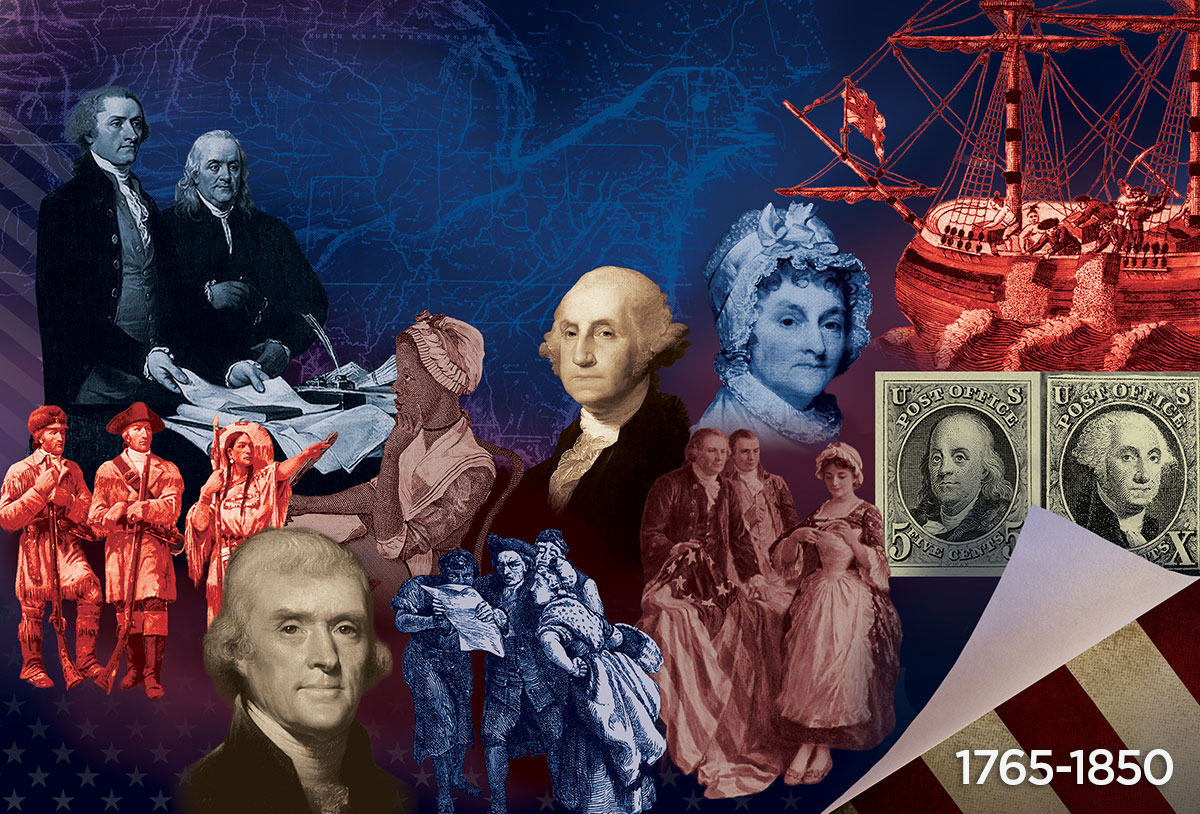
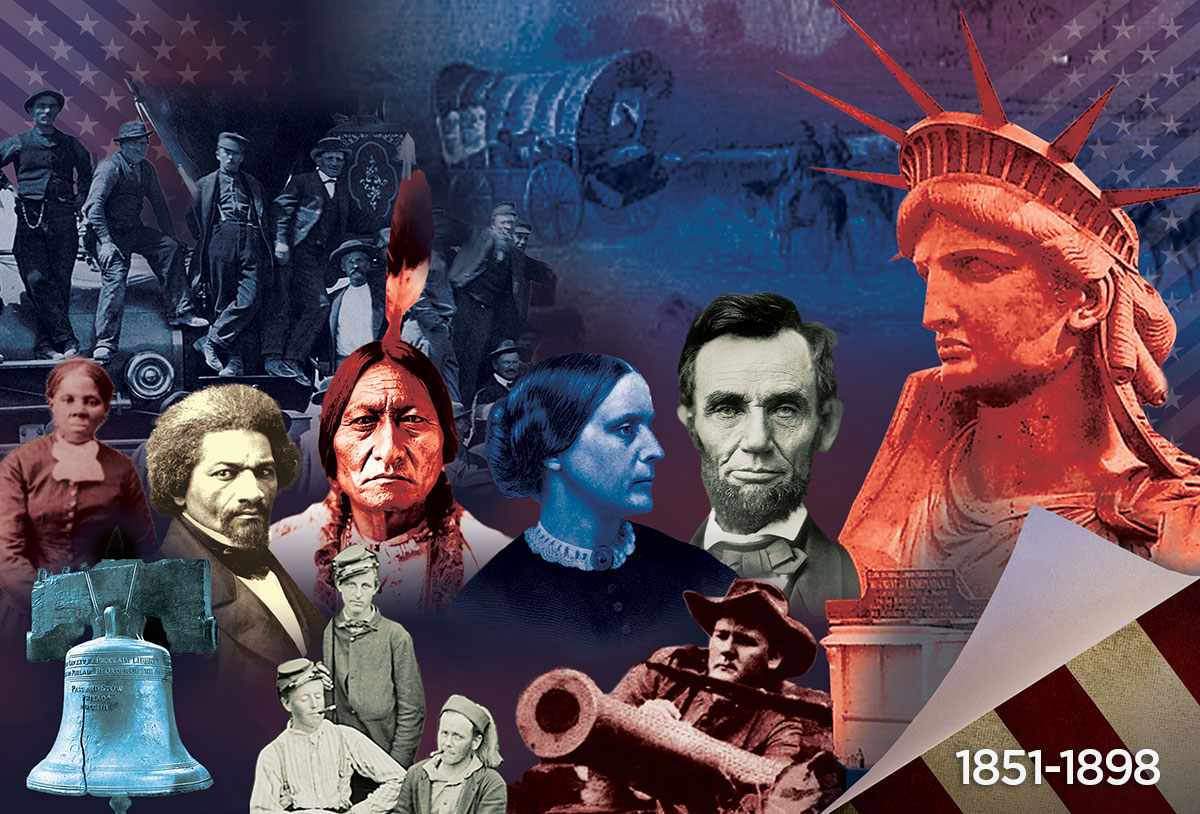
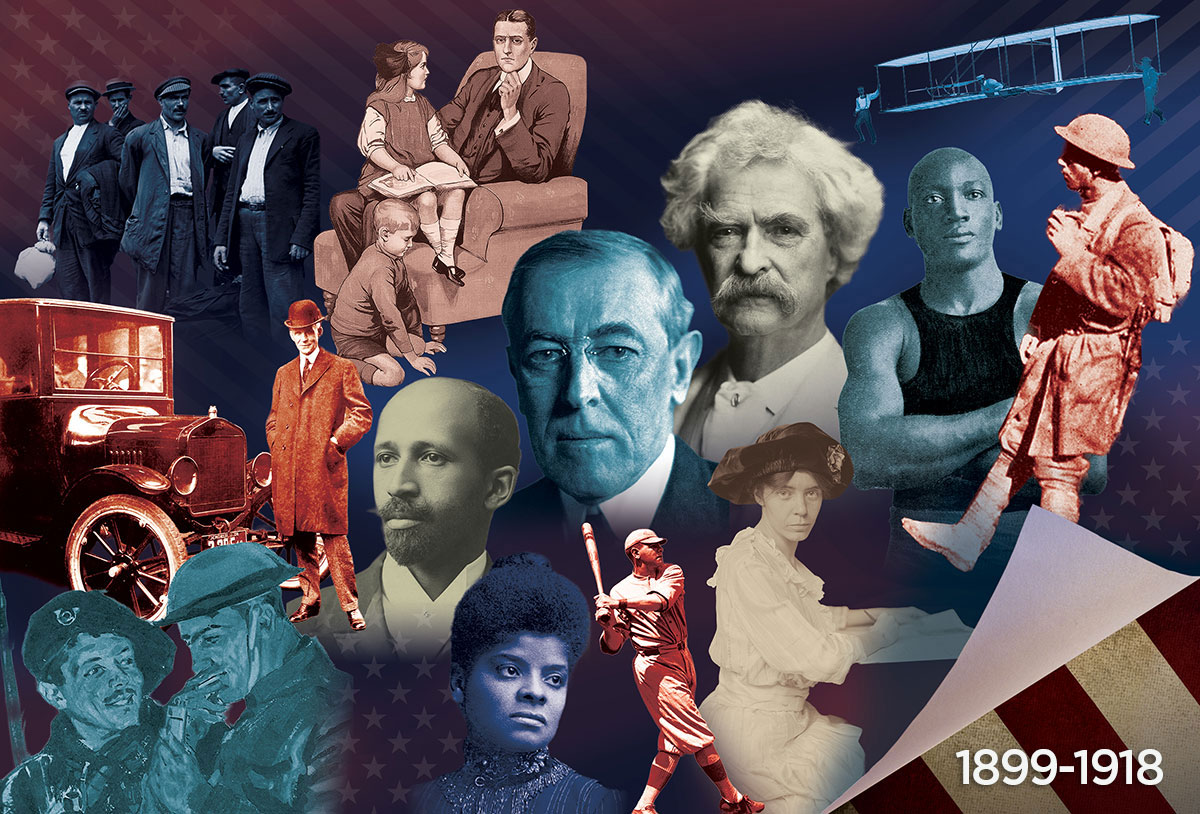
USA@250: Photo Index
1765-1850: The Founding Era
- Stamp Act, 1765[1]
- Boston Tea Party[2]
- Thomas Jefferson[3]
- Phyllis Wheatley[4]
- Declaration of Independence, Congress[5]
- George Washington[6]
- Abigail Adams[7]
- Lewis & Clark & Sacagawea[8]
- The Eagle Map[9]
- First U.S. Stamps, 1847[10]
- Betsy Ross Flag[11]
1851-1898: Expansion & Conflict
- Harriet Tubman[12]
- Susan B. Anthony[13]
- Fourth Infantry, Mich., Civil War[14]
- Abraham Lincoln[15]
- Frederick Douglass[16]
- Union Pacific Railroad Workers[17]
- Oregon Trail[18]
- Head of the Statue of Liberty, Paris, 1878[19]
- Sitting Bull[20]
- Liberty Bell[21]
- Spanish-American War, 1898[22]
1899-1918: Global Emergence
- W.E.B. Du Bois[23]
- American and French Soldiers, World War I[24]
- Italian Immigrants, Ellis Island[25]
- American WWI Soldier, 1921[26]
- Advertisement from WWI Period[27]
- Alice Paul[28]
- Woodrow Wilson[29]
- Wright Brothers[30]
- Henry Ford[31]
- Mark Twain[32]
- Ida B. Wells[33]
- Babe Ruth[34]
- Jack Johnson[35]
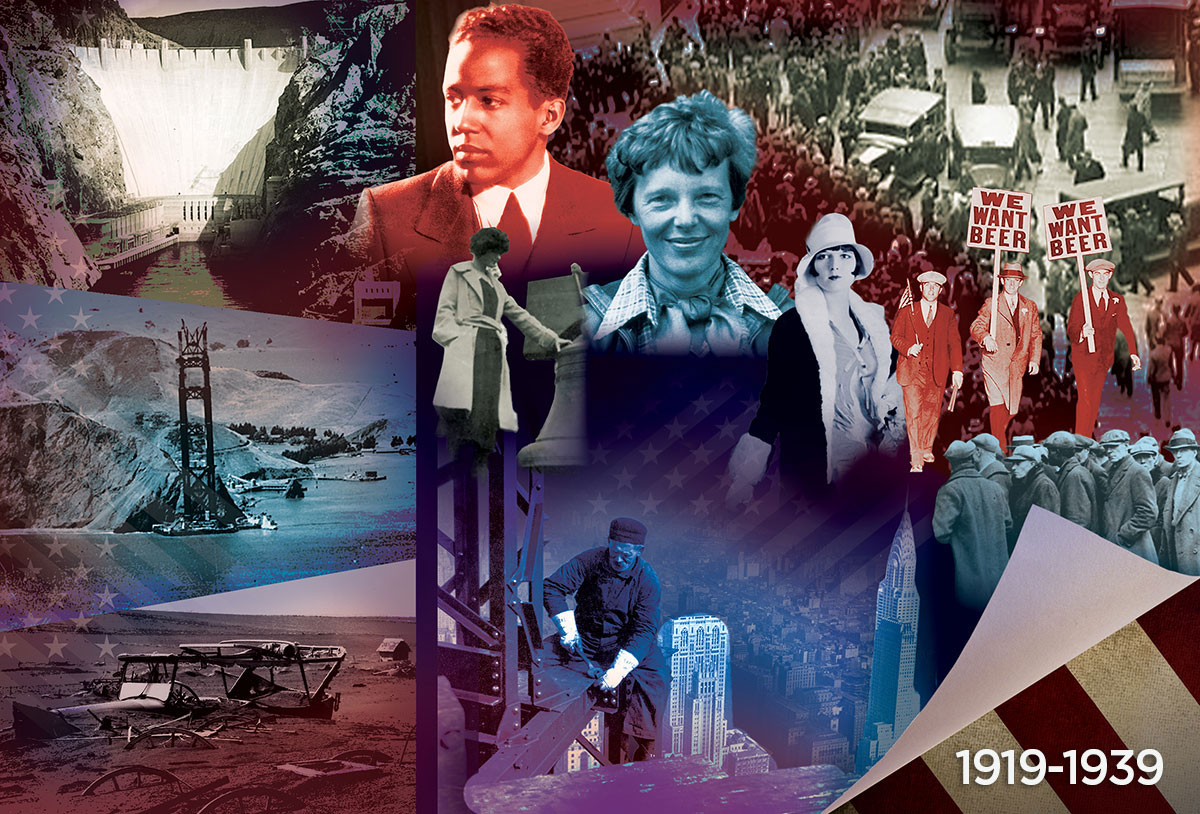
1919-1939: Crisis & Reform
- Catherine Wentworth[36]
- Louise Brooks[37]
- Prohibition[38]
- Wall Street Crash, 1929[39]
- Soup Kitchen Line, Depression Era[40]
- Dust Bowl[41]
- Boulder Dam, renamed Hoover Dam[42]
- Golden Gate Bridge Construction[43]
- Empire State Building Worker[44]
- Amelia Earhart[45]
- Langston Hughes[46]
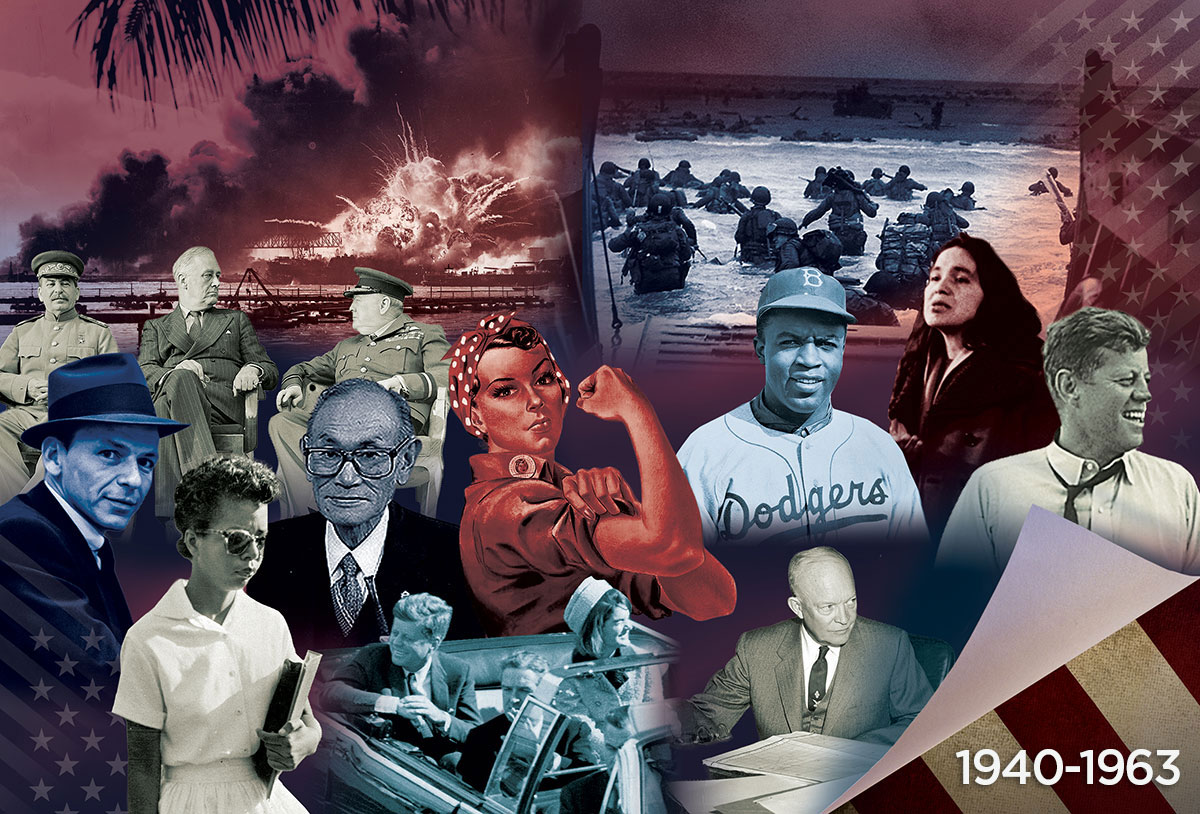
1940-1963: World Power Era
- Joseph Stalin, Franklin D. Roosevelt, and Winston Churchill[47]
- We Can Do It Advertisement, WWII[48]
- D-Day Invasion, WWII[49]
- USS Shaw Exploding in Pearl Harbor, WWII[50]
- Fred Korematsu[51]
- Dwight D. Eisenhower[52]
- Jackie Robinson[53]
- Elizabeth Eckford[54]
- Frank Sinatra[55]
- Dolores Huerta[56]
- John F. Kennedy, America’s Cup[57]
- John F. Kennedy & Jacqueline Kennedy, 1963[58]
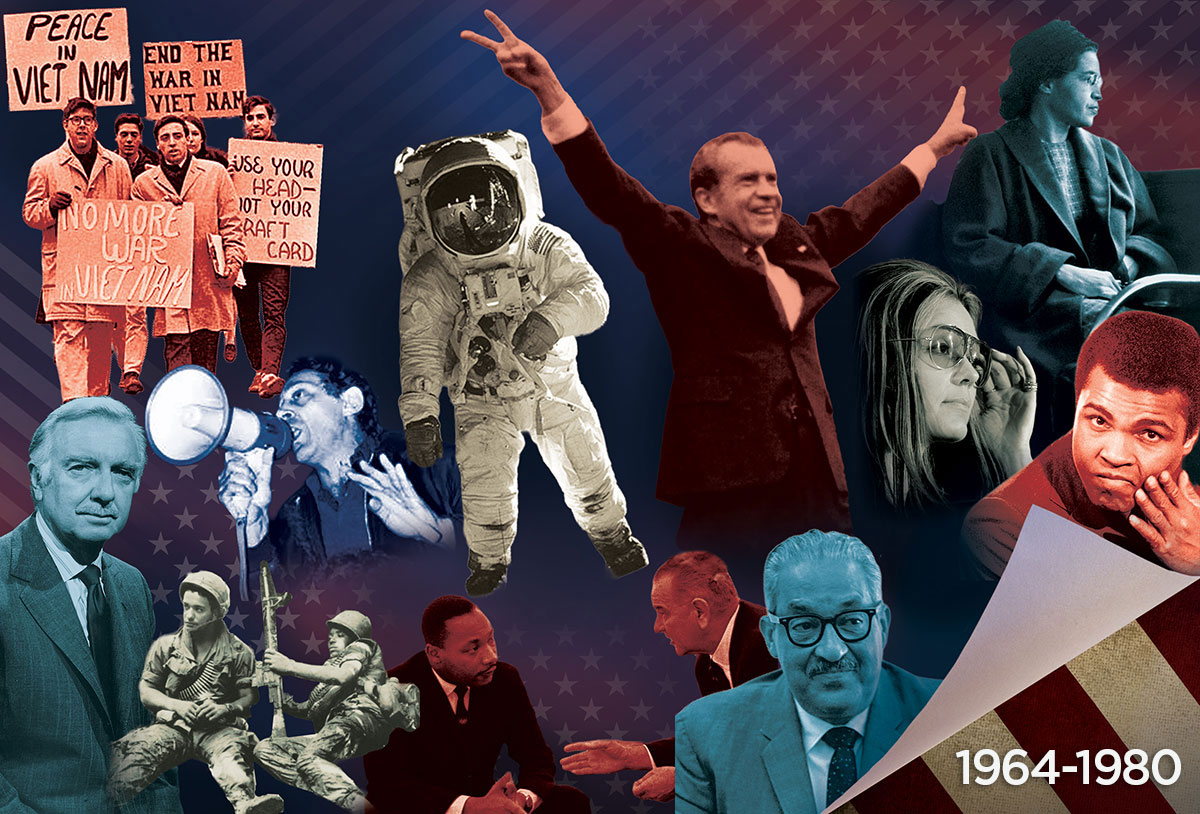
1964-1980: Civil Rights & Social Change
- Rosa Parks[59]
- Thurgood Marshall[60]
- Martin Luther King Jr. (MLK) with Lyndon B. Johnson; MLK (cover)[61]
- Vietnam War Soldiers[62]
- Vietnam War “Protesters,” Madison[63]
- Buzz Aldrin, Moon Landing[64]
- Mohammad Ali[65]
- Harvey Milk[66]
- Gloria Steinem[67]
- Walter Cronkite
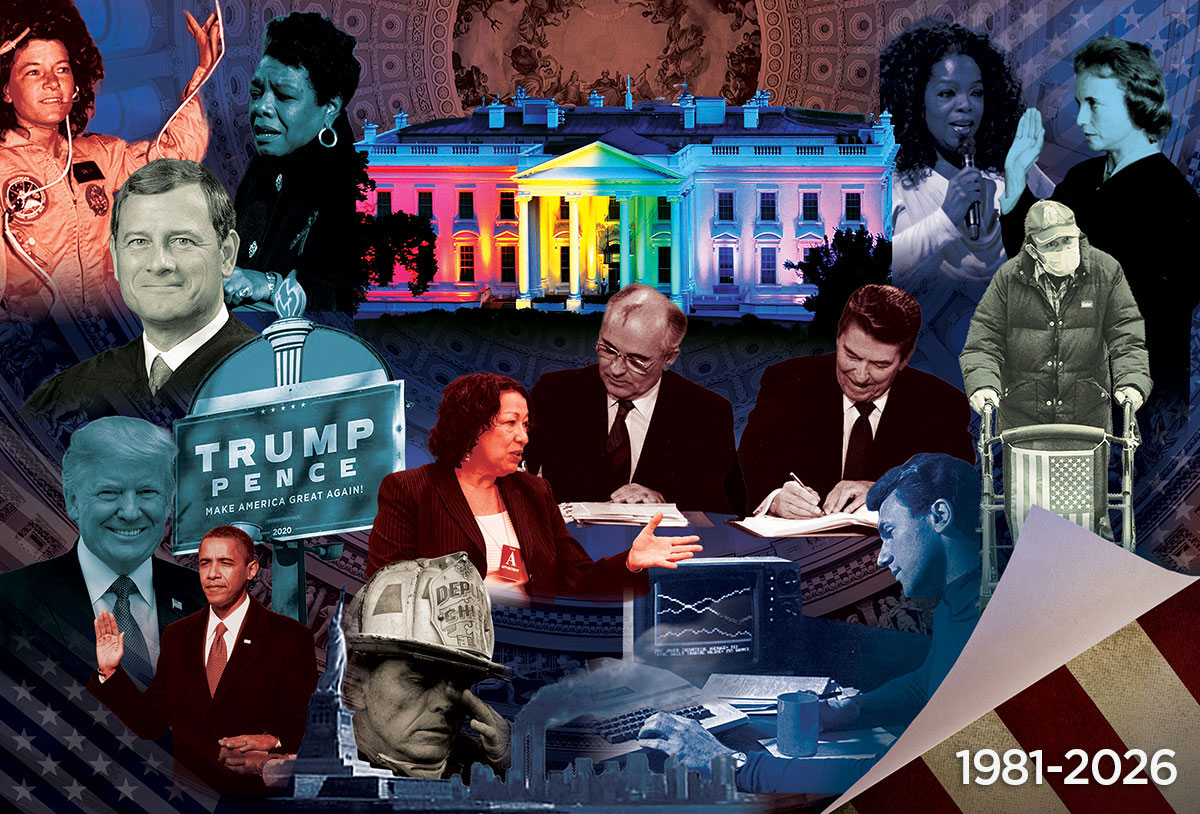
1981-2026: Modern Era
- Ronald Reagan and Mikhail Gorbachev[68]
- Sandra Day O’Connor[69]
- Sally Ride[70]
- Apple 2 Advertisement[71]
- Oprah Winfrey[72]
- Maya Angelou[73]
- 9/11 Ground Zero Firefighter[74]
- John G. Roberts[75]
- Barack Obama[76]
- Sonia Sotomayor[77]
- White House[78]
- COVID-19[79]
- Trump-Pence Billboard, 2020[80]
- U.S. Capitol Rotunda[81]
- Donald Trump[82]
USA@250: Photo Index Endnotes
[1] Getty images. ^
[2] https://commons.wikimedia.org/w/index.php?curid=16857908. ^
[3] https://commons.wikimedia.org/w/index.php?curid=20179140. ^
[4] https://commons.wikimedia.org/w/index.php?curid=1629684. ^
[5] https://commons.wikimedia.org/w/index.php?curid=180069. ^
[6] https://commons.wikimedia.org/w/index.php?curid=591229. ^
[7] https://commons.wikimedia.org/w/index.php?curid=68017805. ^
[8] https://commons.wikimedia.org/w/index.php?curid=19136610. ^
[9] https://commons.wikimedia.org/w/index.php?curid=153242507. ^
[10] https://commons.wikimedia.org/w/index.php?curid=10087298. ^
[11] https://commons.wikimedia.org/w/index.php?curid=11082268. ^
[12] https://commons.wikimedia.org/w/index.php?curid=80294493. ^
[13] https://commons.wikimedia.org/w/index.php?curid=15251802. ^
[14] https://commons.wikimedia.org/w/index.php?curid=47140543. ^
[15] https://commons.wikimedia.org/w/index.php?curid=31506495. ^
[16] https://commons.wikimedia.org/w/index.php?curid=9721553. ^
[17] https://commons.wikimedia.org/w/index.php?curid=41243910. ^
[18] https://commons.wikimedia.org/w/index.php?curid=2730977. ^
[19] Library of Congress Prints and Photographs Division Washington, D.C. 20540, USA, LC-DIG-ds-14924 (digital file from original) LC-USZ62-18086 (b&w film copy neg.), https://www.loc.gov/pictures/item/97502744/. ^
[20] https://commons.wikimedia.org/w/index.php?curid=569602. ^
[21] https://commons.wikimedia.org/w/index.php?curid=83099696. ^
[22] https://commons.wikimedia.org/w/index.php?curid=147485655. ^
[23] https://commons.wikimedia.org/w/index.php?curid=115198978. ^
[24] https://commons.wikimedia.org/w/index.php?curid=98939184. ^
[25] https://commons.wikimedia.org/w/index.php?curid=144542810. ^
[26] https://commons.wikimedia.org/w/index.php?curid=26474104. ^
[27] https://commons.wikimedia.org/w/index.php?curid=153581605. ^
[28] https://commons.wikimedia.org/w/index.php?curid=37503087. ^
[29] https://commons.wikimedia.org/w/index.php?curid=154259867. ^
[30] https://commons.wikimedia.org/w/index.php?curid=6461903. ^
[31] https://commons.wikimedia.org/w/index.php?curid=34071101. ^
[32] https://commons.wikimedia.org/w/index.php?curid=11351079. ^
[33] https://commons.wikimedia.org/w/index.php?curid=93448526. ^
[34] https://commons.wikimedia.org/w/index.php?curid=33818047. ^
[35] https://commons.wikimedia.org/w/index.php?curid=19146835. ^
[36] https://commons.wikimedia.org/w/index.php?curid=95345430. ^
[37] Library of Congress Prints and Photographs Division Washington, D.C. 20540 USA LC-DIG-ggbain-32453 (digital file from original negative), https://www.loc.gov/pictures/item/2014712606/. ^
[38] https://commons.wikimedia.org/w/index.php?curid=116287462. ^
[39] https://commons.wikimedia.org/w/index.php?curid=374410. ^
[40] National Archives photo no. 519837, https://catalog.archives.gov/id/519837. ^
[41] https://commons.wikimedia.org/w/index.php?curid=2246882. ^
[42] National Archives photo no. 541927, https://catalog.archives.gov/id/541927. ^
[43] https://commons.wikimedia.org/w/index.php?curid=60619601. ^
[44] National Archives photo no. 69-RH-4K-1, Lewis Hine, [VENDOR # 39], https://www.archives.gov/exhibits/picturing_the_century/port_hine/port_hine_img23. ^
[45] https://commons.wikimedia.org/w/index.php?curid=57938262. ^
[46] https://commons.wikimedia.org/w/index.php?curid=146630944. ^
[47] https://commons.wikimedia.org/w/index.php?curid=70630657. ^
[48] National Archives photo no. 535413, https://catalog.archives.gov/id/535413. ^
[49] National Archives photo no. 513173, https://catalog.archives.gov/id/513173. ^
[50] National Archives photo no. 520590, https://catalog.archives.gov/id/520590. ^
[51] Fred Korematsu, Image courtesy of the family of Fred T. Korematsu, used under CC by 2.0, https://creativecommons.org/licenses/by/2.0/deed.en/. Cropped from original/color tinted. ^
[52] https://commons.wikimedia.org/w/index.php?curid=1209537. ^
[53] https://commons.wikimedia.org/w/index.php?curid=27757215. ^
[54] https://commons.wikimedia.org/w/index.php?curid=120561759. ^
[55] https://commons.wikimedia.org/w/index.php?curid=92807232. ^
[56] https://commons.wikimedia.org/w/index.php?curid=176045751. ^
[57] National Archives photo no. 194215, https://catalog.archives.gov/id/194215. ^
[58] https://commons.wikimedia.org/w/index.php?curid=162046106. ^
[59] https://commons.wikimedia.org/w/index.php?curid=185211990. ^
[60] National Archives photo no. 2803441, https://catalog.archives.gov/id/2803441. ^
[61] https://commons.wikimedia.org/w/index.php?curid=1303417; National Archives photo no. 542069, https://catalog.archives.gov/id/542069 ^
[62] https://commons.wikimedia.org/w/index.php?curid=11434727. ^
[63] Student protesters marching down Langdon Street, Image courtesy of uw-digitalcollections, used under CC by 2.0, https://creativecommons.org/licenses/by/2.0/deed.en/. Cropped from original/color tinted. ^
[64] https://commons.wikimedia.org/w/index.php?curid=32049 ^
[65] https://commons.wikimedia.org/w/index.php?curid=92795706. ^
[66] https://commons.wikimedia.org/w/index.php?curid=188319873. ^
[67] Library of Congress Prints and Photographs Division Washington, D.C. 20540, USA, LC-DIG-ppmsc-03684 (digital file from original), http://hdl.loc.gov/loc.pnp/ppmsc.03684. ^
[68] https://commons.wikimedia.org/w/index.php?curid=258015. ^
[69] National Archives photo no. 1696015, https://catalog.archives.gov/id/1696015. ^
[70] By NASA - Great Images in NASA Description, Public Domain, https://commons.wikimedia.org/w/index.php?curid=6449682. ^
[71] https://commons.wikimedia.org/w/index.php?curid=16892230. ^
[72] Oprah Winfrey, image courtesy of aphrodite-in-nyc from new york city - P1100887, CC BY 2.0, https://creativecommons.org/licenses/by/2.0/deed.en/. Cropped from original/color tinted. ^
[73] https://commons.wikimedia.org/w/index.php?curid=47410239. ^
[74] U.S. Navy photo by Photographer’s Mate 2nd Class Jim Watson, https://commons.wikimedia.org/w/index.php?curid=173041. ^
[75] https://commons.wikimedia.org/w/index.php?curid=596761. ^
[76] https://commons.wikimedia.org/w/index.php?curid=14857424. ^
[77] https://commons.wikimedia.org/w/index.php?curid=7779138. ^
[78] https://commons.wikimedia.org/w/index.php?curid=91050535. ^
[79] COVID-19 in New York, image courtesy of Anthony Quintano, 89765251, used under CC by 2.0, https://creativecommons.org/licenses/by/2.0/deed.en/. Cropped from original/color tinted. ^
[80] Trump Pence - Make America Great Again Signs in Minnesota, image courtesy of Tony Webster from Minneapolis, Minnesota, United States, used under CC by 2.0, https://creativecommons.org/licenses/by/2.0/deed.en/. Cropped from original/color tinted. ^
[81] https://commons.wikimedia.org/w/index.php?curid=52719032. ^
[82] Library of Congress Prints and Photographs Division Washington, D.C. 20540 USA, LC-DIG-ppbd-00608 (original digital file), http://hdl.loc.gov/loc.pnp/pp.print. ^
» Cite this article: 99 Wis. Law. 10-24 (June 2026).
