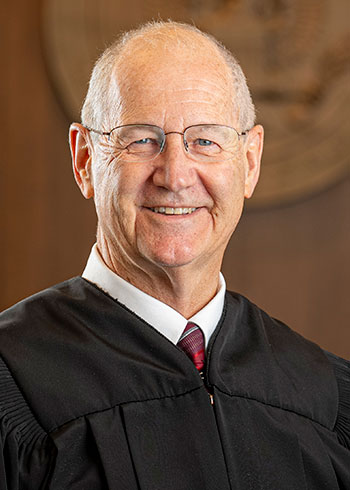
Photo courtesy Andy Manis/Marquette University Law School
When Judge William C. Griesbach talks about the law, he talks about “the joy of law” – using one’s mind to help others solve problems in a society governed by law. That sense of purpose has carried him through decades of judicial service.
Judge Griesbach, senior district judge of the U.S. District Court for the Eastern District of Wisconsin, is the 2026 recipient of the Lifetime Jurist Award from the State Bar of Wisconsin’s Bench and Bar Committee.
The award recognizes jurists who, during their tenure on the bench, were fair and impartial and demonstrated high ideals and personal character along with outstanding, long-term judicial service.
Judge Griesbach “has always demonstrated high ideals, exemplary personal character, judicial competence, and has been actively involved in community efforts that enhance the judicial system,” said his nominators.
“I am humbled and grateful” to receive the award, Judge Griesbach said.
‘Epitome of a Jurist’
Judge Griesbach, said his nominators, “is the epitome of a jurist.” He makes sure that all litigants, including those who are self-represented, are heard. “Everyone has their day in court … and even though he has a large caseload, his decisions are timely and always spot on.”
“He is also more than fair in ensuring that if there are disputed facts in a case, the parties get their right to a bench or jury trial. And during those trials, he is fair, patient, and in control of his courtroom,” the nominators said.
From Grafton to Green Bay
Judge Griesbach grew up as the sixth child in a family of 12 children: 9 boys and 3 girls. “The first eight were boys,” he said. His parents were married toward the end of World War II, in July 1945 – between V-E Day (May 1945) and V-J Day (August 1945) – his father returned from Europe and was home on leave from the army. His father became a professor of philosophy at Marquette University. “He taught there for close to 40 years.” The family lived in the town of Grafton, then moved to Brookfield when Judge Griesbach was 12. His mother taught for almost 20 years at James Madison High School in Milwaukee.
 Shannon Green is communications writer for the State Bar of Wisconsin, Madison. She can be reached by email or by phone at (608) 250-6135.
Judge Griesbach earned his undergraduate and law degrees at Marquette University. His undergraduate degree was in philosophy – inspired by his father. “Philosophy addresses the ultimate questions of life. It helps you think clearly – a lot of what I do is writing and reading, using concepts to address and organize arguments,” he said.
At Marquette, Judge Griesbach met Joanne, his wife of nearly 50 years. She taught religion in a high school and later coordinated adult education for their parish. “We have been blessed with 4 daughters and 10 grandchildren,” he said.
Judge Griesbach chose law because “it offers opportunities to use your mind in trying to answer important questions.” In a 2009 address at Marquette University titled “The Joy of Law,” he said law is “the opportunity to earn a living by using one’s mind to help others, whether individuals or businesses, to avoid or solve the problems and disputes that arise in a society governed by law.”
Earning his J.D. in 1979, he clerked for Wisconsin Supreme Court Chief Justice Bruce F. Beilfuss, who became a major influence. “He was very much a fair and impartial person,” and the court he presided over was very collegial, Judge Griesbach said.
From 1980 to 1982, Judge Griesbach worked as a staff attorney for the U.S. Court of Appeals for the Seventh Circuit, working with all judges, including Judge Thomas Fairchild – someone he very much admired. “He was beloved and respected throughout the Seventh Circuit and beyond,” he said.
Starting in 1982, Judge Griesbach practiced civil litigation with Liebmann, Conway, Olejniczak & Jerry S.C., Green Bay. In 1987, he left the firm and joined the Brown County District Attorney’s office as an assistant district attorney.
Gov. Tommy Thompson appointed him to the state bench in October 1995; Judge Griesbach was elected to a full term in 1996 and reelected in 2002.
Establishing a New Court
After Judge Griesbach submitted his application for the brand-new U.S. District Judge seat for the new Green Bay Division and before he began the interview process, the Sept. 11, 2001, terrorist attacks occurred. Judge Griesbach went to Washington, D.C., for an interview at the White House and hearing before the Senate Judiciary Committee with the city “very much in lockdown. … We all were thinking about the impact of the attacks on civil liberties,” he said.
In January 2002, President George W. Bush nominated him to become the first U.S. District Judge to be seated permanently in Green Bay, and in April 2002 he was confirmed by the U.S. Senate. In May 2002, he was sworn in. Judge Griesbach served as Chief Judge of the Eastern District from 2012 to 2019.
Making a Federal Case
Establishing a new federal court for northeast Wisconsin was “a very interesting process.” Judge Griesbach recalls attending meetings in Green Bay and discussing where this new federal court would be located – across the street from the Brown County Courthouse, as it turned out.
Judge Griesbach attributes much of the success in getting the court up and running to the assistance of his colleagues in Milwaukee, the staff in the clerk’s office, and his own staff, including Mary Fisher, his judicial assistant of nearly 30 years.
The work of a federal trial judge differs significantly from that of a state trial judge, he said. Federal judges often carry heavier civil than criminal caseloads, and the civil matters themselves are different. State courts handle many tort and contract disputes, while federal courts hear cases involving patents, copyrights, civil rights, employment discrimination, labor law, environmental law, Social Security Disability benefits review, prisoner challenges to convictions or conditions of confinement, and complex business litigation. “When I was growing up,” Judge Griesbach said, “a common refrain was ‘don’t make a federal case out of it.’ Now, it seems like you can make a federal case out of anything.”
Federal trial courts also operate somewhat differently than most state trial courts in their approaches to issuing opinions. Because of the heavy volume in state trial courts, judges are encouraged to “rule from the bench” so they don’t get behind. In federal courts, “there’s a lot more research and writing, and reading briefs.” The judges are generalists. “You become educated by the cases themselves. … It’s very challenging – and fulfilling,” said Judge Griesbach.
A case that stands out from his federal docket is United States v. NCR Corporation, No.1:10-cv-00910 (E.D. Wis.), involving cleaning up the Lower Fox River after decades of pollution by paper companies. The lawsuit was filed in 2010 and resolved in March 2019 after the companies responsible for the contamination agreed to pay for the cleanup.
“It was a massive case involving some of the top environmental lawyers. There were a lot of decisions that came out of that case, and it went up to the court of appeals two or three times. It was an important case for this area,” said Judge Griesbach.
On Being a Judge
Being a judge “gives you a window into every aspect of life out of which disputes can arise – into occupations, businesses, and everything that goes on in people’s lives in this amazing country.”
Work on the bench is “intellectually challenging.” Judges need to be willing to work hard and also have a calm disposition. “We need to be fair and impartial, and have a disposition that treats people respectfully,” he said. “You need to see everyone as a human being having intrinsic value.”
It is also important for judges to respect the part they play in our system of government, said Judge Griesbach. The judiciary is one of the three branches of government. “The judiciary isn’t the policymaking branch. The role of the court is to resolve disputes that arise under the law. An inevitable byproduct of the judicial process is that the courts in effect make law. But that’s more a byproduct than the role they have.” The role of the judiciary “is to resolve the disputes under the law as enacted by the legislature and consistent with the Constitution.”
One frustration, he says, is the lack of clarity in some areas of law that makes it harder for people to understand their rights and obligations. Legal disputes are too often resolved through litigation that is costly, slow, and difficult for both parties and courts. From his perspective, clearer rules would help reduce that burden and make outcomes easier to reach without so much expense and delay. He sometimes jokes with his clerks that “maybe trial by combat wasn’t such a bad idea. They got an answer fast.” The “major defect in our system right now is that it’s so costly and time consuming to resolve many of the cases that come before the courts.”
Deserving
In 2019, Judge Griesbach took senior status, allowing the appointment of a new judge to the seat. In October 2024, Judge Byron Conway succeeded Judge Griesbach. After Judge Conway was confirmed, Judge Griesbach reduced his caseload, which is now at 65% of an active district judge. Continuing to serve eases the burden on the district, he said. “At the time I took senior status, I didn’t intend to fully retire and hoped to continue serving.”
Reflecting on his ongoing judicial career, Judge Griesbach said that serving as a judge is really such a privilege that “you spend the rest of your career trying to prove that you’re deserving of it. That can be difficult.”
“In a way, that puts pressure on you to excel and work hard … and I’ve tried to do that,” Judge Griesbach said.
» Cite this article: 99 Wis. Law. 32-34 (May 2026).
