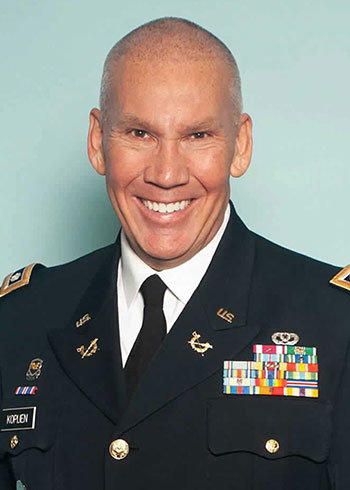
Chad W. Koplien, Marquette 1997, serves as Chief Legal Counsel for the Wisconsin Department of Veterans Affairs (WDVA). He previously served as an administrator and prosecutor for the Wisconsin Department of Safety and Professional Services (DSPS) and practiced litigation in the private sector. He is a member of the State Bar of Wisconsin’s Government Lawyers Division and Veterans of Foreign Wars.
Beginning in 1984, Chad Koplien’s military service includes enlisted and officer positions in the Air Force and Army. He was selected as Director, Staff Judge Advocate, for Wisconsin’s deployment to Combined Joint Task Force, Horn of Africa, in support of Operation Enduring Freedom. As the highest-ranking attorney on the Africa continent at the time, Koplien managed legal personnel from the Army, Navy, and Air Force in AFRICOM joint operations. (Fun Fact: Koplien swam with the whale sharks in the Gulf of Aden off the Red Sea – his only small break from deployment.)
Prior to his military retirement in 2025 as a lieutenant colonel, Koplien served as the deputy state judge advocate, spearheaded legal operations in Wisconsin’s 2020 pandemic response, led security missions for the 2020 and 2024 national political conventions, and coordinated civil unrest missions. Serving in a variety of legal management positions, he staffed legal operations in 18 state emergencies.
Koplien is a graduate of Marquette University Law School, the Judge Advocate General’s Legal Center and School and the Air War College. He holds a certification in Nursing Home Administration from UW-Madison and is a life member of the VFW and the National Guard Association.
We asked him to describe his work.
What are your primary functions on a daily basis at the Department of Veterans Affairs?
My chief legal activities break down as follows:
General Counsel: I manage the Wisconsin Department of Veterans Affairs’ (WDVA’s) Office of Legal Counsel and am the attorney for the Office of the Secretary. My legal sandbox includes state and federal laws and regulations under Wis. Stat. chapter 45, Wisconsin Administrative Code – VA, U.S.C. title 38, 38 C.F.R., and so on.
Healthcare law: I provide legal guidance on state nursing home and long-term care regulations, compliance surveys, HIPAA privacy, and contracts for our state veterans (nursing) homes in King, Union Grove, and Chippewa Falls.
Policy, benefits, and appeals: I provide legal opinions and reviews on state and federal veterans benefits, rulemaking, interagency issues, and legislation to the Secretary, department administrators and directors, the Wisconsin Veterans Museum, the Claims Bureau, the Board of Veterans Affairs, and the Council on Veterans Programs. I adjudicate appeals of veterans benefit denials as a Class III hearings officer under Wis. Stat. chapter 227.
Records custodian and ethics counselor: As the legal records custodian, I coordinate responses to records requests in accordance with Wis. Stat. chapter 19 and provide annual ethics training to state public officials and employees. I also regularly present continuing legal education programs to our department lawyers.
You have been chief counsel for more than a decade. What do you enjoy most about the role?
Dual roles: I thoroughly enjoy my position, and it has been an honor to be appointed as chief legal, which allowed me to serve as a reserve military lawyer while still serving veterans. Collaboration with chief legal counsels, AGs in other state agencies, and state government officials is pretty cool.
Leadership: Working as a government lawyer has provided significantly more leadership opportunities than in the private sector. The WDVA has augmented my military leadership experience earned in active-duty Air Force (RED HORSE), active-duty Army, while deployed, along with and many years later as a Wisconsin Guard judge advocate.
Public servant: I have served as chief legal under four Secretaries, both a Republican and a Democratic governor, and three Adjutant Generals in the Wisconsin Guard. My role has allowed me to serve veterans in a cause bigger than myself. It has also provided me with the security of deploying in support of Operation Enduring Freedom-HOA, a tour in Bavaria, Germany, and staff Covid, political convention, and security missions, without having to worry about a job on return.
What are the biggest challenges and how has the role evolved?
The role has evolved from being a classified position as a full-time state employee to that of a Secretary-appointed position under the authority and approval of the governor.
Some prominent challenges include the significant increase in public records requests. Many requests are complex and require interagency coordination, while some generate tens of thousands of pages of records, requiring high-level attention to detail.
One of the perks is getting to attend meetings in the Governor’s Conference Room, which is historical and exquisitely decorated. I appreciate the historical significance of that room. On its ceiling are the words: “The progress of a state is born in temperance, justice and prudence,” which I find to be very wise advice. I always rub the nose of the bronze badger at the entrance for good luck.
Why did you choose the career path you did and what words of advice would you have for attorneys interested in pursuing this type of legal work?
After my enlisted service, while pursuing an MBA, a professor asked me if I ever considered law school – I loved to read, write, and argue. I hadn’t, and he inspired me to change my majors to public administration and political science and join the debate team. I interned at a district attorney’s office. At Marquette, I gravitated to the trial advocacy curriculum and moot court. By the time I graduated, I had tried both a criminal and a civil jury case.
I first cut my teeth in general practice and public defender trial work in Milwaukee, then focused on plaintiff’s and insurance defense litigation statewide. I later refined my practice to business litigation and healthcare law in Madison. Commissioning as a judge advocate in 2008-09 (Army), after my years in private practice, I found it difficult to balance military service with the 50-70-hour workweeks required for me to meet billable targets. I actively sought out a state position and was hired by the Department of Safety and Professional Services.
I am grateful to the private sector for providing exposure to a wide variety of legal issues, but I have found gratification in my public servant role. The state offers more structure, collaboration, better health insurance, work-life balance, and a pension.
If my story resonates, my advice for interested attorneys is to monitor Wisc.Jobs for state jobs and USAJOBS for federal. For new lawyers and law students, agencies are always on the lookout for interns or limited-term employees. These positions get your toe in the door for a full-time position. Finally, to any lawyer interested in becoming a judge advocate, Wisconsin Lawyer magazine frequently lists openings for that position with the Wisconsin National Guard.
» Cite this article: 99 Wis. Law. 28-29 (March 2026).
