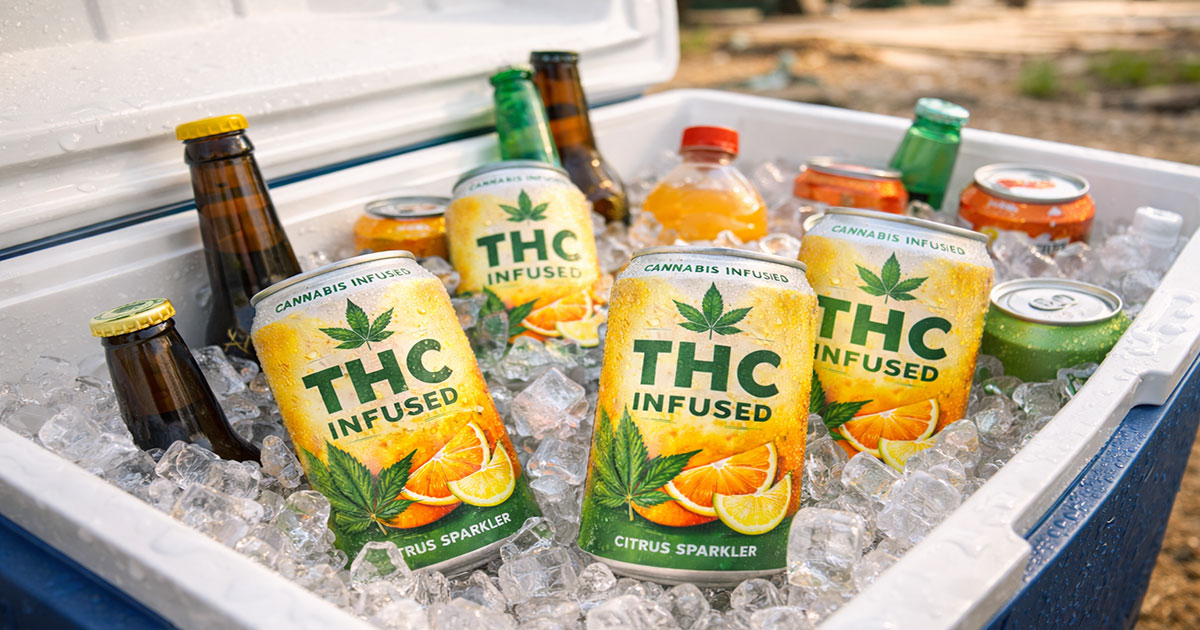
THC-infused beverages are now sold in bars, grocery stores, and breweries across the Midwest, often marketed as “hemp-derived” rather than containing “marijuana.” Their legal status rests on a single sentence in the 2018 Farm Bill that removed “hemp” from the federal controlled substances list.[1] While that sentence opened a new industry of hemp-based products, what that sentence did not do was assign any single federal agency clear authority to regulate them. The result is a fast-growing consumer market governed less by formal federal rules than by guidance, warning letters, and a patchwork of state law.
For lawyers advising manufacturers, distributors, landlords, insurers, and local governments, the challenge is not simply whether THC beverages are lawful. It is understanding how federal regulatory systems behave when Congress draws a bright statutory line and agencies are left to govern the shadows around it.
The One-Line Change that Created a Market
The Agriculture Improvement Act of 2018 (the “Farm Bill”) removed hemp from the Controlled Substances Act (CSA) by defining it as cannabis containing no more than 0.3% delta-9 THC by dry weight.[2] That statutory change did two things at once. It legalized the cultivation and sale of hemp nationwide, and it created a new category of cannabinoids that were no longer, by definition, federally controlled substances.
What it did not do was create a comprehensive regulatory framework for hemp-derived products once they enter the consumer marketplace. Congress assigned the U.S. Department of Agriculture (USDA) authority over cultivation and production. It left unresolved how ingestible hemp products designed to produce intoxicating effects would fit into existing federal food, drug, and consumer safety laws.
That omission matters. A brewery can lawfully source hemp grown under a USDA-approved plan.[3] Whether it can legally sell a THC-infused seltzer is a different question and one that turns less on agriculture law than on how federal agencies interpret their own statutory mandates.
The Agency Triangle
Three federal agencies now occupy overlapping territory around hemp-derived THC products, each operating under a different statute and regulatory culture.
Food and Drug Administration (FDA). The FDA regulates food, beverages, and dietary supplements under the Federal Food, Drug, and Cosmetic Act. The agency has repeatedly stated that THC and cannabidiol (CBD) cannot be added to food or marketed as dietary supplements because they are active ingredients in approved or investigated drugs.[4] Yet the FDA has not issued a comprehensive rule for hemp-derived ingestibles. Instead, it has relied primarily on guidance documents and targeted enforcement actions, including warning letters to companies making health claims.[5]
Drug Enforcement Administration (DEA). The DEA administers the CSA and controls the scheduling of marijuana. It recognizes that “hemp,” as defined by the Farm Bill, is not a controlled substance. At the same time, the agency has taken the position that certain forms of “synthetically derived” or “converted” THC might still fall within the CSA.[6] The DEA, however, is not structured to regulate consumer beverages or retail food products.
U.S. Department of Agriculture (USDA). The USDA oversees hemp cultivation and production plans. Once hemp leaves the field and becomes a consumer good, the USDA’s formal authority largely ends.[7]
The practical result is a regulatory triangle with no clear center. Cultivation is federally regulated. Food safety is federally regulated. Controlled substances are federally regulated. But THC beverages sit in the seams between those regimes.
Guidance Instead of Rules
For administrative lawyers, the most striking feature of this space is not what agencies have done but what they have not done. No federal agency has completed a full notice-and-comment rulemaking to establish a national framework for hemp-derived THC beverages. There are no federal code of labeling standards, permissible dosage thresholds, or uniform manufacturing practices specific to these products.
Instead, the market is shaped by a combination of informal guidance, enforcement discretion, and state-level experimentation. The FDA’s public statements signal skepticism. The DEA’s interpretations signal caution. State regulators fill the gaps with widely varying approaches ranging from explicit authorization and licensing schemes to outright bans.[8]
For businesses, that means compliance planning based less on settled federal rules than on regulatory signals. For lawyers, it means advising clients in an environment in which tomorrow’s enforcement theory might not look like today’s guidance document.
The Executive Signal
This regulatory hesitation contrasts sharply with how the federal system operates when political urgency runs in the opposite direction. Recent executive actions directing federal agencies to move forward with marijuana rescheduling have drawn attention to how quickly the executive branch can push agencies to act on high-profile issues.
Rescheduling under the CSA is a formal administrative process. It requires scientific and medical evaluation, a proposed rule, public participation, and a final agency determination that can be reviewed in federal court. An executive order cannot, by itself, change a drug’s legal status, but it can set priorities and timelines for the agencies that have statutory authority.
Hemp-derived THC beverages illustrate the inverse problem. Here, Congress has already acted. The statute is in place. The market is operating at scale. Yet the federal agencies with overlapping jurisdiction have not completed a formal regulatory framework. The result is a consumer industry governed more by executive signals and agency discretion than by codified rules.
The State-Federal Divide
Nowhere is this more visible than in the Midwest. States have taken sharply different paths in regulating hemp-derived intoxicants. Some have folded them into existing alcohol or cannabis regulatory systems. Others treat them as ordinary food products. Still others prohibit them altogether.
A summary illustrates the divergence:
Wisconsin generally treats hemp-derived THC products as lawful if they meet the federal hemp definition, with regulation largely occurring through consumer protection, food safety, and local licensing rather than a dedicated cannabis-style framework.[9] Enforcement and policy guidance have been fragmented across agencies, leaving municipalities and businesses to navigate uncertainty.
Minnesota has moved toward an explicit regulatory model for “hemp-derived consumer products,” including THC beverages, establishing age limits, serving restrictions, and licensing requirements that resemble elements of alcohol regulation.[10]
Iowa maintains a more restrictive posture, with state agencies and prosecutors taking the position that many intoxicating hemp-derived products fall outside the scope of lawful hemp and may trigger controlled substances or consumer protection concerns.[11]
Illinois operates a mature, comprehensive cannabis regulatory regime, and tends to treat intoxicating THC products – whether marijuana derived or hemp derived – within a tightly controlled, licensed market rather than as ordinary consumer goods.[12]
For Wisconsin lawyers, this creates practical issues that go well beyond products liability or licensing. Lease agreements, lending relationships, insurance coverage, and municipal permitting all hinge on how a product is classified. A business that is lawful under state law but operates in a gray area under federal law may face different risk assessments from national insurers or federally regulated banks.
The absence of a clear federal rule also complicates preemption analysis. Without a formal agency position adopted through rulemaking, it is harder to predict when federal law might displace or leave room for state regulatory schemes.
Administrative Law in Plain Sight
THC beverages are an unusually useful case study because the administrative law is not buried in technical rulemakings or appellate opinions. It is playing out in real time on store shelves and in city council meetings.
Congress drew a narrow statutory line by legalizing hemp defined by THC concentration. Agencies inherited the task of applying broad, older regulatory statutes to a new class of products. Some have responded with caution and guidance. Others have signaled enforcement priorities. None has yet produced a comprehensive, binding regulatory framework.
This is administrative law at its most practical: the space between what the statute clearly says and what regulated entities need to know to operate with confidence.
Why It Matters for Lawyers
For lawyers advising clients in this space, the key question is not “Is this legal today?” It is “What regulatory theory is likely to emerge tomorrow?”
A formal FDA rule could transform the market overnight. A change in DEA interpretation could affect supply chains. Congressional amendments in a future farm bill could redraw the statutory boundary altogether. Each of those developments would shift risk profiles for businesses and the legal advice that supports them.
Until then, THC beverages will continue to exist in a space shaped by informal agency action and state-level regulation rather than uniform federal rules. For lawyers, this means watching not only the headlines but also the Federal Register and the guidance documents and enforcement actions that often signal that formal rulemaking may eventually follow.
A Broader Lesson
The hemp-derived THC market highlights a broader feature of the modern regulatory state. Executive action can accelerate agency movement when political priorities demand it. Congressional action can open markets with a few lines of statutory text. But the day-to-day legal environment for businesses is often defined by what agencies choose to formalize and what they leave to discretion.
For regulatory and administrative lawyers, that gap is where most of the real work begins.
If you’d like to explore this topic in greater depth, the State Bar of Wisconsin’s Nonresident Lawyers Division is hosting speakers on this topic at the 2026 Annual Meeting & Conference. The presentation titled “An Industry in Legal Limbo: Surveying the Federal and State Landscape for THC-Infused Products” will feature legal experts who work in this field.
The 2026 Annual Meeting & Conference is June 10-12 in La Crosse. For more information and to register, visit wisbar.org/AMC.
Endnotes
1 Agriculture Improvement Act of 2018, Pub. L. No. 115-334, § 12619, 132 Stat. 4490, 5018-19 (2018) (codified at 7 U.S.C. § 1639o(1)) (removing “hemp” from the definition of marijuana under the CSA and defining hemp as cannabis containing not more than 0.3% delta-9 THC on a dry weight basis), https://uscode.house.gov/view.xhtml?req=granuleid:USC-prelim-title7-section1639o&num=0&edition=prelim.
2 Id.
3 USDA, Establishment of a Domestic Hemp Production Program: Final Rule, 86 Fed. Reg. 5596 (Jan. 19, 2021) (establishing federal and state/tribal plan approval system for lawful hemp production under the 2018 Farm Bill), https://www.govinfo.gov/content/pkg/FR-2021-01-19/pdf/2021-00967.pdf.
4 FDA, FDA Regulation of Cannabis and Cannabis-Derived Products, Including Cannabidiol (CBD) (content current as of July 16, 2024), https://www.fda.gov/news-events/public-health-focus/fda-regulation-cannabis-and-cannabis-derived-products-including-cannabidiol-cbd.
5 FDA, Warning Letters for Cannabis-Derived Products (content current as of Sept. 3, 2025), https://www.fda.gov/news-events/public-health-focus/warning-letters-cannabis-derived-products.
6 DEA, DEA Letter Regarding Delta-8 THC, Sept. 15, 2021, https://albop.com/oodoardu/2021/10/ALBOP-synthetic-delta8-THC-21-7520-signed.pdf; see also Implementation of the Agriculture Improvement Act of 2018, 85 Fed. Reg. 51639, 51641-42 (Aug. 21, 2020), https://www.federalregister.gov/documents/2020/08/21/2020-17356/implementation-of-the-agriculture-improvement-act-of-2018.
7 Congressional Rsch. Serv., Farm Bill Primer: Hemp Industry Support and Regulation, IF12278 (Jan. 10, 2025) (explaining USDA’s authority over hemp cultivation and production plans under the Farm Bill and noting that regulation of downstream consumer products and ingestible cannabinoids falls primarily to other federal agencies, including FDA), https://www.congress.gov/crs-product/IF12278.
8 Nat’l Conf. of State Legis., Regulating Hemp and Cannabis-Based Products (updated April 30, 2022), https://www.ncsl.org/agriculture-and-rural-development/regulating-hemp-and-cannabis-based-products; see also Congressional Rsch. Serv., Changes to the Federal Definition of Hemp: Legal Considerations (LSB11381) (Dec. 22, 2025) (explaining how the Farm Bill hemp definition interacts with cannabinoid product categories and legal uncertainty that contributes to divergent state regulation), https://www.congress.gov/crs-product/LSB11381.
9 Wis. Stat. § 94.55 (2023-24) (establishing Wisconsin’s hemp production and regulation framework administered by the Department of Agriculture, Trade and Consumer Protection (DATCP)); DATCP, Wisconsin Hemp Resources, https://datcp.wi.gov/Pages/Programs_Services/Hemp.aspx (last visited Feb. 12, 2026); Wis. DOJ, Controlled Substances: Cannabis & Food FAQs, https://www.wisdoj.gov/Pages/CriminalJusticeServices/controlled-substances.aspx (last visited Feb. 12, 2026).
10 Minn. Stat. § 151.72 (2025) (regulating the sale of cannabinoid products); Minn. Off. of Cannabis Management, Hemp Business Overview, https://mn.gov/ocm/businesses/resources/hemp/overview/ (last visited Feb. 12, 2026).
11 Iowa Code § 204.2 (2024) (the “Iowa Hemp Act” defining hemp and consumable hemp products); Iowa Health & Hum. Servs., Consumable Hemp, https://hhs.iowa.gov/health-prevention/consumable-hemp (last visited Feb. 12, 2026).
12 Cannabis Regulation and Tax Act, 410 Ill. Comp. Stat. §§ 705/1-1 705/999-99 (establishing Illinois’ comprehensive, statewide licensing and regulatory framework for the cultivation, distribution, and retail sale of cannabis and cannabis products); Illinois Dep’t of Fin. & Prof. Regul., Adult Use Cannabis Program, https://idfpr.illinois.gov/profs/adultusecan.html (last visited Feb. 12, 2026).
» Cite this article: 99 Wis. Law. 24-27 (March 2026).
