
In 2025, legal malpractice claim activity in Wisconsin took a noticeable turn. In that time, Wisconsin Lawyers Mutual Insurance Co. (WILMIC) opened 339 claim matters, averaging a little more than 28 new matters per month. By comparison, only 282 claim matters were opened in all of 2024. The sharp rise in reported matters is undeniable.
Yet there is good news. Despite the uptick in frequency, both severity and high-reserve claims remain historically low. As of Dec. 31, 2025, no new claim required a six-figure reserve, and overall reserve trends continue to move in a positive direction.
What follows is a closer look at the emerging patterns – the sources of claims, the types of mistakes driving them, and what Wisconsin lawyers can do to protect themselves.
Practice-Area Sources of Claims
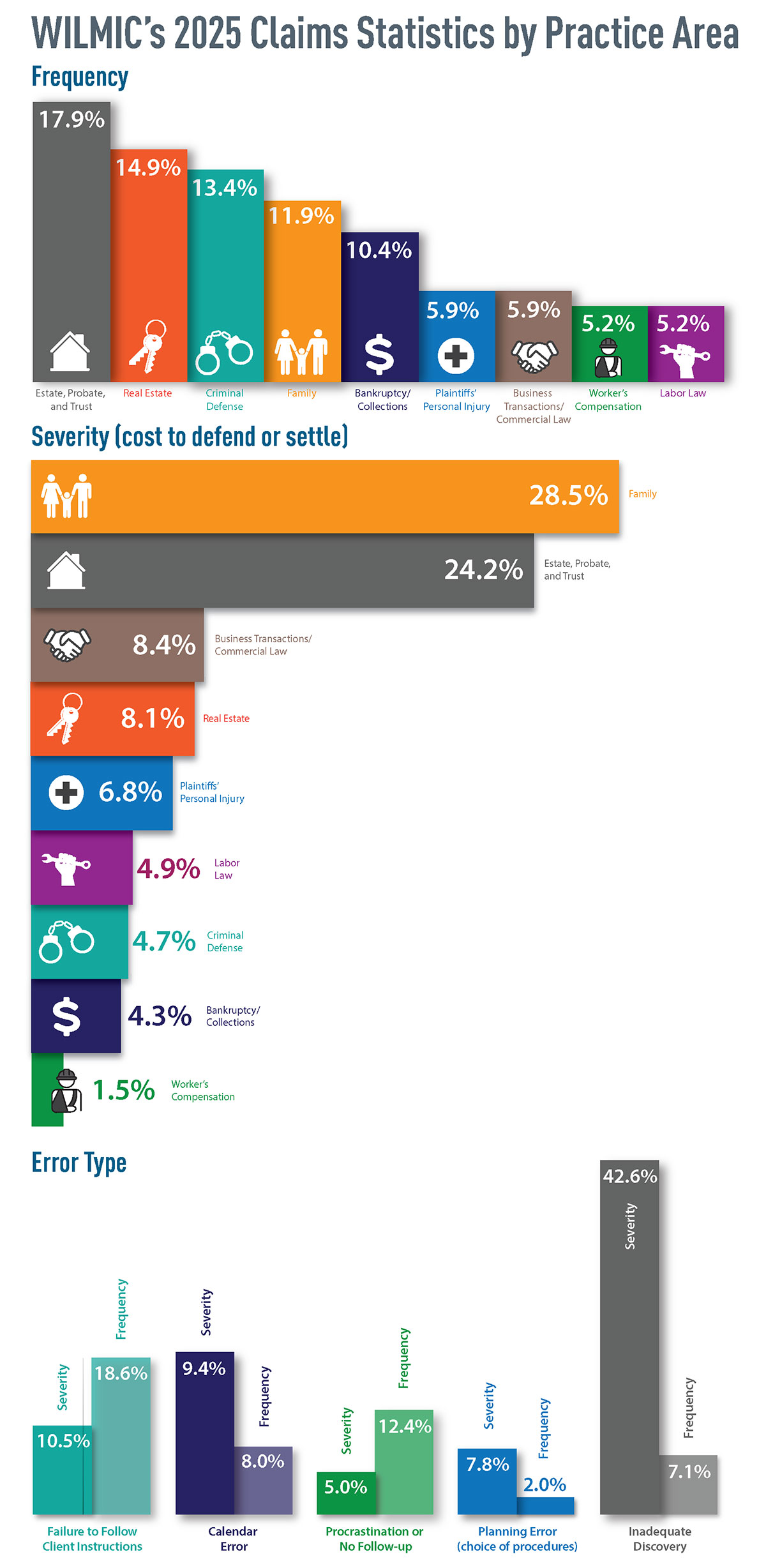
Four areas of practice led the way in frequency: estate, probate, and trust; real estate; criminal defense; and family law. But frequency and severity tell very different stories. (See the accompanying graphic.) While family law accounted for 12% of new matters, it made up nearly 30% of WILMIC’s total severity in 2025. Business transactions and commercial law – though smaller in volume – also carried outsized severity risk.
Estate Planning. Estate planning remained the most claim-prone practice area. Disinherited beneficiaries or people who perceive that they were disinherited continue to allege that drafting lawyers failed to capture testators’ true intent. Brian Anderson, WILMIC’s director of claims, offered this description: “Blaming the lawyer for the litigation expense that is associated with an estate dispute can become very costly. We are currently embroiled in several claim matters where it appears clear that litigation was inevitable to resolve the dispute in the estate, based upon strained family dynamics, and the drafting lawyer becomes a convenient target to pay for the fees being incurred.”
Mistakes That Are Driving Claims
A few types of errors were responsible for an outsized share of losses. The top five error types accounted for 80% of all incurred losses. (See the accompanying graphic.)
Costliest Error of 2025: Inadequate Discovery. The spike in losses associated with inadequate discovery highlights a difficult balancing act for lawyers: developing the case versus controlling costs at the client’s request. When experts, appraisers, or specialists are not engaged – and damages later become difficult to prove – the hindsight critique can be severe.
Clear documentation of client decisions and informed consent is more important than ever.
Practice-Area-Specific Trends
Family Law: Severity on the Rise. Family law matters now account for nearly 30% of WILMIC’s total severity. The driving factors include:
Large marital estates,
Claims of inadequate asset protection,
Attacks on marital settlement agreements, and
Invalidation of prenuptial agreements.
In these situations, the drafting lawyer frequently becomes the focus of the client’s financial frustration.
Plaintiff-Side PI: Statutes-of-Limitation Problems Persist. Missed statutes of limitation remain the leading cause of PI malpractice claims. With high case volumes and variable deadlines depending on the underlying facts, opportunities for error are abundant.
Brian Anderson noted the danger in relying on referrals as a source of revenue. “Referrals are a great option in this area of practice in terms of a fee source. However, they carry with them a risk. Lawyers that maintain a fee interest in the underlying personal-injury claim ultimately share responsibility for any mistakes made by the lawyer or law firm handling the underlying claim.”
Criminal Defense: Most-Prone-to-OLR-Grievance Practice Area. In 2025, criminal defense attorneys continued to face the highest rate of Office of Lawyer Regulation (OLR) grievances. The good news? Most grievances brought against criminal defense attorneys are dismissed. The bad news? Poor or infrequent written communication often triggers these grievances in the first place.
Regular, documented communication is still the best protection.
Reducing Risk: Practical Reminders for Every Wisconsin Lawyer
Legal malpractice is a risk for every practice. But timely action and awareness can dramatically reduce the consequences of mistakes. Anderson explained, “The risk of a legal malpractice claim is the reality of your law practice. Prompt notice to your lawyers’ professional liability (LPL) carrier can provide you with peace of mind and take the stress off an otherwise unsettling experience.”
Here are the top five risk-avoidance tips every lawyer should keep front and center:
1) Document clients’ decisions – especially when they decline recommended action. Many of 2025’s costliest claims stemmed from inadequate discovery or expert input that was skipped at the client’s request. If a client instructs you not to hire an appraiser, tax professional, investigator, or expert, do the following:
Put the recommendation in writing.
Explain how this might affect the case.
Obtain explicit, informed consent.
A short email confirming the conversation can make the difference between dismissal and exposure.
2) Treat file-transfer requests as a red flag. When a client asks you to send their file to another lawyer, assume there is dissatisfaction, miscommunication, or a brewing claim.
This is the moment to:
Notify your LPL carrier,
Review the history of communication with this client, and
Ensure your file is complete and well-documented.
Early notice allows your carrier to help you manage the transition – before the situation escalates.
3) Call your carrier if you’re given notice of a deposition. If you receive notice that you must appear for a deposition in a matter you handled – even if you are not a named defendant – you may be entering risky terrain. Lawyers sometimes “take responsibility,” thinking that they’re helping the client, but then unintentionally admit fault.
Your LPL carrier can:
You do not need to go it alone.
4) Strengthen your communication habits in high-complaint areas. Criminal defense remained the top source of OLR grievances in 2025, with most tied to communication issues, not substantive-law errors.
Protect yourself by adopting habits such as the following:
Monthly status letters or emails,
Written confirmation of instructions and advice,
Clear explanation of next steps, and
Prompt documentation of missed calls or unreturned outreach.
These practices take little time – and can prevent months of grievance-related stress.
5) Don’t rely on memory or informal systems for statutes of limitation and other deadlines. Missed statutes of limitation and deadline tracking errors continue to drive PI and general malpractice claims. Double-system calendaring remains the gold standard:
When a case involves unique deadlines – governmental claims, contractual shortening provisions, cases in which minors are involved, or probate-related timelines – flag them clearly for future you.
Conclusion
The 2025 claim landscape shows rising frequency but reassuring stability in severity. Nevertheless, some trends – estate planning disputes, family law exposure, PI deadline errors, and OLR grievances in criminal defense – underscore the ongoing need for vigilance.
Understanding how your LPL policy works, what triggers a report, and how to communicate with clients remains essential to safeguarding your practice and your peace of mind.
» Cite this article: 99 Wis. Law. 45-47 (February 2026).
