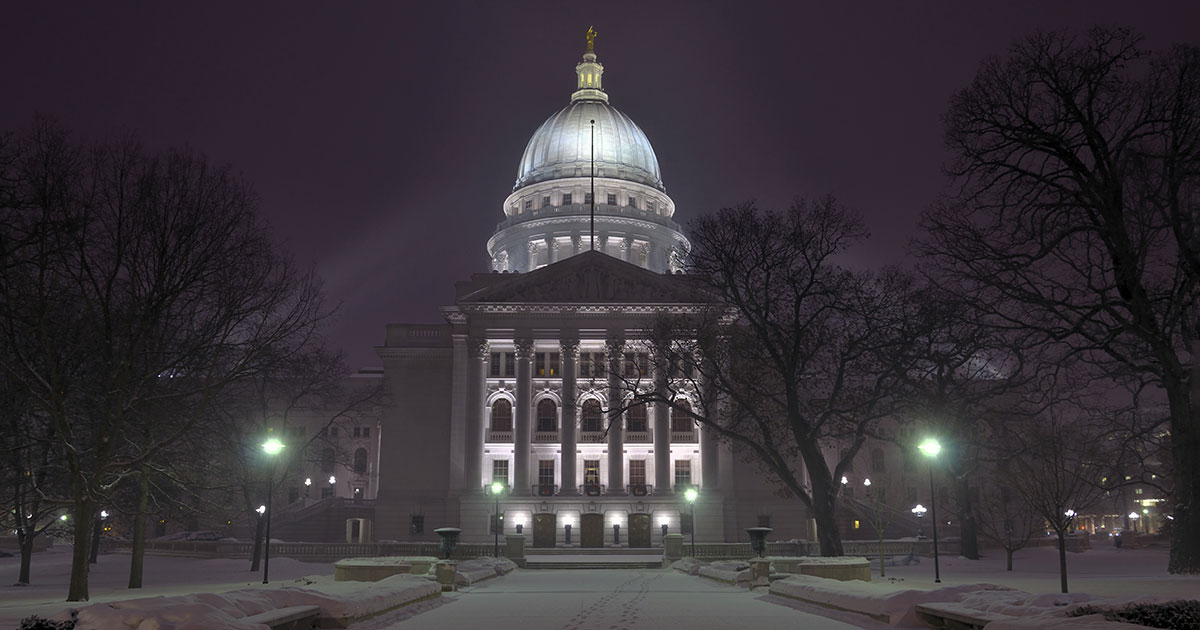
As the trees lost their leaves in the fall and the weather shifted to winter, so, too, did the mindsets of those working in the Wisconsin Capitol. After a limited floor period in September, legislative activity increased significantly throughout October and November, with numerous committee hearings and floor days, completing the fall floor session on Nov. 18 (Senate) and Nov. 19 (Assembly). Now those who work in and around state government are looking ahead to the remaining session days in early 2026.
While the fall floor period closed in November, legislative committees continued to meet right up until the holidays, in a mad dash to ensure bills were in place for the final floor periods of the 2025-2026 legislative session. In January, the legislature will return for the final floor periods sometime between Jan. 13 and 22 and between Feb. 10 and 19.
Additional floor days are also scheduled from Mar. 17 to Mar. 19, but if the past is any indication, the March floor period might be used only for limited action, or one house might meet for a single day to conclude any outstanding business from the other chamber.
While technically there are only a few months left on the 2025-2026 session calendar, this period is expected to be the busiest part of the legislative cycle. A frenzied pace at the end of session is common, but it is anyone’s guess what might, or might not, be resolved in these remaining months. Ask almost anyone who works in the Capitol what they expect to happen and the guesses they share – often prefaced with the caveat that “this could change at any moment” – will vary from how many floor days each chamber will hold to the number of outstanding bills anticipated to pass on those few, or perhaps numerous, floor session days. What everyone can agree on is that there will be intense pressure to keep up with the frantic pace and ensure their favored bills are on the calendar, while those they oppose are left off.
Regardless of how many floor days remain in 2026, the State Bar of Wisconsin’s Advocacy Team hopes to resolve a few outstanding issues in which the Board of Governors policy positions apply.
Criminal Justice System Funding
The first of these matters is an attempt to build on the 43 new assistant district attorney (ADA) positions and 12.5 support positions for the Wisconsin State Public Defenders Office (SPD) that were included in the 2025-2027 budget compromise[1] reached last July. While the additional positions helped address a growing need in these important criminal justice agencies, legislators have recognized that more needs to be done. In acknowledgement of this, Rep. David Steffen (R-Howard) and Sen. Eric Wimberger (R-Oconto), along with 17 other legislators, introduced Assembly Bill 514[2] and Senate Bill 546,[3] which they declared the “Justice for All Act.”
The legislation provides position authority for 30.5 ADAs, 13.0 assistant state public defenders (ASPDs), 23.0 SPD support staff, and 2.0 circuit court judges (and a corresponding 2.0 court reporters) in 2027-28, and 64.5 ADAs, 22.0 ASPDs, 41.0 SPD support staff, and 4.0 circuit court judges (and a corresponding 4.0 court reporters) in 2028-29. The bill adds four circuit court branches, in Brown County (Aug. 1, 2027), Menominee and Shawano County (Aug. 1, 2027), Brown County (Aug. 1, 2028), and Kenosha County (Aug. 1, 2028). It should be noted that funding for the new positions will need to be requested in the respective agency budget requests for the 2027-29 biennial budget.
Ensuring proper staffing and support is critical to maintaining the integrity and effectiveness of Wisconsin’s criminal justice system. The State Bar’s Board of Governors supports the position increases and will continue to advocate for fully funding these positions.
Exoneree Compensation
In addition, a bipartisan proposal, led by Rep. Jessie Rodriguez (R-Oak Creek) and Sen. Van Wanggaard (R-Racine), aims to improve justice for people wrongfully convicted of a crime in Wisconsin with the recent introduction of Assembly Bill 583 / Senate Bill 577.[4]
 Cale Battles, is the Government Relations Program manager with the State Bar of Wisconsin. He can be reached by email, or by phone at (608) 250-6077.
 Lynne Davis, is a lobbyist with the State Bar of Wisconsin. She can be reached by email, or by phone at (608) 852-3603.
 Devin Martin is grassroots outreach coordinator with the State Bar of Wisconsin.
Over a century ago, Wisconsin became the first state to pass laws to compensate individuals who were wrongly convicted, but those laws have not been updated in decades. Today, the state’s limits on compensation are the lowest of any such statute in the nation.
SB 577/AB 583 would increase the annual and lifetime caps for compensation that exonerees can receive, from $5,000 per year and $25,000 per lifetime, to $50,000 for each year of wrongful imprisonment with a $1 million cap. In addition, exonerees could be eligible for health insurance for each year imprisoned, with a five-year maximum. Exonerees may also seek transition assistance from the Department of Corrections and request that records related to the case be sealed. The bill would also create a faster process for hearing and deciding compensation claims, while ensuring that undeserving individuals – such as those who committed related offenses or subsequent serious felonies – do not receive a windfall.
The State Bar’s Board of Governors supports Rep. Rodriguez and Sen. Wanggaard’s efforts to more justly compensate wrongfully convicted individuals for the time and freedom they lost.
Negotiations Continue to Strike Balance Between Justice System Funding and Access to Justice
While the State Bar’s Board of Governors supports the aforementioned bills as introduced, they are also working in tandem with the Advocacy Team to negotiate a reasonable resolution to legislation seeking to increase court fees, public policy that the State Bar opposes in certain circumstances.
Assembly Bill 320[5] and Senate Bill 333,[6] proposed by Rep. Scott Allen (R-Waukesha) and Sen. Van Wanggaard (R-Racine), would apply an inflationary increase to all statutorily set court fees, based on when the fee was added to a statute or the most recent time the fee was adjusted, and continue to index those fees to inflation in the future. The revenue generated by the increased fees would be directed back to the counties where the fees are collected.
The State Bar testified against the proposal in an Assembly Judiciary Committee public hearing in October, highlighting access to justice concerns for individuals and the impact increased fees might have on participants seeking justice during times of significant emotional or financial distress.
Legislators on the committee were receptive to the State Bar’s concerns and the State Bar’s lobbyists are working with the bill authors on potential areas of compromise.
What everyone can agree on is that there will be intense pressure to keep
up with the frantic pace and ensure their favored bills are on the calendar,
while those they oppose are left off.
Finding a Path Forward
In politics, as in life, you gather more flies with honey than with vinegar. This is why the State Bar’s Advocacy Team tries to find every opportunity to work with legislators and interest groups, either to support the legislation they craft or to find a mutually acceptable resolution to legislation that may concern State Bar members.
By engaging in good-faith discussions, supporting legislation when appropriate, and serving as a resource for legislators curious about the justice system, the State Bar of Wisconsin will continue to grow in its presence in the Capitol, as well as its influence on public policy.
If you would like to reach out to your legislators and let them know that you, too, are an available and willing resource in their community, we encourage you to use the State Bar’s Grassroots Advocacy Network to introduce yourself to your legislators and share how you may be of assistance to them as they represent their district. To participate, please visit wisbar.org/govrelations.
For questions or more information on legislation, please feel free to contact State Bar Lobbyist Lynne Davis or Government Relations Manager Cale Battles. For grassroots advocacy questions, please contact Grassroots Outreach Coordinator Devin Martin. To stay up to date on budget news, please subscribe to the Rotunda Report and follow us on X to stay informed and get involved in the legislative process.
Sign Up
Stay engaged to help move legislation forward. Learn about the State Bar’s Government Relations program, access the Advocacy Network Grassroots Toolkit, and read the monthly e-newsletter, Rotunda Report.
State Bar Advocacy Network wisbar.org/GovRelations
Rotunda Report wisbar.org/rotundareport
Endnotes
1 Cale Battles & Lynne Davis, Governor and Legislative Leaders Reach Compromise, Pass Budget, Rotunda Report (July 14, 2025).
2 Assembly Bill 514, Wis. State Leg. (2025-2026), https://docs.legis.wisconsin.gov/2025/proposals/ab514.
3 Senate Bill 546, Wis. State. Leg. (2025-2026), https://docs.legis.wisconsin.gov/2025/proposals/sb546.
4 Assembly Bill 583, Wis. State Leg. (2025-2026), httphs://docs.legis.wisconsin.gov/2025/proposals/ab583; Senate Bill 577, Wis. State Leg. (2025-2026), https://docs.legis.wisconsin.gov/2025/proposals/sb577.
5 Assembly Bill 320, Wis. State Leg. (2025), https://docs.legis.wisconsin.gov/2025/related/proposals/ab320.
6 Senate Bill 333, Wis. State Leg. (2025), https://docs.legis.wisconsin.gov/2025/related/proposals/sb333.
» Cite this article: 99 Wis. Law. 53-55 (January 2026).
