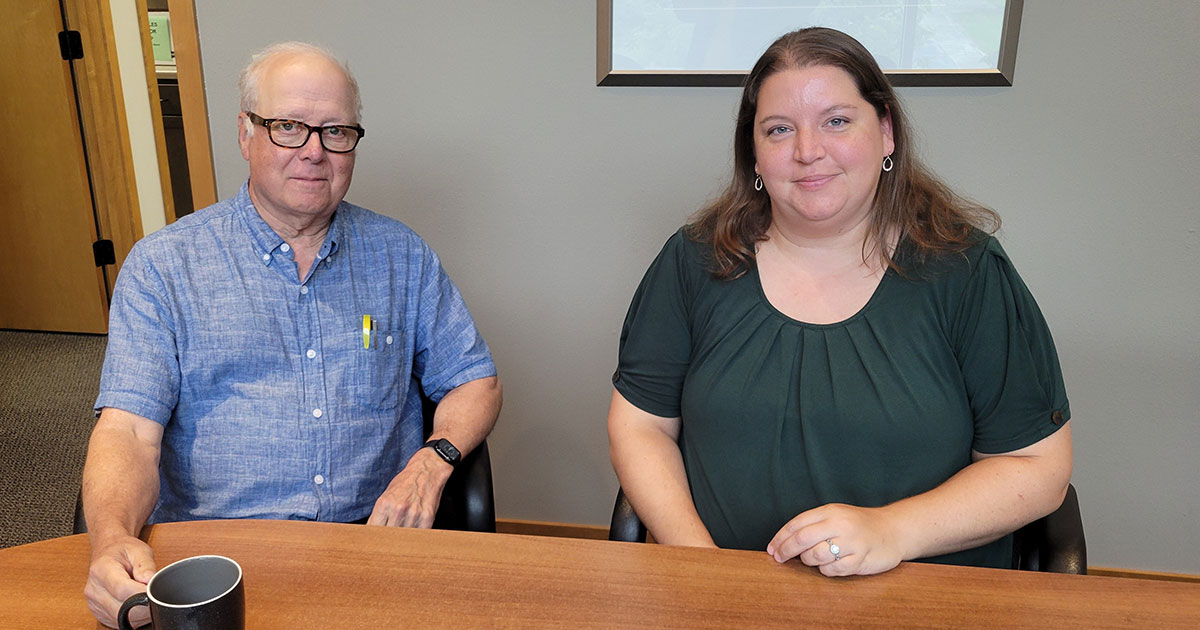
Mount Horeb attorney Mark Rooney (left) with paralegal Ashley Kempf (right), who became the first SBWCP to be certified by the new General Certification Test.
Feb. 4, 2026 – Attorneys – let’s be honest. Aren’t there tasks you could do, but you know your paralegal can do them better (and probably faster)?
Attorneys working with paralegals know their paralegals are essential to their practice. As Atty. Mark Rooney, who runs a solo practice in Mount Horeb, says: Paralegals are needed in his practice for many reasons, including “to keep me on track and check for drafting errors,” to help keep his office organized and running smoothly, and perhaps most importantly: “to suggest better ways to do things.”
His paralegal is Ashley Kempf, who became a
State Bar of Wisconsin Certified Paralegal™ last year through the program’s new General Certification Test.
The test is a component of
the three separate pathways to becoming an SBWCP paralegal – the pathways allow for those with varying education and work experience to obtain certification. The test is a required component for two of the three pathways.
Why Certification?
By becoming certified through the SBWCP program, paralegals like Kempf showcase their dedication to professional growth and their commitment to excellence in the legal field. This credential affirms their role as knowledgeable and dependable partners in the legal process.
 Shannon Green is communications writer for the State Bar of Wisconsin, Madison. She can be reached by
email or by phone at (608) 250-6135.
Shannon Green is communications writer for the State Bar of Wisconsin, Madison. She can be reached by
email or by phone at (608) 250-6135.
It also is an opportunity for attorneys to invest in paralegals, to deepen their firm’s knowledge and strengthen its service to clients.
A State Bar of Wisconsin Certified Paralegal (SBWCP™) signals that the paralegal has Wisconsin-specific legal knowledge, including ethics, substantive law, and procedural competency, which can reduce the level of attorney oversight needed for substantive tasks and free attorneys to focus on strategy and advocacy.
The State Bar offers
three pathways to certification:
paralegal education plus experience (a paralegal studies degree from a qualified Wisconsin program plus 2,000-4,000 hours of substantive experience);
paralegal education plus exam (21 credits of Wisconsin-focused continuing education (paralegal or legal) (CLE) plus the General Certification Exam); or
other education plus coursework plus exam (at least 18 credits in paralegal courses plus the General Certification Exam).
Certified paralegals maintain the credential with 15 CLE hours every two years, including three ethics credits, ensuring they are up to date. For more details on eligibility and how to obtain certification,
visit the information page on paralegal certification on WisBar.org.
The State Bar Offers the Gamut of CLE Programs for Paralegals
Whether or not your paralegal is certified, these CLE program will boost their skills and your office’s efficiency.
Here are new programs available now – more will be out soon.
Visit this page on WisBar’s Marketplace for the full selection of paralegal CLE from State Bar of Wisconsin PINNACLE™.
 The Nuts & Bolts of GenAI Legal Work: Ethics, Efficiency, and Practical Tips 2026
1.0 CLE, 1.0 EPR, 1.0 LPM. Available via webcast on specific dates through August 2026.
This CLE program examines how generative AI models fit into day-to-day legal work – providing clarity on what AI can do well, where it falls short, and how to use it as a support tool – not a shortcut – in everyday work.
 eDiscovery & AI for Paralegals 2026
1.0 CLE. Available via webcast on select dates through July 2026.
Discovery is about managing vast amounts of electronically stored information (ESI) under tight deadlines and complex rules. And new tools – including artificial intelligence (AI) – are changing how discovery tasks get done.
eDiscovery and AI for Paralegals focuses on the day-to-day realities of electronic discovery work and the decisions that come with it. Learn what to watch for and how to apply discovery rules and technology in ways that support attorneys and protect the cases you’re working on.
 The Paralegal Power-Up: Advanced Estate Planning & Administration Strategies 2026
4.0 CLE. Available via webcast on select dates through June 2026.
This CLE program focuses on real-world decisions, documentation challenges, and coordination issues that arise in the context of tax exposure, marital property concerns, contested claims, and sophisticated trusts – and on how paralegals can support attorneys effectively.
