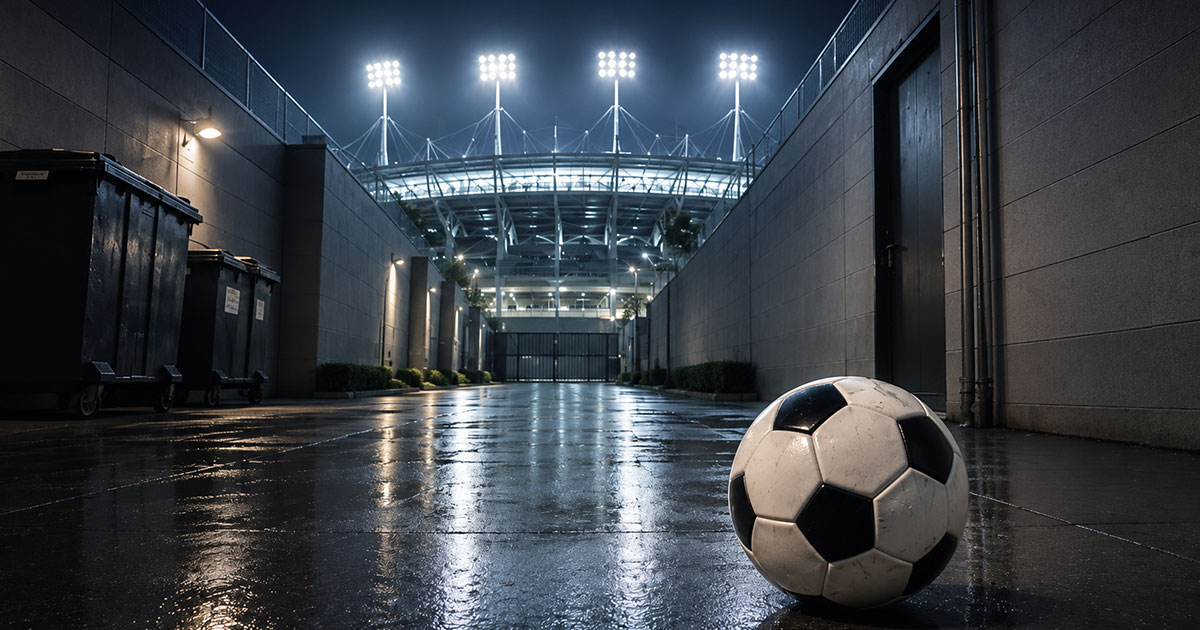
May 20, 2026 – Stadiums will erupt with cheers across the United States after the FIFA World Cup begins June 11.
A darker excitement may be unfolding behind the scenes.
Large sporting events that draw thousands of visitors to hotels and rideshares also attract human trafficking.[1]
Forced labor and sexual exploitation are no longer only criminal acts. The Trafficking Victims Protection Reauthorization Act (TVPRA) offers victims recovery against businesses that facilitated the crime.
“Mega-events involve thousands of temporary workers, volunteers, vendors, franchisees, and third-party partners operating across multiple jurisdictions. When responsibility is shared, accountability can become blurred, creating exposure across the ecosystem,” an international law firm recently advised.[2]
Victims’ claims have exploded this decade, especially against hotels, but with slim results because of franchising arrangements and limits to a traumatized victim’s memory.
A critical business defense requires employees trained to find victims in the crowd and help them.
‘A Complete Remedy’
Before the Trafficking Victims Protection Act (TVPA) took effect in 2000, human trafficking was not specifically a crime. Prohibitions against slavery provided the only means of enforcement.[3]
 Jay D. Jerde, Mitchell Hamline 2006, is a legal writer for the State Bar of Wisconsin, Madison. He can be reached by
email or by phone at (608) 250-6126.
Jay D. Jerde, Mitchell Hamline 2006, is a legal writer for the State Bar of Wisconsin, Madison. He can be reached by
email or by phone at (608) 250-6126.
States subsequently enacted their own human trafficking laws of varying strengths.[4] Wisconsin enacted its law, Wis. Stat.
section 940.302, in 2008.[5]
TVPA funding reauthorizations expanded its scope. The TVPRA of 2003 created civil recovery against the perpetrator for victims of slavery, forced labor, and sex trafficking. Recovery from others who profited from the crime came in 2008.[6]
Civil recovery aids victims by offering a fuller recovery for harm. Although
18 U.S.C. section 1593 requires restitution, the prosecutor controls that source.[7]
Many human trafficking crimes aren’t prosecuted, undermining the promise of restitution.[8]
A preference for conviction, perhaps gained by plea bargain, may come at the victim’s expense, justified by prosecutorial discretion.[9]
The perpetrator also may be judgment proof.
Sex trafficking victims initially didn’t sue. Eight years after the remedy became available in 2003, “practically no suits” had been filed.[10]
“In 2019, plaintiffs sued nearly three times as many defendants (257) for sex trafficking than the preceding four years combined (91), 46% of which (117) were hotels.” The next year, victims filed 149 cases, about half of which were against hotels.[11]
An American Law Review Annotation in early 2024 lists 155 TVPRA opinions from 2011 to 2024. Only 14 decisions date before 2020.[12]
The Southern District of Ohio had 45 pending cases by December 2024.[13]
A generous statute of limitation allows 10 years after the act or 10 years after the victim reaches 18 if trafficked as a minor.[14]
Contested Elements
The elements of a TVPRA civil claim[15] in
18 U.S.C. section 1595(a) include:
Knowingly benefited. Any rideshare that received a tip, any subcontractor that got paid, and any hotel proprietor that rented a room and knows a benefit was received.[16]
From participating in a venture. A venture can be nothing more than taking part “in a common undertaking or enterprise involving risk and potential profit,” especially in “a continuous business relationship” or “tacit agreement.” All that’s needed is “a desire to promote the wrongful venture’s success.”[17]
That venture violated the statute. At minimum “two or more individuals associated in fact” in any venture – not necessarily a “sex trafficking venture” – violated the TVPRA.[18]
The defendant knew or should have known that the venture violated the statute. At minimum, “the defendant had constructive knowledge that a venture
generally has violated” the TVPRA. Knowledge of a specific victim is not necessary.[19]
What to Look For
The National Human Trafficking Resource Center identified nine “key indicators of sex trafficking in hotels”:
“rooms paid for in cash.”
“heavy foot traffic in and out of the room.”
“victims dressed inappropriately for the climate.”
“frequent requests for new linens and towels.”
“presence of excessive alcohol, drugs, or sex paraphernalia.”
“signs of physical or sexual abuse.”
“signs of poor hygiene, malnourishment, or fatigue.”
“a guest with a lack of control of money, identification, [or] their phone.”
“guests that exhibit fearful, anxious, or submissive behavior.”[20]
‘Participation in a Venture’
An early U.S. Court of Appeals decision,
Ricchio v. McLean, found a connection when the sex trafficker and the hotel owner “exchang[ed] high-fives in the motel’s parking lot while speaking about ‘getting this thing going again.’”[21]
“[T]he district court found it ‘meaningless.’”
Associate Justice David Souter read it “in light of the allegations of the Patels’ complaisance in response to the several alleged exhibitions of [Clark] McLean’s coercive and brutal behavior to a physically deteriorating [Lisa] Ricchio, who pleaded for help.”[22]
The Seventh Circuit applied the TVPRA to Salesforce.com, Inc. for its relationship with Backpage.com, known for generating “more than 99% of its revenue from ‘adult advertisements,’ including those offering minors for sex.”[23]
The victim had been advertised on the site starting at age 13.[24]
Salesforce “sold … software designed specifically for Backpage and provided affirmative, personalized support” that was “ongoing.” Salesforce consulted with Backpage about once a year about its business.[25]
These activities tied Salesforce to the illegal venture.[26]
A.G. v. Northbrook Industries, Inc., released March 30, signaled a change sought by the district court that found itself constrained by harsh Eleventh Circuit precedent.[27]
At one hotel, the trafficker persuaded the front desk employee to allow the victims back into the room after they were locked out. The victims’ names weren’t on the registration, and they didn’t need to show identification.[28]
The reviewing court saw the incident as “an example of ‘something more’ than merely renting rooms to sex traffickers.”[29]
Another hotel had a policy of placing “sex offenders” in a separate building. The owner told a housekeeper, “[t]he only way you going to make some money, you got to get these girls back up here working.”[30]
These facts, among others, the Eleventh Circuit held “sufficient to establish ‘participation in a venture.’”[31]
‘Re-traumatization’?
A victim claimed she had been trafficked in several hotels near the Seattle-Tacoma International Airport. Hotel records revealed otherwise. The court had no alternative but to grant defendants’ summary judgment.[32]
“There is no serious dispute that S.A.S. was a victim of sex trafficking,” the court said, “Nor is it questioned that S.A.S. has difficulty recalling the timeline of what she endured because of the traumatic nature of those events.”[33]
Critical commentary highlights the unaddressed limitations caused by victim trauma.
One can spot a human trafficking victim by “[s]igns of disorientation, confusion, or mental/physical abuse.”[34]
A victim may not pin events precisely to a place and time even when they’re happening.
“In some cases, victims may be too traumatized to recall the facts reliably, or if they can, recalling their experiences leads to re-traumatization,” Theodore R. Sangalis wrote in
Fordham Law Review.
“In recounting events, they may lose track of time or forget significant portions of their days. Sometimes they have simply suppressed the memories of their abuse and need time and care to recount their story.”[35]
Victims not legally in the United States have it worse. A police encounter is scarier. Enforcement requires cooperation with multiple federal agencies.[36] Merely being sexually trafficked at a hotel isn’t enough to prove the hotel bore any fault.
Endnotes
[1] Judge Stephanie Domitrovich,
Rideshares, Air Carriers, and Hotels, 60 No. 2 Judges’ J., Spring 2021, at 35, 35 (explaining that “high-profile events can be accompanied by nefarious activities such as human trafficking … to attract customers for exploiting victims”); Ashley R. Lynam, Claire M. Lesikar & Louise Skinner,
Beyond the Games: The Overlooked Sexual Abuse and Trafficking Risks of Mega-Sporting Events, Morgan Lewis & Bockius LLP, Mar. 6, 2026,
https://www.morganlewis.com/pubs/2026/03/beyond-the-games-the-overlooked-sexual-abuse-and-trafficking-risks-of-mega-sporting-events (last visited May 7, 2026) (noting “recently expanding use of the Trafficking Victims Protection Act”).
^
[2] Lynam,
supra note 1.
^
[3] Maxime A. Kasznia,
From Hotel Rooms to the Courtroom: Civil Remedies for Sex Trafficking Victims, 27 J. Gender Race & Just. 185, 192-193 (Winter 2024).
^
[4]
Id. at 197; Lori Nazry Ross,
See No Evil: A Look at Florida’s Legislative Response to Holding Hotels Civilly Liable for ‘Turning a Blind Eye’ to the Sex Trafficking Monster Hiding Behind Closed Doors, N.Y.U. J. Legis. & Pub. Pol’y 375 (2019-20) (describing state laws).
^
[5]
See also2007 Wis. Act 116 (published Apr. 2, 2008).
^
[6]
18 U.S.C. § 1595 and Editorial Notes; Chelsea Caplinger,
The Trafficking Victims Protection Act (TVPA): A Brief Summary of Each Authorization, Human Trafficking Search,
https://humantraffickingsearch.org/wp-content/uploads/2021/08/TVPA-Summary-HTS-2021.pdf (last visited May 7, 2026).
^
[7] Theodore R. Sangalis,
Elusive Empowerment: Compensating the Sex Trafficked Person Under the Trafficking Victims Protection Act, 80 Fordham L. Rev. 403, 419, 425-27 (2011) (explaining that while the TVPRA requires restitution, “a civil remedy gives the trafficked person control over the legal process”); Tessa Zavislan,
Inhospitable: Third Party Liability for Sex Trafficking in the Hospitality Sector, 71 Am. U. L. Rev. F. 137, 166-68 (Apr. 2022) (describing the TVPRA as “the most holistic theory of liability for survivors of sex trafficking. Trafficking survivors can seek a complete remedy using the TVPRA”); Sarah C. Pierce, Student Note:
Turning a Blind Eye: U.S. Corporate Involvement in Modern Day Slavery, 14 J. Gender Race & Just. 577, 585 (2011) (quoting scholarly commentary that prosecutors focus on conviction instead of restitution).
^
[8] Pierce,
supra note 7, at 578-79 (stating “the vast majority of trafficking cases go unprosecuted” and that prosecution against culpable corporations “is even rarer”).
^
[9] Sangalis,
supra note 7,
at 424-26 (explaining that “[t]he prosecutorial priority of obtaining a conviction may obscure a victim’s immediate need for housing or other services more immediately” and “its adequacy largely depends on the prosecutor’s aggressiveness”); Zavislan,
supra note 7, at 167-68 (stating that “although the TVPA requires mandatory restitution in criminal cases, survivors of trafficking rarely receive any money”); Pierce,
supra note 7, at 585 (detailing that “a restitution award depends largely on the aggressiveness of the prosecutor and the court to inform the criminal defendant” but because “prosecutors are mostly focused on incarceration, restitution is easily forgotten to the detriment of the victim”).
^
[10] Sangalis,
supra note 7, at 427.
^
[11] Kasznia,
supra note 3, at 191, 196, 201-02.
^
[12] Theodore Z. Wyman, Annotation,
Civil Remedies for Sex Trafficking Under Trafficking Victims Protection Reauthorization Act (TVPRA), 18 U.S.C.A. § 1595, 91 A.L.R. Fed. 3d Art. 1 (2024) (providing search terms for any update to start after Feb. 14, 2024).
^
[13]
In re Hotel TVPRA Litigation, 2024 WL 4945135, at *1 (S.D. Ohio, Dec. 3, 2024) (deciding motion for reconsideration affecting 24 cases).
^
[14]
18 U.S.C. § 1595(c); Zavislan,
supra note 7, at 167 (describing the statute of limitation as “longer than many state statutes and increases the ability for survivors to recover”).
^
[15]
G.G. v. Salesforce.com, Inc., 76 F.4th 544, 553 (7th Cir. 2023);
Doe #1 v. Red Roof Inns, Inc., 21 F.4th 714, 723 (11th Cir. 2021).
^
[16]
Salesforce, 76 F.4th at 564 (requiring “only that the defendant was aware that it was benefitting in some way from its participation in the venture. That’s it.”);
Red Roof, 21 F.4th at 723-24.
^
[17]
Salesforce, 76 F.4th at 559-60;
A.G. v. Northbrook Indus., Inc., 171 F.4th 1257, 1268 (11th Cir. 2026) (quoting
Red Roof, 21 F.4th at 725).
^
[18]
Salesforce, 76 F.4th at 553-54 (concluding that the definition of “venture” for civil liability cannot “be any more demanding than ‘venture’” defined in the criminal statute of
18 U.S.C. § 1591);
cf. Northbrook, 171 F.4th at 1268 (declining “to transpose § 1591’s [criminal] definition of venture to § 1595” civil remedy).
^
[19]
Salesforce, 76 F.4th at 558;
seeNorthbrook, 171 F.4th at 1270 (explaining that in
Red Roof, the plaintiff failed to allege an element and that the TVPRA does not require “defendant’s knowledge that the common enterprise engaged in a TVPRA violation
as to the victim”).
^
[20] Kasznia,
supra note 3, at 191-92;
see also Janise Macanas,
A Primer For Recognizing and
Supporting Utah Victims of Human Trafficking, 28 Utah B.J., July/Aug. 2015, at 22, 22-23 (describing indicators that may be seen in court, including individuals appearing disconnected from family, friends, or community, and “[s]igns of disorientation, confusion, or mental/physical abuse”); Zavislan,
supra note 7, at 143-44 (adding “women without suitcases accompanied by older men,” and “refusal of cleaning services”).
^
[21]
Ricchio v. McLean, 853 F.3d 553, 555 (1st Cir. 2017).
^
[22]
Id. at 557.
^
[23]
Salesforce, 76 F.4th at 549, 555.
^
[24]
Id. at 549.
^
[25]
Id. at 549-50.
^
[26]
Id. at 559-63.
^
[27]
C.B. v. Naseeb Investments, Inc., 748 F. Supp. 3d 1338, 1362-63 (N.D. Ga. 2024) (concluding “the issues posed in this case also suggest the need for further consideration of the rigid legal standards” of Eleventh Circuit precedent).
^
[28]
Northbrook, 171 F.4th at 1264, 1271.
^
[29]
Id. at 1271.
^
[30]
Id. at 1265-66, 1272;
see also Naseeb, 748 F. Supp. 3d at 1341-50 (providing detailed facts showing hotel connection with traffickers).
^
[31]
Id. at 1273.
^
[32]
Doe (S.A.S.) v. Hilton
Domestic Operating Co. Inc., 795 F. Supp. 3d 1294, 1297, 1306-09 (W.D. Wash. 2025).
^
[33]
Id. at 1298.
^
[34] Macanas,
supra note 20, at 22.
^
[35] Sangalis,
supra note 7, at 417.
^
[36]
Id. at 404-05, 415-17.
^
