Feb. 11, 2026 – “[T]ens of thousands of criminal aliens remain in the United States,” and “[w]here there is an increase in criminal aliens, there is likely to be an increase in criminal activity,” said Kristi Noem, secretary of the Department of Homeland Security (DHS).
Immigration and Customs Enforcement (ICE) “continue to prioritize the need to remove criminal aliens rather than divert resources to detain aliens recently apprehended at the Southwest border,” Noem advised in extending the
Finding of Mass Influx of Aliens.
“Between April 1 and August 31, 2025, ICE arrested 84,215 aliens with criminal convictions or pending criminal charges, 502 arrested aliens were known or suspected terrorists, and 2,356 arrested aliens were suspected gang members.
“During this period, ICE removed 85,249 aliens with criminal convictions, 561 aliens that were known or suspected terrorists, and 2,651 suspected gang members.”
“[I]ncreased enforcement efforts in the interior have resulted in large numbers of aliens” arrested, which has made ICE conspicuous.
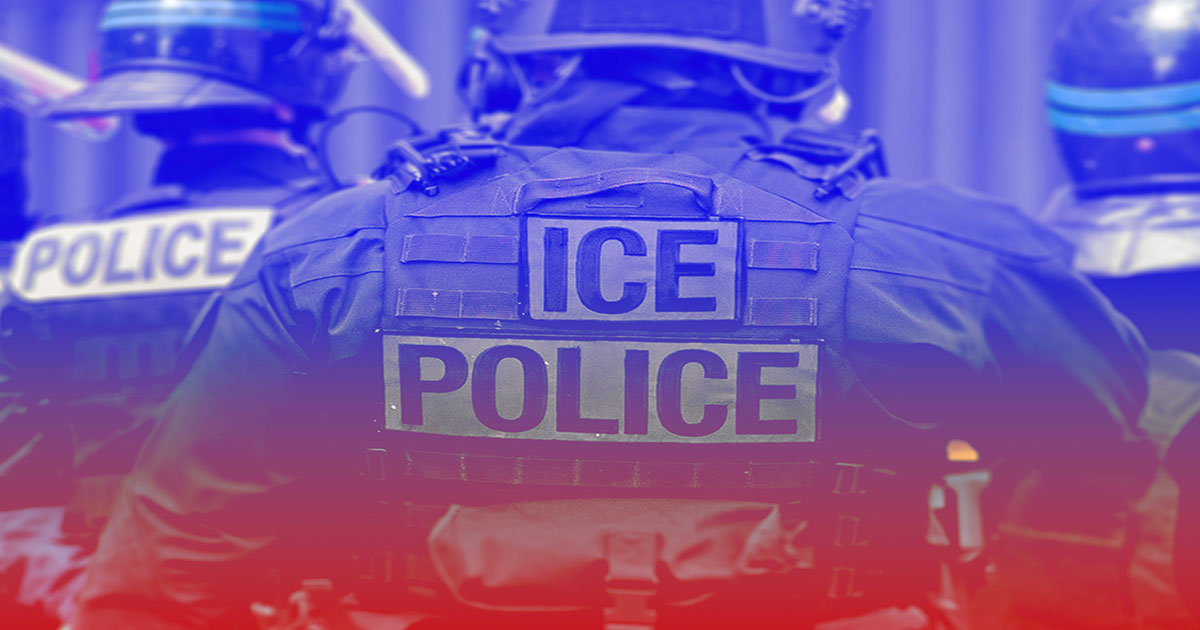
ICE officers are federal law enforcement. How do they differ from the police officers on the street, especially for citizens?
Alphabet Soup
Immigration enforcement falls within DHS, an agency created by the
Homeland Security Act of 2002 to coordinate intelligence for more unified, effective protection against threats.
 Jay D. Jerde, Mitchell Hamline 2006, is a legal writer for the State Bar of Wisconsin, Madison. He can be reached
by email or by phone at (608) 250-6126.
Jay D. Jerde, Mitchell Hamline 2006, is a legal writer for the State Bar of Wisconsin, Madison. He can be reached
by email or by phone at (608) 250-6126.
DHS’s website explains that the effort combined 22 federal departments and agencies, resulting in a sprawling department whose
organization chart shows 26 major subdivisions.
DHS handles citizenship and enforcement. The public interacts with the agency at a Transportation Security Administration (TSA) airport checkpoint. The U.S. Coast Guard and Secret Service are other agencies within DHS.
What the public may remember as the Border Patrol is within U.S. Customs and Border Protection. CBP primarily operates within 100 miles of the border.[1]
ICE operates under two primary groups. Homeland Security Investigations (HSI) tackle crimes across international borders, such as drugs, gangs, and human trafficking.
Enforcement and Removal Operations (ERO) apprehend criminal aliens throughout the country. They are the officers who have made ICE conspicuous.
Mass Influx
Since Jan. 23, 2025, DHS has operated under a Finding of Mass Influx of Aliens, which provides justification for the need for help from the U.S. Attorney General and state and local law enforcement.[2]
Tied into the finding is the existence of an immigration emergency – an event that promises to render conditions “beyond the existing capabilities” of immigration authorities creating risks for increased crime.
Although such findings address border conditions, the most recent finding published in the
Federal Register documents both the threat and the lack of human resources available to DHS to manage the situation.
In addition to the numbers of criminal aliens, the finding points out that, as of Sept. 22, ICE had 6,204 ERO officers – and 9,960 vacancies, a 61% vacancy rate.
The high number of vacancies resulted from the
One Big Beautiful Bill Act’s mandate to increase staffing by 8,125 ICE officers through 2029 – including 2,500 new hires in the fiscal year that ended Sept. 30.
The Act provided $9.5 billion for recruitment, salaries, and retention and signing bonuses.[3]
Uniform Rule
The U.S. Constitution delegates to Congress “Power … [t]o establish a uniform Rule of Naturalization.”[4]
James Madison revealed that the provision addressed an ambiguity in the Articles of Confederation that could mean each state could create its own standards for naturalization.[5]
The differences could make a naturalized citizen in one state an illegal alien in another.
Madison’s cohort, Alexander Hamilton, emphasized that the language demonstrates Congress’ “exclusive” power, “because if each state had power to prescribe A DISTINCT RULE, there could not be a UNIFORM RULE.”[6]
Since 1952, the uniform law is the Immigration and Nationality Act (INA), 8 U.S.C. sections
1101-1537, a comprehensive, frequently amended, prolix law, that by its defining terms governs aliens.
An “alien” under the Act “means any person not a citizen or national of the United States.”[7]
Three Types of Violation
The obvious violations of INA enforceable by ICE’s ERO are aliens who are here illegally or who have extended their stay beyond when they were permitted.[7]
A U.S. citizen can be a legitimate target of immigration enforcement.[9]
Such violations could include bringing in aliens illegally, concealing or harboring illegal aliens, knowingly hiring at least 10 individuals in a year with actual knowledge they are aliens, hiring or recruiting known aliens, continuing to employ people who have stayed beyond authorization, assisting to bring in an illegal alien, or bringing in aliens for prostitution or “immoral purposes.”[10]
Any vehicle used to bring in or harbor illegal aliens “shall be seized and subject to forfeiture.”[11]
Like any law enforcement officer, ERO officers don’t have to look away while a crime is being committed. “Immigration officers and U.S. Customs Agents are not limited to investigate solely for the presence of illegal aliens.”[12]
Statute empowers an officer while enforcing immigration laws to arrest people who may escape before a warrant can be obtained.[13]
The perpetrator must be committing a federal crime in the officer’s presence or when the officer “has reasonable grounds to believe that the person to be arrested has committed or is committing such a felony.”[14]
With increased enforcement, and crowds and confusion on the streets, the possibility isn’t remote.
“ICE records indicate that aliens assaulted or used force against 18 ICE [ERO] officers in August 2025,” Secretary Noem documented in the
Federal Register.
“In February 2025, ICE records indicated that aliens assaulted or used force against 10 ICE ERO officers” – an 80% increase over six months.
It’s a federal crime for anyone who “forcibly assaults, resists, opposes, impedes, intimidates, or interferes with” a federal officer who is “engaged in or on account of the performance of official duties.”[15]
Echoes of this law appear regularly in advice to individuals who want to protest against ICE to avoid interfering with officers.
Pending cases in Los Angeles, Chicago, and Minneapolis claim that citizens weren’t interfering but were nonetheless targeted.
The specific groups varied by case – press, legal observers, protesters, or religious practitioners. The stories allege ICE indiscriminately fired pepper balls, tear gas, and rubber bullets, resulting in First, Fourth, and Fifth Amendment violations.[16]
Excessive force and unlawful detentions and arrests also figure in the claims in Minneapolis.[17]
‘Reason to Believe’
Before any ICE officer gets a badge or a gun, he or she must complete 22 weeks of basic training at the
Federal Law Enforcement Training Center at Glynco, Georgia.
Before any interrogation, arrest, search, or use of force, the officer must have completed “basic immigration law enforcement training.”[18]
A key phrase in those powers is “reason to believe” or “reasonable grounds to believe.” “Reasonable suspicion” limits interrogation of an individual not under arrest.[19]
The foremost case governing Fourth Amendment requirements in immigration enforcement,
U.S. v. Brignoni-Ponce, 422 U.S. 873 (1975), translates those statutory terms.
Border Patrol officers who parked their car on Interstate Highway 5 south of San Clemente, California, stopped a car only because “its three occupants appeared to be of Mexican descent.” The passengers were illegal aliens.
Felix Humberto Brignoni-Ponce challenged the evidence as an illegal seizure. The Court agreed.
An immigration officer may stop a car to ask questions of nationality but only if justified on reasonable suspicion under
Terry v. Ohio, 392 U.S. 1 (1968), the Court held.
In fact, “the nature of illegal alien traffic and the characteristics of smuggling operations tend to generate articulable grounds for identifying violators,” Justice Lewis F. Powell Jr. wrote in the unanimous decision. He provided examples of suitable factors.
Although
Brignoni-Ponce established a
Terry stop in vehicular immigration enforcement, the Court began its analysis stating, “[t]he Fourth Amendment applies to all seizures of the person.”
Subsequent courts have clarified that
Brignoni-Ponce holds that the immigration term “reason to believe” means the same as probable cause.[20]
Citizens Swept Up?
If immigration enforcement ensnares a U.S. citizen, the full range of due process applies.
A judge, quoting the U.S. Supreme Court, explained in forwarding a
Bivens claim, “[i]n the exercise of its broad power over naturalization and immigration, Congress regularly makes rules that would be unacceptable if applied to citizens.”[21]
Bivens claims seek damages from officers who violated constitutional rights.[22]
Ada Morales, a naturalized U.S. citizen from Guatemala living in Rhode Island, filed a
Bivens claim against ICE officers who twice detained her – and upon release warned, “it could happen again in the future.”[23]
The U.S. Circuit Court for the First Circuit denied qualified immunity, an element in a
Bivens claim, to the ICE officers responsible for the detainer.[24]
In Los Angeles, U.S. citizens sued DHS for Fourth Amendment violations last summer from ICE activity.
Plaintiffs alleged masked ICE agents without warrants physically subdued them without asking a question. ICE asked for identification only after it transported them to a CVS parking lot. Agents refused to believe legitimate identification.[25]
The U.S. District Court granted a temporary restraining order (TRO) prohibiting detentive stops without reasonable suspicion, which the court held requires more than the four factors allegedly used in the stops.[26]
Plaintiffs alleged that ICE used only four factors – race or ethnicity, speaking Spanish or accented English, at bus stops, car washes, and places where laborers gathered, and locations of certain types of work.
The government appealed. The U.S. Supreme Court on a 4-3 vote reversed the TRO in
Noem v. Vasquez Perdomo, 146 S. Ct. 1 (2025).
Justice Sonia Sotomayor’s dissent, joined by Justice Elena Kagan and Justice Ketanji Brown Jackson, considered the alleged four factors unconstitutionally overinclusive.
The dissent explained that in central Los Angeles, nearly 47% of the population is Hispanic or Latino and more than 37% speaks Spanish at home.
The ICE encounters had less talk and more action, the dissent summarized. ICE seized citizens “on sight, often before asking a single question.”
The merits of this case, like others in Los Angeles, Chicago, and Minneapolis, await trial.
Endnotes
[1]
8 U.S.C. section 1357(a)(3) (granting powers for searches of aliens without a warrant within reasonable distance of the border);
8 C.F.R. section 287.1(a)(2) (setting “reasonable distance” as “within 100 air miles from any external boundary of the United States”).
[2]
See8 U.S.C. section 1103(a)(10) (authorizing Attorney General to obtain state or local law enforcement assistance upon determination of “actual or imminent mass influx of aliens”); 28 C.F.R. sections
65.80-65.83 (setting standards for immigration emergency and allowing authorization of state or local law enforcement officers).
[3]
One Big Beautiful Bill Act, Pub. L. No. 119-21, sections 70102-70104 (2025).
[4] U.S. Const., article I, section 8, clause 4.
[5]
The Federalist No. 42, at 269-71 (James Madison) (Clinton Rossiter ed., 1961).
[6]
The Federalist No. 32, at 199 (Alexander Hamilton) (Clinton Rossiter ed., 1961).
[7]
8 U.S.C. section 1101(a)(3).
[8]
8 U.S.C. section 1324d (failure to comply with order of removal);
8 U.S.C. section 1325 (improper entry of alien);
8 U.S.C. section 1326 (reentry of an alien previously removed from the United States).
[9]
See8 U.S.C. section 1357(a)(4) (authorizing officers without warrants “to make arrests for felonies which have been committed and which are cognizable under any law of the United States regulating the admission, exclusion, expulsion, or removal of aliens.”).
[10]
8 U.S.C. section 1323;
8 U.S.C. section 1324(a)(1)-(2);
8 U.S.C. section 1324(a)(3);
8 U.S.C. section 1324a(1)-(2);
8 U.S.C. section 1327;
8 U.S.C. section 1328.
[11]
8 U.S.C. section 1324(b).
[12]
U.S. v. McCormick, 468 F.2d 68, 73 (10th Cir. 1972).
[13]
8 U.S.C. section 1357(a)(5).
[14]
Id.
[15]
18 U.S.C. section 111(a).
[16]
Los Angeles Press Club v. Noem, 799 F. Supp. 3d 1036 (C.D. Cal. 2025);
Chicago Headline Club v. Noem, 2025 WL 3240782 (N.D. Ill. 2025);
Tincher v. Noem, 2026 WL 125375 (D. Minn. 2026).
[17]
Tincher, 2026 WL 125375.
[18]
8 C.F.R. section 287.1(g) (defining “basic immigration law enforcement training”);
8 C.F.R. section 287.5 (authorizing exercise of power contingent on passing basic law enforcement training);
8 C.F.R. section 287.8 (establishing standards for use of force by designated officers).
[19]
8 U.S.C. section 1357(a)(4)-(5) (allowing arrests without warrants);
8 C.F.R. section 287.8(a)-(c) (regarding use of force, interrogations, and arrests).
[20]Morales v. Chadbourne, 793 F.3d 208, 216 (1st Cir. 2015) (citing cases in Seventh, Eighth, Ninth, and D.C. circuits).
[21]
Lyttle v. U.S., 867 F. Supp. 2d 1256, 1282 (M.D. Ga. 2012) (quoting
Demore v. Kim, 538 U.S. 510, 521 (2003), which quoted
Mathews v. Diaz, 426 U.S. 67, 79-80 (1976)).
[22]
Bivens v. Six Unknown Named Agents, 403 U.S. 388 (1971).
[23]
Morales, 793 F.3d at 212-13;
cf.,
Mendia v. Garcia, 165 F. Supp. 3d 861, 895 (N.D. Cal. 2016) (denying declaratory relief because, unlike in
Morales, plaintiff did not “explain why or how this is likely to occur again”).
[24]
Morales, 793 F.3d at 223.
[25]
Vasquez Perdomo v. Noem, 790 F. Supp. 3d 850, 868-70, 872 (C.D. Cal. 2025).
[26]
Id. at 873, 897.
