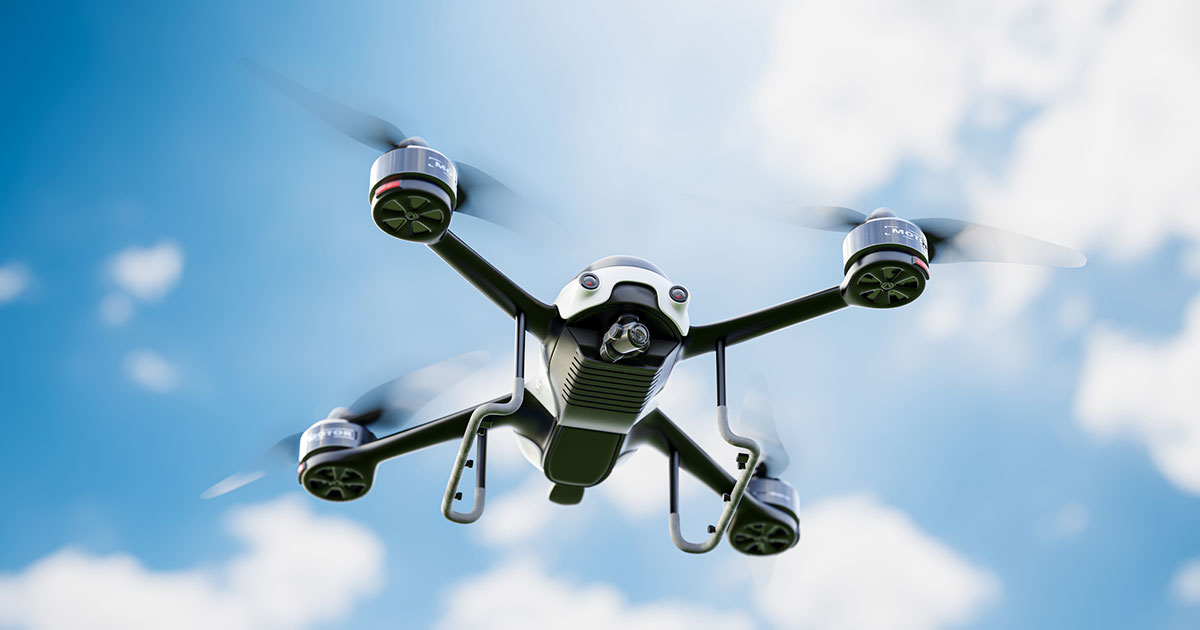
April 15, 2026 – The blue yonder in 2014 for drones has become less wild.
Twelve years ago, the Federal Aviation Administration (FAA) couldn’t license a commercial drone flight other than under airplane regulations. Recreational users could fly under a statutory exemption granted in 2012, using rules from the FAA’s model airplane Advisory Circular from 1981.[1]
The FAA had less than a year after the 2012 legislation to make a comprehensive plan and 18 months after that to promulgate regulations. The final small unmanned aircraft systems (UAS) rule, 14 C.F.R. Part 107, landed in 2016.[2]
The challenge now isn’t knowing what one may do in the absence of rules but knowing which rules apply.
What Kind of Flyer Are You?
Recreational drone owners have fewer responsibilities than drone pilots on commercial missions, but they still must follow rules.
 Jay D. Jerde, Mitchell Hamline 2006, is a legal writer for the State Bar of Wisconsin, Madison. He can be reached by email or by phone at (608) 250-6126.
Before one flies the drone, the owner may need to register it with the FAA. Only if the drone fully loaded weighs 0.55 pounds or less and is used for recreational purposes only, it doesn’t need to be registered.
If the recreational drone weighs more than that but less than 55 pounds fully loaded, the FAA requires registration, which the owner completes at the FAA website. The resulting registration number must appear legibly on the drone.
Most drones requiring registration also must broadcast a Remote ID signal, explained Ryan Seib of Assurity Legal LLC in Madison, who is also an airplane and drone pilot.
That can catch the amateur drone pilot off guard, especially with older craft that may need “a firmware update or external module” to comply with regulations.
Although a drone weighing at least 55 pounds may be used for recreational purposes, it needs an airplane registration number (an “N” number).[3]
The recreational owner still needs a license.
The FAA says, “it’s as easy as 1-2-3.” Learn the rules for recreational flyers on the FAA website and download the B4UFLY app. Pass The Recreational UAS Safety Test (TRUST). Download proof of passage and keep it handy while flying.
Rules of the Air
A recreational flyer must operate the drone consistently with safety guidelines of a community-based organization (CBO), a tax-exempt group the FAA recognizes that “further[s] … model aviation.”[4]
The FAA’s recommended safety guidelines for CBOs in Advisory Circular 91-57D cover more than six single-spaced pages, effectively providing for recreational flyers a simplified equivalent to the rules of the air.
Under the 49 U.S.C. section 44809(a) exception for recreational use, the flyer must operate the drone within unaided visual line of sight, fly no higher than 400 feet above the ground, “give[] way to any manned aircraft,” and stay out of restricted airspace.
Those restrictions may cover more airspace than one expects. Airports cause the most common limitation.
Wisconsin has about 122 airports, some of them grassy fields in the countryside but also including Fort McCoy at Sparta, Truax Field in Madison, and Volk Air Guard Base at Camp Douglas. They take a big bite out of the open Class G airspace allowed for drones.
Only 20 Wisconsin airports fall within the FAA’s Low Altitude Authorization and Notification Capability (LAANC), an easy way to obtain permission to fly within otherwise controlled airspace.
If the airport isn’t available through LAANC, a drone flyer obtains permission through FAADroneZone.
Where one may fly, however, changes. Temporary Flight Restrictions (TFRs) can arise from natural disasters, event security, or Air Force One. B4UFLY and LAANC are critical to keep up.
Flying for Profit
In the gig economy, one’s recreation may slip into commercial airspace.
Any drone use for gain – whether for money or volunteering – falls within the commercial side of drone regulations.[5] The simple request to check a roof or shoot wedding pictures may stray beyond recreational flight.
“Intent at takeoff matters,” Seib said. “The moment someone flies with any business purpose in mind – helping a friend with a real estate listing, monetizing YouTube footage, using images for a website, even indirect compensation – they are legally operating under Part 107 and need a remote pilot certificate.”
Commercial pilots operate under the small UAS rule. The rule specifies drone registration and a pilot test good for two years with 13 areas of knowledge.[6]
The rules reflect what an airplane pilot may be concerned with: preflight checklists, maintaining Air Traffic Control contact, managing in-flight emergencies, and reporting accidents.[7]
A commercial drone pilot may fly at night with a drone equipped with anti-collision lighting but always must stay within visual line of sight from the drone.[8]
Don’t Go There
Federal law criminalizes drone flights creating a safety hazard with any aircraft[9] and interfering with wildfire suppression, including law enforcement and emergency services.[10]
Drones are generally prohibited over professional sporting events, Washington, D.C., and national parks.[11] Flying over individuals or moving vehicles is restricted.[12]
“Many people also do not realize that state and local laws layer on top of FAA rules – privacy statutes, prison overflight bans, and voyeurism laws are relevant,” Seib said.
Wisconsin was the first state to criminalize flying a drone armed with a weapon.[13]
Nor can a drone pilot in Wisconsin invade an individual’s privacy. Law enforcement seeking to fly a drone in an area where the owner may have a reasonable expectation of privacy are required to get a search warrant.[14]
Other states have enacted similar laws. An Indiana man committed harassment under state statutes by hovering a drone over a neighbor while fishing, over the neighbor’s daughters while swimming, and by window peeping.[15]
In Wisconsin one cannot fly a drone over a correctional institution,[16] a sportsman can’t fish by using a drone,[17] and a pilot can’t use a drone to interfere with hunters.[18]
The pilot bears the presumption of liability for injuries and damage resulting from a crash.[19] A growing number of sources recommend obtaining specific drone insurance.[20]
A pilot’s homeowner’s insurance probably won’t cover a drone, which is an aircraft, Seib explained. “That leaves many users uninsured.”
Even with insurance, any flight not complying with FAA regulations wouldn’t be covered, Seib said.
State law prohibits flying a drone with a blood alcohol content as low as at 0.04%.[21]
Municipalities may set additional rules governing a drone’s effect on the ground – all laws that a drone flyer needs to check before taking even the smallest of drones into the air.[22]
Don’t Shoot the Drone or Attack the Pilot
In 2015, people asked whether a landowner may shoot down a drone.[23]
The issue shouldn’t have been uncertain, on the air or on the ground.
A drone is an aircraft. Federal law prohibits shooting down an aircraft. Violators face a fine and a maximum penalty of 20 years.[24]
A century ago, Congress ended the common law maxim predating Blackstone that land ownership extends from the center of the earth to the heavens. The Air Commerce Act of 1926 created “navigable airspace” under federal regulation.[25]
Radio jamming a drone – which also could cause it to crash – is another federal offense.[26]
In a physical altercation, an Ohio man was guilty of assault and theft after he confronted a drone flyer and slapped the control away. The control shattered; the drone flew uncontrolled. The drone was later found in the defendant’s fire pit.[27]
[1] FAA Modernization and Reform Act of 2012, Pub. L. No. 112-95, section 336, 126 Stat. 11, 77, 78, current version codified at 49 U.S.C. section 44809; Robert L. Ellis, Drones & the Law, S.C. Law. 42, 44-45 (May 2016); Raymond L. Mariani, Rise of the Drones, 43 Brief 18, 20-22 (Summer 2014). ^
[2] FAA Modernization and Reform Act of 2012, Pub. L. No. 112-95, section 332(a)-(b),126 Stat. 11, 73-74 (setting initial deadlines); Nancy K. Carr, Look! It’s a Bird! It’s a Plane! No, It’s a Trespassing Drone, 23 J. Tech. L. & Pol’y 147, 161 (2019) (providing history of rule). ^
[3] 49 U.S.C. section 44809(c)(3) (allowing recreational drones weighing at least 55 pounds to operate from a fixed site under community-based organization (CBO) limitations); 14 C.F.R. Part 47 (traditional aircraft regulations); 14 C.F.R. section 107.3 (placing a drone of at least 55 pounds outside the definition of a small unmanned aircraft). ^
[4] 49 US.C. section 44809(a)(2) (requiring operation under CBO safety guidelines); 49 US.C. section 44809(h) (defining CBOs). ^
[5] 49 U.S.C. section 44809(a)(1) (limiting exception to “aircraft … flown strictly for recreational purposes.”). ^
[6] 14 C.F.R. section 107.13 (requiring civil aircraft registration as required under 14 C.F.R. section 91.203(a)(2)); 14 C.F.R. section 107.65 (requiring “aeronautical knowledge recency”); 14 C.F.R. section 107.73 (listing 13 areas of knowledge). ^
[7] 14 C.F.R. section 107.9 (reporting accidents); 14 C.F.R. section 107.21 (handling in-flight emergencies); 14 C.F.R. section 107.41 (obtaining Air Traffic Control clearance); 14 C.F.R. section 107.49 (preflight checklists). ^
[8] 14 C.F.R. section 107.29 (anti-collision lighting); 14 C.F.R. section 107.31 (requiring visual line of sight with drone). ^
[9] 18 U.S.C. section 39B. ^
[10] 18 U.S.C. section 40A. ^
[11] FAA, Airspace Restrictions, https://www.faa.gov/uas/getting_started/where_can_i_fly/airspace_restrictions (last visited Mar. 30, 2026); Nat’l Park Serv., Unmanned Aircraft Systems (UAS), https://www.nps.gov/subjects/sound/uas.htm (last visited Mar. 30, 2026); ^
[12] 14 C.F.R. sections 107.100-.165 (limiting commercial flights over people); 14 C.F.R. section 107.145 (limiting commercial flights over vehicles); U.S. Dep’t of Transp., Advisory Circular 91-57D section 3.3.2.1.1.1 (June 24, 2025) (recommending CBOs establish restrictions). ^
[13] Mariani, supra note 1, at 22 (referring to Wis. Stat. section 941.292). ^
[14] Wis. Stat. section 175.55 (requiring warrant); Wis. Stat. section 942.10 (prohibiting private flights invading privacy). ^
[15] Scheel v. State, 235 N.E.3d 1278 (Ind. Ct. App. 2024). ^
[16] Wis. Stat. section 114.045. ^
[17] Wis. Admin. Code section NR 20.06(10). ^
[18] Wis. Stat. section 29.083(2)(a)(8). But see, Brown v. Kemp, 86 F.4th 745 (7th Cir. 2023) (holding unconstitutional under the First Amendment Wis. Stat. section 29.083(2)(a)(7) that prohibits talking with hunters). ^
[19] Wis. Stat. section 114.05. ^
[20] Mariani, supra note 1, at 25-26. ^
[21] Wis. Stat. section 114.09. ^
[22] Wis. Stat. section 114.105 (authorizing local regulations consistent with state aeronautics laws). ^
[23] See, e.g., Vivek Sehrawat, Liability Issue of Domestic Drones, 35 Santa Clara High Tech. L.J. 110, 127-29 (2018) (describing anti-drone weapons and 2015 downing of drone). ^
[24] 18 U.S.C. section 32(a). ^
[25] Act of May 20, 1926 (Air Commerce Act of 1926), Pub. L. No. 69-254, 44 Stat. 564. ^
[26] 47 U.S.C. section 333 (prohibiting willfully or maliciously interfering with radio communications that are federally authorized); Carr, supra, note 2 at 177 (describing prohibition of using advertised drone jamming products). ^
[27] State v. Newcomb, 237 N.E.3d 324, 328-31, 334, 336-38 (Ohio Ct. App. 2024). ^
