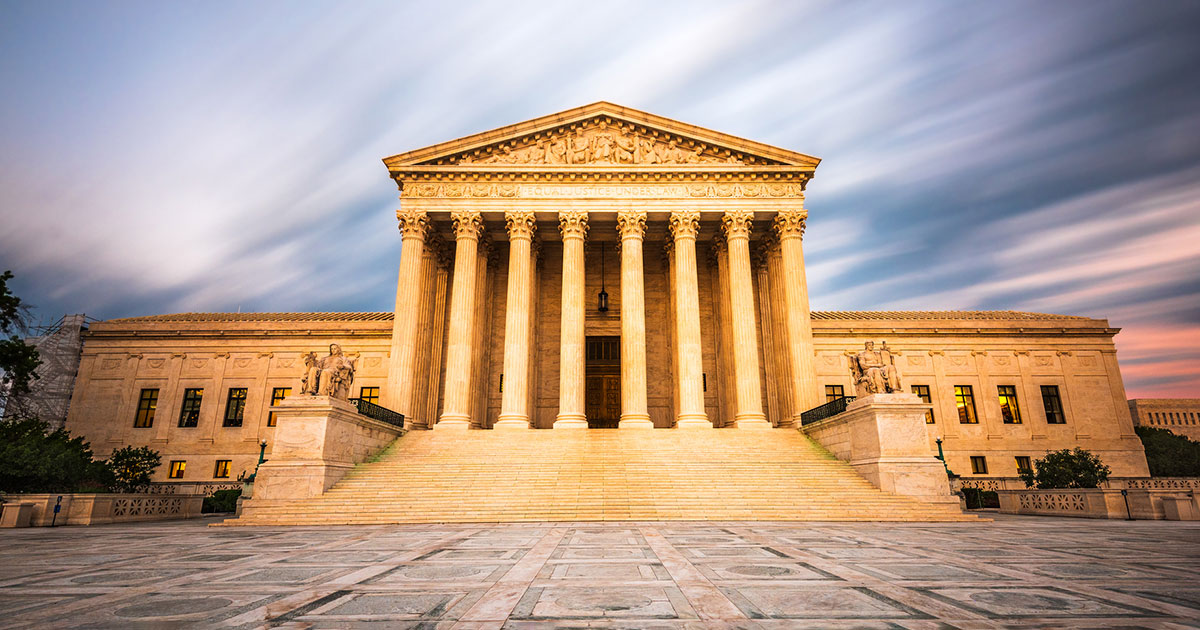
March 4, 2026 – As of Feb. 26, 2026, the U.S. Supreme Court has heard 38 cases, with 10 oral arguments scheduled for March and no cases set for argument but with petitions for review pending.
Major Decisions in February
Learning Resources, Inc. v. Trump (Feb. 20, 2026)
On appeal from the U.S. Court of Appeals for the District of Columbia Circuit, the Supreme Court affirmed (6-3), holding that the International Emergency Economic Powers Act (IEEPA) does not authorize the President to impose tariffs.
The authors. ROBERTS, C. J., announced the judgment of the Court and delivered the opinion of the Court with respect to Parts I, II – A – 1, and II – B, in which SOTOMAYOR, KAGAN, GORSUCH, BARRETT, and JACKSON, JJ., joined, and an opinion with respect to Parts II – A – 2 and III, in which GORSUCH and BARRETT, JJ., joined. GORSUCH, J., and BARRETT, J., filed concurring opinions. KAGAN, J., filed an opinion concurring in part and concurring in the judgment, in which SOTOMAYOR and JACKSON, JJ., joined. JACKSON, J., filed an opinion concurring in part and concurring in the judgment. THOMAS, J., filed a dissenting opinion. KAVANAUGH, J., filed a dissenting opinion, in which THOMAS and ALITO, JJ., joined.
U.S. Postal Service v. Konan (Feb. 24, 2026)
On appeal from the U.S. Court of Appeals for the Fifth Circuit, the Supreme Court vacated and remanded (5-4), holding that the United States retains sovereign immunity for claims arising out of the intentional nondelivery of mail because both “miscarriage” and “loss” of mail under the Federal Tort Claims Act’s (FTCA) postal exception can occur as a result of the Postal Service’s intentional failure to deliver the mail.
The authors. THOMAS, J., delivered the opinion of the Court, in which ROBERTS, C. J., and ALITO, KAVANAUGH, and BARRETT, JJ., joined. SOTOMAYOR, J., filed a dissenting opinion, in which KAGAN, GORSUCH, and JACKSON, JJ., joined.
Villarreal v. Texas (Feb. 25, 2026)
On appeal from the Court of Criminal Appeals of Texas, the Supreme Court affirmed (9-0), holding that a qualified conferral order that prohibits only discussion of the defendant’s testimony for its own sake during a mid-testimony overnight recess permissibly balances the defendant’s Sixth Amendment right to counsel against the burden of offering unaltered trial testimony and does not violate the Constitution.
The authors. JACKSON, J., delivered the opinion of the Court, in which ROBERTS, C. J., and ALITO, SOTOMAYOR, KAGAN, KAVANAUGH, and BARRETT, JJ., joined. ALITO, J., filed a concurring opinion. THOMAS, J., filed an opinion concurring in the judgment, in which GORSUCH, J., joined.
Featured February Oral Arguments
Havana Docks Corp. v. Royal Caribbean Cruises, Ltd. (argued Feb. 23, 2026)
Exxon Mobil Corp. v. Corporación Cimex, S.A. (Cuba) (argued Feb. 23, 2026)
Issues: Both cases evaluate claims under the Cuban Liberty and Democratic Solidarity (LIBERTAD) Act of 1996 (Helms-Burton Act) of property that the Cuban government expropriated from U.S. companies.
In
Havana Docks, the issue is whether a plaintiff must prove that the defendant trafficked in property confiscated by the Cuban government as to which the plaintiff owns a claim, or instead that the defendant trafficked in property that the plaintiff would have continued to own at the time of trafficking in a counterfactual world “as if there had been no expropriation.”
An American company built the docks at issue with rights to use them until at least 2004, but the Cuban Revolution intervened. The cruise line paid the Cuban government starting in 2015 for rights to use the docks.
In
Exxon Mobil, the issue is whether the Act abrogates foreign sovereign immunity in cases against Cuban instrumentalities, or whether parties proceeding under that act must also satisfy an exception under the Foreign Sovereign Immunities Act. The confiscated property was American-owned oil refineries and service stations transferred to Cuban state-owned companies.
That’s what Howe said: “In a pair of oral arguments …, the Supreme Court wrestled with disputes over whether U.S. companies can recover under U.S. law for losses resulting from the confiscation of property that they owned in Cuba more than 65 years ago. … In both cases, several justices had tough questions for both sides, and Chief Justice John Roberts was all but silent, making it difficult to predict how the court will rule.” – Amy Howe, SCOTUSblog
Pending Applications on the Interim Docket
Executive Action Cases Pending
Trump v. Slaughter: Under federal law, Federal Trade Commission commissioners can only be removed for “inefficiency, neglect of duty, or malfeasance in office.” The issue is whether these “for-cause” protections violate the separation of powers,
i.e., the President’s power to terminate members of the Executive Branch. The case involves the attempted firing of FTC commissioner Rebecca Slaughter.
Trump v. Cook: The Court is asked to block a federal court ruling that allowed Lisa Cook, a member of the Federal Reserve’s Board of Governors, to stay in office despite President Trump’s attempt to fire her. U.S. District Judge Jia Cobb initially ruled that Cook was “substantially likely” to succeed on the merits because of “for-cause” protections that apply only to conduct occurring in office. The U.S. Supreme Court deferred an application for stay pending oral argument on Jan. 21, 2026.
Trump v. Barbara: Whether a presidential executive order that would end the guarantee of citizenship for all persons born in the U.S. violates a provision of the U.S. Constitution’s Fourteenth Amendment, which says “[a]ll persons born or naturalized in the United States, and subject to the jurisdiction thereof, are citizens of the United States and of the State wherein they reside.”
