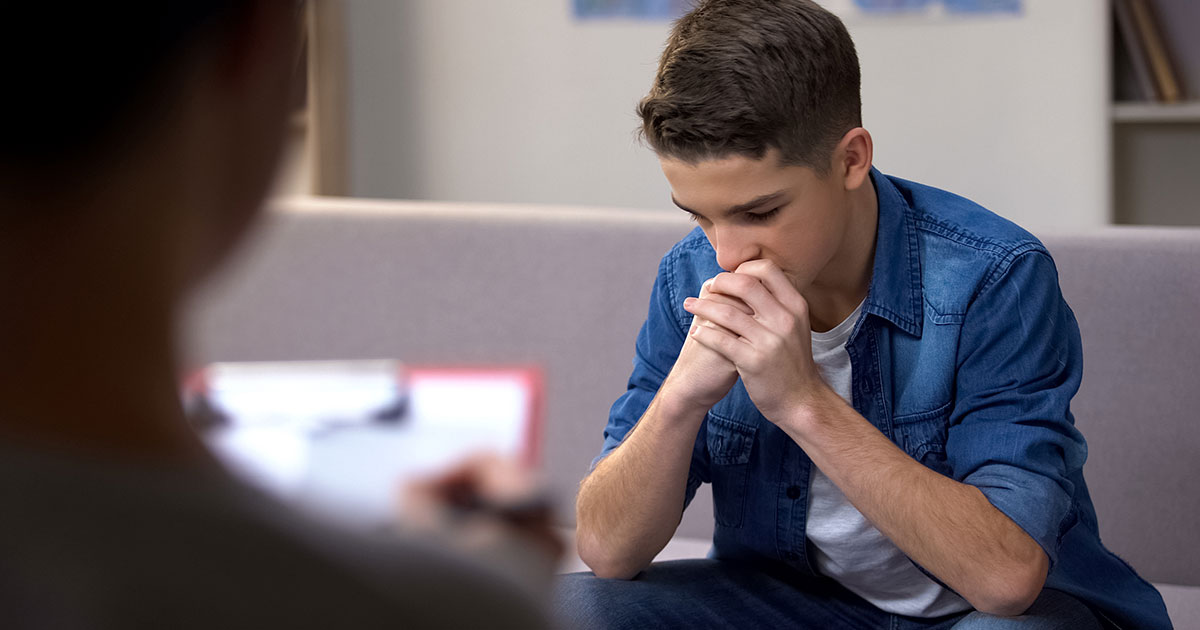
April 7, 2026 – A 12-year-old student deserved
Miranda protection for questioning in the tiny school resource officer’s (SRO) office and at an in-school suspension desk, a 4-3 Wisconsin Supreme Court majority held in
State v. K.R.C., 2026 WI 10.
But everyone on the Supreme Court affirmed the circuit court’s finding of delinquency.
The majority said it was harmless error. Other testimony sufficiently supported delinquency for fourth-degree sexual assault.
“In sum, the [SRO’s] testimony about Kevin’s statements was duplicative of other testimony, unnecessary for a finding of intent, and went unmentioned during the State’s closing,” wrote Justice Janet C. Protasiewicz for the majority, which included Chief Justice Jill J. Karofsky, Justice Rebecca Frank Dallet, and Justice Susan M. Crawford.
The concurrence saw no correlation between school conversations and the intimidating police tactics struck down in
Miranda v. Arizona, 384 U.S. 436 (1966).
“Kevin’s situation is not analogous to the coercive pressures that motivated the Court in
Miranda,” wrote Justice Brian K. Hagedorn in the concurrence joined by Justice Annette Kingsland Ziegler and Justice Rebecca Grassl Bradley.
“And while a trip to the office may cause an ordinary 12-year-old student to sweat, these run of the mill schoolhouse fears do not – at least under the facts here – require that the student be warned of his constitutional rights first.”
Called to the Office
A school administrator told Kevin (a pseudonym) to go to the SRO’s office after another student complained that Kevin had touched his groin. Kevin complied.
 Jay D. Jerde, Mitchell Hamline 2006, is a legal writer for the State Bar of Wisconsin, Madison. He can be reached by
email or by phone at (608) 250-6126.
Jay D. Jerde, Mitchell Hamline 2006, is a legal writer for the State Bar of Wisconsin, Madison. He can be reached by
email or by phone at (608) 250-6126.
The room was small. A police officer in uniform stood at the closed door. Kevin sat comfortably in front of the SRO, identified as police only by a vest over civilian clothes.
A sign near Kevin said “You Are in Here Voluntarily Unless Told Otherwise. You Are Being Filmed And Can Leave at Any Time!”
The conversation was calm. It lasted 10 minutes.
Adults surrounded Kevin an hour later, including two officers and the vice principal, while Kevin sat in an in-school suspension cubicle.
The three-minute conversation was “more direct.” The SRO may have raised her voice.
Kevin held to his story in both conversations. He might have accidentally hit the other student.
In the delinquency proceedings, the Manitowoc County Circuit Court allowed the SRO testimony, holding that “this was a non-custodial voluntary conversation.”
The trial included four witnesses. In addition to the SRO, testimony came from the victim, another classmate, and the assistant principal. The circuit court found Kevin delinquent.
The Wisconsin Court of Appeals affirmed “because Kevin was not in custody and that his statements were voluntary.”
Miranda in Schools
Miranda protects the Fifth Amendment right against self-incrimination. Without the standard warnings prescribed by
Miranda, a defendant’s statements while in police custody may be suppressed.
A
Miranda analysis involves two questions. Would “a reasonable person … have felt free to leave?” Did “the relevant environment present[] the same inherently coercive pressures as the type of station house questioning at issue in
Miranda?”
Age affects what is reasonable. “[C]hildren will often feel bound to submit to police questioning when an adult in the same circumstances would feel free to leave,” advises
J.D.B. v. North Carolina, 564 U.S. 261 (2011), which applied
Miranda in a school setting.
The majority interpreted the SRO office as “the schoolhouse version of a police-station interrogation room.” The SRO made deceptive statements, including reference to witnesses.
No one told Kevin he was free to leave or explained what the sign saying that he was free to leave meant to him. No one invited him to call his parents.
“To be sure, some factors cut against our conclusion,” the majority summarized, “but considering the totality of the circumstances we are nevertheless convinced that a reasonable 12-year-old would not feel free to leave the office.”
The second meeting, less than an hour later, happened in a more open space but restricted by surrounding adults at a school-suspension cubicle.
“Students do not feel free to walk out of suspension,” the majority said, concluding that this “closer call” remained a situation where Kevin did not feel free to leave.
The majority concluded that the brief time between encounters meant Kevin remained in custody between them.
Although the majority believed
Miranda warnings were necessary before those conversations, justifying suppressing Kevin’s statements to police, the SRO’s testimony from those interrogations was superfluous, the majority said.
Any evidence from Kevin’s conversations with the SRO “came in through the assistant principal” who heard the same story from Kevin outside police presence.
The victim testified that Kevin’s movement was intentional.
‘Ordinary Schoolhouse Questioning’
“In my view,” wrote Justice Hagedorn in concurrence, “the majority’s contrary view misses the forest for the trees, erroneously transforming a rather ordinary schoolhouse questioning (on a serious offense, to be sure) into a matter of constitutional moment.”
A focus on “how this interrogation compares to the station house questioning in
Miranda” is necessary, he advised.
Miranda is challenging to apply, Justice Hagedorn sympathized, especially “when the suspect is a minor.” Confusion grows from precedent that is “utterly irreconcilable.”
He admitted that the majority “presents a reasonable countervailing view.”
The concurrence pointed to the advice of
State v. Halverson, 2021 WI 7 ¶ 15, that the “anti-coercion objective is central to understanding”
Miranda.
In
Miranda, a defendant at a police station sat “in a room in which he was cut off from the outside world” facing “the danger of police brutality.”
In those conditions, the concurrence explained, time is on the side of police, who can patiently continue with “relentless questioning” to “erode the will of the accused.”
Not every police contact requires
Miranda warnings. A traffic stop – a brief, public encounter – doesn’t need one, nor does a
Terry stop.
An imprisoned individual needs no
Miranda warning. The prisoner has lost freedom already and has no hope from ending the conversation early. The prisoner has only the prospect of returning to a cell.
Such precedent applies here, the concurrence analogized.
“During the school day, a student’s freedom is always limited and subject to the direction of adults” – any adult in authority – “in whose care they have been entrusted,” the concurrence explained.
Nor was Kevin “‘whisked’ to the police station where the sudden ‘shock’ might overwhelm him.”
He was at his school around people he knew, the concurrence said, and “in the familiar student services office.”
In a school with a permanent SRO, Kevin wouldn’t “see SROs as unfamiliar and antagonistic adults,” the concurrence said.
Kevin could expect that after the conversation, the concurrence said, he would return to school. “At some point, the school day ends.”
Kevin had two brief conversations. His freedom to leave after the first one “is pretty sound evidence that he was not functionally under arrest,” the concurrence noted.
“Someone in Kevin’s shoes would certainly feel the weight of adult condemnation,” the concurrence summarized. “His conscience might even call him to come clean in the face of a serious infraction.
“But this normal human experience should not so quickly be placed on par with the uniquely coercive station house questioning to which
Miranda applies.”
