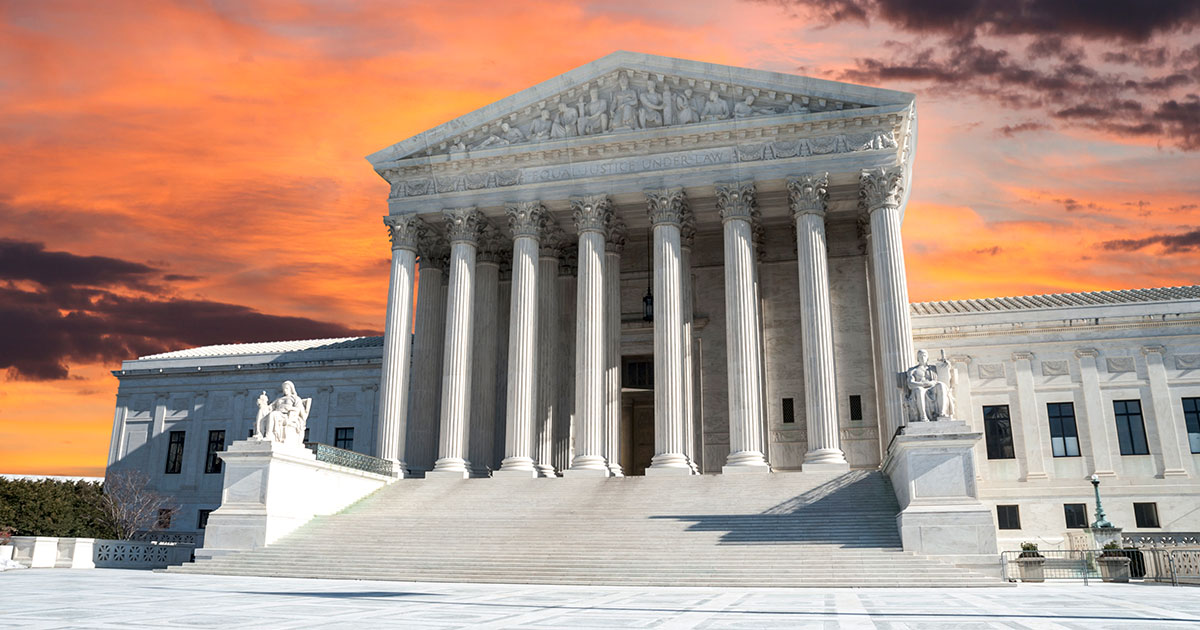
April 1, 2026 – As of April 1, 2026, the U.S. Supreme Court has heard 48 cases, with 30 cases awaiting decisions after oral argument and 9 oral arguments scheduled for April.
Major Decisions in March
Chiles v. Salazar (March 31, 2026)
On appeal from the U.S. Court of Appeals for the Tenth Circuit, the Supreme Court reversed 8-1, holding that Colorado’s law banning conversion therapy, as applied to Chiles’s talk therapy, regulates speech based on viewpoint, and the lower courts erred by failing to apply sufficiently rigorous First Amendment scrutiny.
GORSUCH, J., delivered the opinion of the Court, in which ROBERTS, C. J., and THOMAS, ALITO, SOTOMAYOR, KAGAN, KAVANAUGH, and BARRETT, JJ., joined. KAGAN, J., filed a concurring opinion, in which SOTOMAYOR, J., joined. JACKSON, J., filed a dissenting opinion.
Olivier v. City of Brandon, Mississippi (March 20, 2026)
On appeal from the U.S. Court of Appeals for the Fifth Circuit, the Supreme Court unanimously held that Olivier’s suit seeking purely prospective relief – an injunction stopping officials from enforcing an ordinance in the future – can proceed, notwithstanding Olivier’s prior conviction for violating that ordinance. The prohibition in Heck v. Humphrey doesn’t apply to his Section 1983 claim, the Court ruled, reversing the lower court.
KAGAN, J., delivered the opinion for a unanimous Court.
Cox Communications, Inc. v. Sony Music Entertainment (March 25, 2026)
On appeal from the U.S. Court of Appeals for the Fourth Circuit, the Supreme Court reversed 9-0, holding that the provider of a service is contributorily liable for a user’s copyright infringement only if it intended that the provided service be used for infringement, which can be shown only if the party induced the infringement or the provided service is tailored to that infringement. Cox neither induced its users’ infringement nor provided a service tailored to infringement. Accordingly, Cox is not contributorily liable for the infringement of Sony’s copyrights.
THOMAS, J., delivered the opinion of the Court, in which ROBERTS, C. J., and ALITO, KAGAN, GORSUCH, KAVANAUGH, and BARRETT, JJ., joined. SOTOMAYOR, J., filed an opinion concurring in the judgment, in which JACKSON, J., joined.
Rico v. United States (March 25, 2026)
On appeal from the U.S. Court of Appeals for the Ninth Circuit, the Supreme Court reversed 8-1, holding the Sentencing Reform Act does not authorize automatically extending a defendant’s term of supervised release when the defendant absconds. In this case, during Isabel Rico’s second abscondment from supervised release, she violated, and was later convicted, of a state drug offense that occurred after her supervised release term ended. Back in federal district court, the judge treated Rico’s drug offense as a Grade A violation of her supervised release conditions and sentenced her to 16 months of incarceration followed by two more years of supervised release, affirmed by the Ninth Circuit.
GORSUCH, J., delivered the opinion of the Court, in which ROBERTS, C. J., and THOMAS, SOTOMAYOR, KAGAN, KAVANAUGH, BARRETT, and JACKSON, JJ., joined. ALITO, J., filed a dissenting opinion.
Featured March Oral Argument
Keathley v. Buddy Ayers Construction. (argued March 24, 2026)
The case addresses whether the doctrine of judicial estoppel can be invoked to bar a plaintiff who fails to disclose a civil claim in bankruptcy filings from pursuing that claim simply because there is a potential motive for nondisclosure, regardless of whether there is evidence that the plaintiff in fact acted in bad faith.
The principle as applied here prevented the debtor in a Chapter 13 bankruptcy plan from suing a party at fault for injuries from a car-truck accident.
As the petitioner’s brief described it, “The question in this case is what happens when a debtor pursues an action against someone outside of bankruptcy but neglects to timely advise the bankruptcy court of his claim.”
Although Keathley informed his bankruptcy lawyer of the claim, of value to his creditors for its potential proceeds, his lawyer failed to present it to the bankruptcy court. Keathley described the omission as “inadvertent.”
The district court granted the respondent’s summary judgment motion and dismissed this personal injury case.
That’s what Mann said: “You know it is a bad sign at oral argument when several different justices debate among themselves the best rationales for an opinion ruling against you. And that was the experience of William Jay yesterday, who represents the other driver’s employer. His most determined opponent was Justice Neil Gorsuch, who repeatedly floated the idea of a ‘short and succinct’ opinion telling the lower court that characterizing Keathley’s misstep as either a ‘mistake’ or ‘inadvertence’ would be enough to excuse it. Another thread came from Justice Elena Kagan. For her, complete inadvertence and the absence of any intention to mislead would also seemingly weigh against barring the suit.” – Ronald Mann, SCOTUSblog
Executive Action Case Scheduled for Oral Argument
Trump v. Barbara (oral arguments April 1)
The Supreme Court will determine whether a presidential executive order that would end the guarantee of citizenship for all persons born in the U.S. violates a provision of the U.S. Constitution’s Fourteenth Amendment, which says “[a]ll persons born or naturalized in the United States, and subject to the jurisdiction thereof, are citizens of the United States and of the State wherein they reside.”
Of Interest in Wisconsin
Enbridge Energy, LP v. Nessel
A Supreme Court decision may be the tip of the iceberg for an issue, which in this case involves Enbridge’s ability to operate and upgrade the “Line 5” pipeline.
The pipeline transports crude oil from the Athabasca Tar Sands in Alberta to refineries in eastern Canada through northern Wisconsin and Michigan.
In the Supreme Court case, argued Feb. 24 and with a decision pending, the only issue is whether a district court has the discretion to remove a case to federal court contrary to the limits in 28 U.S.C. section 1446(b)(1), which provides a 30-day deadline.
The district court granted removal 30 months after the filing of the original lawsuit in which the Michigan attorney general sought to shut down part of the pipeline that sits at the bottom of the Straits of Mackinac, both a key Native American fishing location and seafaring pinch point. Environmental concerns justified the lawsuit.
A case filed by Michigan Governor Gretchen Whitmer inspired the removal action. Whitmer also sought to shut down the pipeline. Enbridge successfully removed the case to federal court. The case was dismissed. Enbridge then sought, and obtained, federal removal for Nessel.
But, Nessel is only one of the pipeline’s many challenges.
The Bad River Band of Lake Superior Chippewa in Wisconsin chose not to renew an easement allowing the pipeline to go through the reservation. Enbridge resisted, and the tribe sued and won in federal court. Enbridge is appealing the decision, which some experts say may end up at the U.S. Supreme Court
Meanwhile, Enbridge seeks federal and state permits to reroute the pipeline around the reservation. The Wisconsin Department of Natural Resources (DNR) granted permits in 2024, which are now challenged in state court on administrative procedural issues.
Enbridge also seeks to bury its pipeline under the Straits. Ship anchors have damaged the current pipeline that rests on the lake bed. Opposition has arisen in Michigan, especially from Native American tribes seeking protection for fishing under treaty rights – another issue likely complicated enough to reach the U.S. Supreme Court.
As Bradley Joondeph of SCOTUSblog summarized about the Supreme Court’s oral arguments, “Ultimately, the hour of discussion revealed little about where the justices stood. We must wait to find out until the court hands down its decision, likely by the end of June.”
That uncertainty may apply to all issues Enbridge faces for Line 5.
