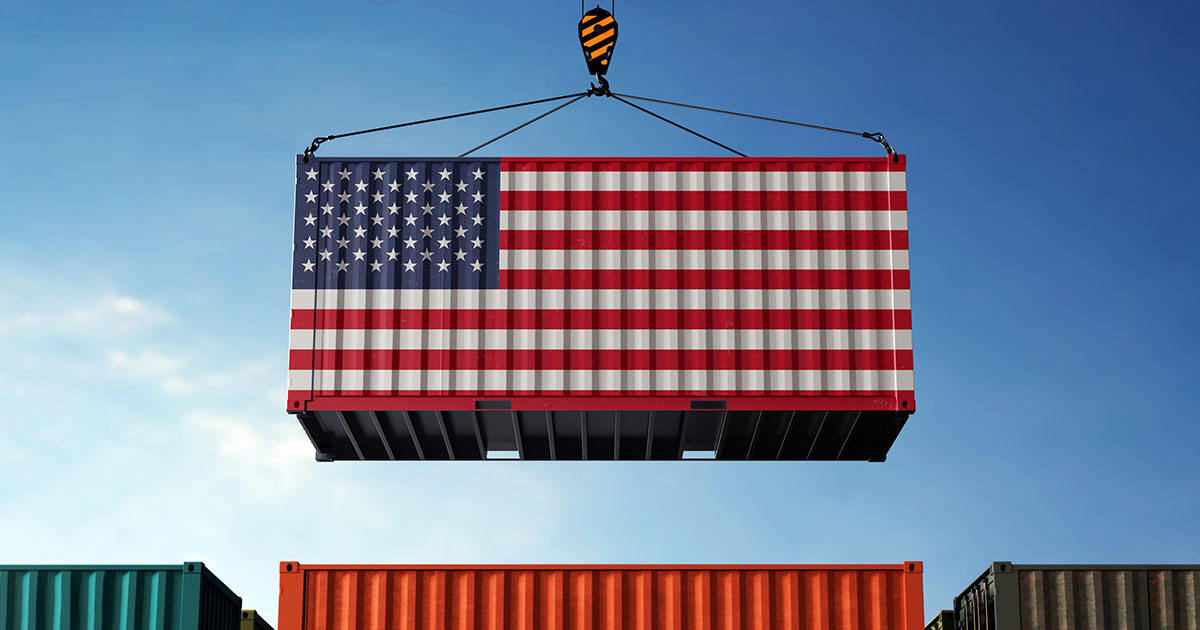
Jan. 7, 2026 – Tariffs, once an issue for specialists and historians, became current events as President Donald Trump tilted the international trade landscape, leaving businesses and consumers to guess the final cost of newly imposed tariffs.
A critical decision resides with the U.S. Supreme Court as it considers the legality of the president’s tariffs under the International Emergency Economic Powers Act (IEEPA).
The Court’s decision in
Learning Resources, Inc. v. Trump,
No. 24-1287, which the Court consolidated with
Trump v. V.O.S. Selections, Inc.,
No. 25-250, may create further turbulence.
If the Court strikes down the taxes, will businesses get money back? Costco Wholesale Corporation, among other importing companies, has
sued for a tariff refund.
“There’s a lot more awareness to what’s going on now because it’s in the headlines,” said Ngosong Fonkem, whose practice at Amundsen Davis LLC in Milwaukee focuses on import issues.
“It’s a hot area of practice right now,” Fonkem said, “and everyone has become an amateur trade lawyer, in essence, because it’s all over the news.”
A Debate as Old as the Government
Tariffs – a tax on imports – fall within Congress’s power under article I, section 8, clause 1 of the U.S. Constitution: “To lay and collect Taxes, Duties, Imposts and Excises.”
 Jay D. Jerde, Mitchell Hamline 2006, is a legal writer for the State Bar of Wisconsin, Madison. He can be reached by
email or by phone at (608) 250-6126.
Jay D. Jerde, Mitchell Hamline 2006, is a legal writer for the State Bar of Wisconsin, Madison. He can be reached by
email or by phone at (608) 250-6126.
James Madison, in explaining the clause, expected “[t]axation will consist, in a great measure, of duties, which will be involved in the regulation of commerce.”[1]
After the U.S. had more labor than needed for agriculture, Madison foresaw that “imported manufactures will decrease as the number of people increases.”[2]
Manufacturing would then need “the encouragement of bounties than to be loaded with discouraging duties.”[3]
While Madison worried that, in a developing economy, tariffs would not always sustain government, Alexander Hamilton feared a hamstrung government would overtax imports to raise revenue – a tax on everyone.[4]
When the First Congress drafted the Tariff Act of 1789, 1 Stat. 24,[5] the issue split the nation.
Pennsylvania wanted high tariffs on iron and molasses to protect its foundries and whiskey distillers. Southern states favored a low iron tariff to keep hinges and nails cheaper. New England’s rum distillers sought a low tariff on the raw material of molasses.[6]
Similar political disputes erupted throughout the nineteenth century, placing cotton-exporting Southerners against Northern manufacturers who desired tariff protection from England’s powerful industrial base.
The New England textile industry benefited from the nation’s first protective tariff in 1816.[7]
Tariff opponents took to heart Adam Smith’s words. In
The Wealth of Nations, published in 1776, Smith argued, “If a foreign country can supply us with a commodity cheaper than we ourselves can make it, better buy it of them with some part of the produce of our own industry, employed in a way in which we have some advantage.”[8]
Countering another country’s high tariffs justified increasing duties, Smith said.[9]
The federal government relied upon tariff income until the Sixteenth Amendment in 1913 permitted income tax.
Tariffs remained high through World War II when “the U.S. was actually one of the most protective countries in the world,” Fonkem said.
After the war, the U.S. encouraged free trade, Fonkem said, now sustained through the World Trade Organization (WTO).
At its inception in the 1990s, the North American Free Trade Agreement (NAFTA), now rebranded as the United States-Mexico-Canada Agreement (USMCA), divided opinion.
Presidential candidate H. Ross Perot predicted NAFTA would cause “a giant sucking sound” of jobs lost to Mexico.
Some sources claim NAFTA increased the U.S. trade deficit and eliminated as many as 950,000 jobs.[10]
Imported Goods Entering

The biggest question, says Ngosong Fonkem, whose practice at Amundsen Davis LLC in Milwaukee focuses on import issues, “is Trump going to enforce that Court’s judgment, given that [tariffs are] basically his signature program in this administration?”
When U.S. Customs and Border Protection (CBP) allows goods into the country, the importer of record – the company that bought the items – pays, according to
19 U.S.C. section 1484, the applicable duties, or tariffs.
In this process as outlined in
19 U.S.C. section 1500, CBP appraises the value of the import, classifies it, and determines the amount of duties owed.
Three main factors determine what the importer’s tax bill will be, Fonkem explained, including the import’s classification code under the
Harmonized Tariff Schedule (HTS), country of origin, and when applicable, whether a free trade agreement exists with the country of origin.
The HTS, incorporated by reference into law under
19 U.S.C. section 1202, comes from WTO agreement. These precise numerical codes help track goods coming into and out of the country, serving functions in assigning duties and providing statistical data, Fonkem said.
President Trump’s executive orders included provisions amending the HTS.[11]
‘Confusion and … Sophistication’
“When you add in all the different executive orders on steel, aluminum, copper and the ‘derivatives’ of these metals,” Fonkem said, “that just adds to the confusion and the sophistication.”
“For some countries like China, for example, the effective category rate is somewhere between 45% and about 70%, depending on what the product description is,” Fonkem said.
“If it’s coming from Mexico or Canada, … it could be 0% or it could be 50% if it contains aluminum, steel, or copper.”
At entry, the importer of record also must comply with any other laws affecting the product, Fonkem said, such as the U.S. Department of Agriculture (USDA) regulating food, the Food and Drug Administration (FDA) regulations on cosmetics and medical devices, or the Federal Communications Commission (FCC) for electronic components.
Those regulatory limitations may affect the list of countries in which a business may shop for goods.
Although tariffs may encourage domestic production, a business is stuck if the U.S. doesn’t produce the item, Fonkem said.
“The only way [businesses] can make themselves more competitive is [through] strategies of mitigating, reducing, and avoiding these tariffs,” Fonkem said.
If one can fit their imports into a special provision in the HTS, one can avoid duties, or one can import raw materials into a country that has a free-trade agreement with the U.S., Fonkem said.
If the product is “substantially transformed into a new and different product” in the country covered by the free-trade agreement, Fonkem advised, then the finished product can enter the U.S. duty-free.
With China retaliating against U.S. tariffs with higher duties of its own, now American exporters also feel the pinch, Fonkem said.
“I think every industry is hurting,” he said.
Constitutional Dispute
The IEEPA (50 U.S.C. sections
1701-1710) authorizes the president to “deal with any unusual and extraordinary threat” from outside the United States as identified by a presidential declaration of a national emergency.[12]
The IEEPA may be used only for the emergency declared. A new threat requires a new declaration.[13]
Powers under the IEEPA are limited to a year, but renewable. The president must consult with Congress throughout the emergency – and Congress may pass a concurrent resolution to terminate the national emergency.[14]
The current Supreme Court case focuses on whether President Trump could use IEEPA power to “regulate … any importation … of … any property in which any foreign country or a national thereof has any interest by any person, or with respect to any property, subject to the jurisdiction of the United States” by enacting tariffs.[15]
The two cases,
Learning Resources, Inc. and
V.O.S. Selections, Inc., challenge five executive orders, justified in part by the IEEPA, to raise tariffs. Trump issued the principal executive orders from February through April 2025.[16]
The tariffs come in two categories. Increases in tariffs of 25% for Canada and Mexico and 10% for China arose out of the national emergency of illegal drugs, especially synthetic opioids such as fentanyl.[17]
Reciprocal tariffs, imposed in April 2025, address the national emergency of trade imbalances. Tariffs increased on “nearly every” trading partner from 10% to 50%, although the president suspended most of those tariffs.[18]
Tariffs against China continued and increased at one point to 125%, but that rate has gone down, too.[19]
The principal legal complaints against the tariffs, as held by the lower courts, argue that to “regulate … importation” is not the same as setting a tariff, based on the plain meaning of the words, its context, and the historic use of the IEEPA, which had never been used to enact a tariff.
This argument gains force, they argue, because setting tariffs falls directly within Congress’s core power to tax.
Trump’s lawyers – and a four-judge dissent in the
V.O.S. Selections
en banc Federal Circuit decision – counter that IEEPA’s delegation is narrow. Statutory procedures demand precision, stringent limits, and Congressional oversight.[20]
The president also holds core Article II power in foreign affairs.[21]
Judicial Skepticism
Reports on the Nov. 5 oral arguments showed a Supreme Court majority highly skeptical of Trump’s claims and raising separation-of-powers concerns.[22]
“Based on the transcript that was released at the first hearing, it seemed like the Supreme Court was essentially going to beat down President Trump’s authority to impose this IEEPA-type of tariffs,” Fonkem said.
Justice Samuel Alito, in contrast, said “statutes that confer emergency powers are often phrased quite broadly.”[23]
One report argued further that Chief Justice John Roberts may use the case to build support among liberal justices for the Major Questions Doctrine, defined in
West Virginia v. Environmental Protection Agency,
597 U.S. 697 (2022).[24]
The Major Questions Doctrine requires that “major policy decisions,” ones with “economic and political significance” that defy historical administrative practice and operate with breathtaking scope, may come only from “clear congressional authorization.”[25]
The tariff case may either confirm presidential power or strengthen a new doctrine that limits administrative agencies.
Refunds?
If the Supreme Court decides against Trump, Fonkem asked, “then what does that mean for all the billions and hundreds of billions of duties that have been collected?
“Is that going to be just refunded to the main parties, the parties to that litigation, or is that going to apply to everybody that has imported and paid these duties?”
If refunds are due, Fonkem doesn’t know how the U.S. Treasury will manage them. “The U.S. government likes taking money, but they don’t like giving it back.”
The biggest question, Fonkem said, “is Trump going to enforce that Court’s judgment, given that [tariffs are] basically his signature program in this administration?”
“It’s up to the Supreme Court to ponder what effect your decision is going to have.”
Costco isn’t waiting to find out. On Nov. 28, it
filed a complaint in the U.S. Court of International Trade (CIT) against CBP for a refund.
Although the CIT denied the motion in a consolidated case involving Costco, the court did find that it had “the explicit power to order reliquidation and refunds where the government has unlawfully exacted duties.”[26]
Liquidation is the process CBP uses to render a final calculation of duties owed.[27] Refunds are harder to obtain after the liquidation’s final computation, which is why the parties requested that the liquidation be suspended through a preliminary injunction.[28]
“Reliquidation would result in a refund of all duties determined to be unlawfully assessed, with interest,” according to the CIT.[29]
It remains unclear whether individual suits will be required under CIT’s jurisdictional statute
28 U.S.C. section 1581(i).
The wholesaler has a specific deadline in mind. By statute, CBP has a year.[30] CBP’s goal, according to Costco’s complaint, is liquidation within 314 days. Given the dates the tariffs took effect, time is running out.
Endnotes
[1] The Federalist No. 56, at 347 (James Madison) (Clinton Rossiter ed., 1961).
[2] The Federalist No. 41, at 262 (James Madison) (Clinton Rossiter ed., 1961).
[3]
Id.
[4] The Federalist No. 35, at 211-12 (Alexander Hamilton) (Clinton Rossiter ed., 1961).
[5] Act of July 4, 1789 (Tariff Act of 1789), 1 Stat. 24.
[6] John Steele Gordon,
An Empire of Wealth 72-73 (2004).
[7]
Id. at 95-96.
[8] Adam Smith,
An Inquiry into the Nature and Causes of the Wealth of Nations 424 (Edwin Cannan ed., The Modern Library, 1937) (1776).
[9]
Id. at 434.
[10] Economic Policy Institute,
NAFTA’s Impact on U.S. Workers, Working Economics Blog, 4 p.m. Dec. 9, 2013,
https://www.epi.org/blog/naftas-impact-workers/ (last visited Jan. 2, 2026) (finding 700,000 lost jobs and a negative effect on wages due to competition);
NAFTA’s Legacy: Lost Jobs, Lower Wages, Increased Inequality, Public Citizen, Feb. 2018, (last visited Jan. 2, 2026) (finding more than 950,000 jobs lost, trade deficit increased, and wage decline).
Contra, M. Angeles Villarreal & Ian F. Fergusson,
The North American Free Trade Agreement (NAFTA) 16 (Congressional Research Service, May 24, 2017),
available at
https://sgp.fas.org/crs/row/R42965.pdf (last visited Jan. 2, 2026) (citing a study showing no significant change in employment).
[11]
V.O.S. Selections, Inc. v. Trump, 149 F.4th 1312, 1320, 1321 (Fed. Cir. 2025);
Learning Res., Inc. v. Trump, 784 F. Supp. 3d 209, 216, 217 (D. D.C. 2025).
[12]
50 U.S.C. section 1701(a).
[13]
50 U.S.C. section 1701(b).
[14] 50 U.S.C. sections
1703,
1706(a), (d) (presidential limits);
50 U.S.C. section 1706(b) (legislative control).
[15]
See
50 U.S.C. section 1702(a)(1)(B).
[16]
V.O.S., 149 F.4th at 1319-22;
Learning, 784 F. Supp. 3d at 216-18.
[17]
V.O.S., 149 F.4th at 1319-20;
Learning, 784 F. Supp. 3d at 216-17.
[18]
V.O.S., 149 F.4th at 1320-22;
Learning, 784 F. Supp. 3d at 217-18.
[19]
V.O.S., 149 F.4th at 1321-22;
Learning, 784 F. Supp. 3d at 218.
[20]
V.O.S., 149 F.4th at 1362-71 (Taranto, C.J., dissenting).
[21]
Id. at 1379-80.
[22] Amy Howe,
Court Appears Dubious of Trump’s Tariffs, SCOTUSblog, Nov. 5, 2025,
https://www.scotusblog.com/2025/11/court-appears-dubious-of-trumps-tariffs/; Ann E. Marimow,
Key Justices Cast a Skeptical Eye on Trump’s Tariffs, N.Y. Times, Nov. 5, 2025, https://www.nytimes.com/2025/11/05/us/politics/supreme-court-trump-tariffs.html; Mark Joseph Stern,
The Supreme Court’s Tariffs Arguments Were a Bloodbath for Trump, Slate, 3:33 p.m. Nov. 5, 2025,
https://slate.com/news-and-politics/2025/11/supreme-courts-tariffs-trump-fail-kavanaugh.html.
[23] Howe,
supra note 22.
[24] Stern,
supra note 22.
[25]
West Virginia v. EPA, 597 U.S. 697, 721, 723 (2022).
[26]
AGS Co. Auto. Solutions v. U.S. Customs & Border Prot., No. 1:25-cv-00255-3JP (CIT Dec. 15, 2025), at pg. 6, (last visited Jan. 2, 2026).
[27]
19 C.F.R. section 159.1 (defining liquidation).
[28]
AGS Co. Auto. Solutions v. U.S. Customs & Border Prot., at pg. 2.
[29] Id. at pg. 3.
[30] 19 U.S.C. section
1504(a) (deeming liquidation complete if the entry is not liquidated within a year).
