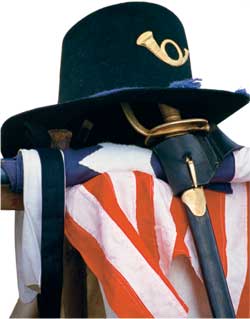
 Dealton Tichenor's legal career spanned only 10 years before it was ended by his 1864 death as a Union prisoner of war in Andersonville Prison in Georgia, but his journal and letters preserved at the State Historical Society at Madison depict a life familiar to lawyers today. He worked hard for his clients, he never got rich, he was accused of twisting words by his eloquence, and he was a leader in local public disputes.
Frontier Lawyering
Joseph Ranney, the foremost Wisconsin legal historian, has styled the earliest Wisconsin lawyers, those who practiced between 1836 and 1865, as the "heroic" generation.1 These early lawyers usually had not attended law school, but rather trained themselves or became apprenticed to another lawyer. How and where Tichenor learned lawyering and when he was admitted to practice is unknown. Tichenor was born in New York state in 1822. He moved to Platteville in Grant County shortly before Wisconsin attained statehood in 1848 and then, by the mid-1850s, moved to Seneca Township in Crawford County, where the first record of his practice exists.
Presumably like the great majority of the early bar, Tichenor had a general practice, taking any civil or criminal matter that came in the door. The door was to his home, where Tichenor conducted his business. His simple pine desk was of a schoolhouse design, four feet wide and three feet deep. His business card declared that he was a notary public as well as a lawyer.
Civil and criminal litigation. In those days newspapers often noted every local court case, naming the lawyers and summarizing the outcomes. On June 3, 1859, a Prairie du Chien newspaper printed the results of the 54 cases heard during the May term of the circuit court serving Crawford County. Tichenor appeared in eight of the cases. By the latter half of 1861, Tichenor was trying five to 10 cases a month.
A quaint picture of Civil War-era justice emerges from Tichenor's journal entry of Dec. 23, 1861. Tichenor tried a case at Lynxville for McDonald against Graham for trespass and assault. Justice of the Peace Cole was set to hear the matter at plaintiff McDonald's saloon - perhaps itself the site of the trespass and assault. Justice Cole arrived and adjourned the suit until "about 1/4 before 11 o'clock." The defendant decided it was past 11 and went home. Justice Cole went to his house and told him that he should try the suit. Apparently none of the participants had a watch, because Tichenor writes "I got [a] compass and by the Time it was not 10 o'clock." The trial was called and notice was served on defendant Graham that the jury was ready to try the suit. Graham was subpoenaed and took the stand. "Verdict for Pltiff $20.00 & cost."
Although in that case Tichenor had a victory in a suit for tortious damages, he is rarely explicit about the nature of the case for which he had been retained. However, Tichenor's journal entries suggest that his cases frequently were about breach of contract. In addition, his journal lists six actions in trespass, four in replevin, one in assault, and one in contract. Compared to today, the number of intentional torts is striking, but even more striking is the total absence of lawsuits based on negligence, which was only then emerging as a cause of action.2
His office practice. Tichenor's practice was not limited to litigation; it also involved what we describe today as transactional work. Much of his work outside the courtroom concerned real estate, which was likely a common component of most lawyers' practices in the 1850s and 1860s. On the frontier, the government gave away land, and people moved frequently, so they needed lawyers for land transactions. Tichenor made and gave deeds for his clients, as well as drafting and taking satisfaction for mortgages. He also drew up deeds to divide the township and assisted in defining the boundaries of real property. Finally, he advised his clients on land purchases and acted as their agent to sell real estate.
In addition to doing real property work, Tichenor often acted as a general financial agent for his clients. He gave, made out, signed, and received bonds. He acted as collection agent, endorsed notes, paid debts and taxes, and received goods and accounts to sell on commission. He even practiced a little family law, drawing up papers for "binding out" children of a man who had died.
The remainder of Tichenor's nontrial legal work was probably related to his service as town clerk - performing a marriage and paying the school teacher, for example. He also managed the bidding for the wood contract for the school house and made out notices of road taxes due. He even convened a meeting of the cemetery association and appointed its officers.
Public office and politics. The vast majority of the first generation of Wisconsin lawyers held public office,3 including Tichenor. In 1858 he was elected "Town Clerk & Seale of Weights and Measures etc" and, in 1860, to the Seneca Township Board of Supervisors. In 1861 he was appointed a court commissioner.
The few formal offices Tichenor held before his enlistment in the army were not, however, the measure of him politically. From 1858 until 1860 he was the unsuccessful leader of the major prewar political dispute internal to Crawford County: the attempted relocation of the county seat from Prairie du Chien to Seneca Township.4
Prairie du Chien was founded in the 1700s as a French fur-trading village on the Mississippi River. It long remained the population center of the area. However, by shortly after statehood in 1848, the Mississippi River trappers lost their predominance to the farmers who had spread across the county and who were in the majority by 1860. It was hard for farmers, who traveled on foot or horse, to reach the river-boat town on the county's southwest border.
Tichenor's efforts to relocate the county seat presumably did not endear him to the court sitting in Prairie du Chien nor to the rest of the political establishment, which was centered there. The surviving newspaper accounts of the controversy do not suggest any sophisticated argument. Tichenor's "county seat" campaign even failed to get the support of his own Republican party and of newspaper editor Greene in the Republican-leaning Leader - presumably because the editor lived in Prairie du Chien.
Opposing Tichenor's concurrent run for the Seneca Township Board, the editor of the Democratic-leaning Prairie du Chien Courier lashed out, claiming that Tichenor "... will of course hatch any and all kinds of reports to make his hobby - the county seat question - an issue in the election. ... Tichenor would be engaged in his habit of pettifogging and palavering."5
The words are old-fashioned, but they express a sentiment still common today. The editor was attacking Tichenor as a typical lawyer. A pettifogger, according to the Oxford English Dictionary, is "a legal practitioner of inferior status, who gets up or conducts petty cases; esp. in an opprobrious sense, one who employs mean, sharp, cavilling practices; a 'rascally' lawyer." Similarly, palaver is defined as "to talk profusely or unnecessarily, to 'jaw,' to 'jabber,' to talk plausibly or flatteringly."
The state legislature authorized a vote on relocating the county seat, the issue went to the voters, and Tichenor obtained a seven-vote majority in favor of the move.6 But, through post-election legal maneuvering, the established powers prevailed and the status quo was maintained. Warning signs of trouble soon followed the 1859 election. A meeting was called a month after the vote by Colonel Hercules L. Dousman, the famed and wealthy fur trader who no doubt was the most powerful individual in Crawford County and probably in this entire section of the state.7 Dousman raised the question of whether the vote was legal and added that, if not, the county seat could not be removed. Apparently, meeting attendees decided to seek the advice of the local member of the Wisconsin Senate on the legality of the election.8 Tichenor, who was present at the meeting, presumably felt no second opinion was necessary. Rumors and confusion about the outcome of the election swirled for months. There were allegations of post-election vote-tampering.9 A history published 25 years later in 1884 attributed the outcome to "some technical point of law, or artful management on the part of the opposers of the movement."10 In any event, the county seat stayed at Prairie du Chien.
The Economics of a Frontier Law Practice
It seems unlikely that many Civil War-era lawyers outside the largest towns could have supported themselves by their legal work alone. Tichenor, who also was a farmer, certainly did not. It is difficult to determine from his journal the financial importance of Tichenor's work as a lawyer, because he usually does not record his fees.
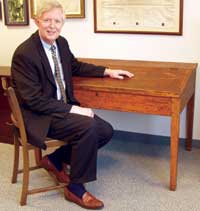 Seated at Dealton Tichenor's law office desk is his great-great-grandson Larry A. Jones. Jones, Ph.D. 1975, J.D. 1989, is a Washington state lawyer.
Not shown is coauthor Phillip J. Tichenor, Ph.D., a retired member of the journalism faculty at the University of Minnesota, and a great-grandson of Dealton Tichenor.
However, three 1857 journal entries show that Tichenor charged $1 for drafting a deed and in 1861 the same amount for "Legal Advise." In 1861 he charged $5 for a half-day trial. If an estimate is used of $1 for each deed or power of attorney drafted, $1 for legal advice given, and $5 for a half-day trial, then Tichenor's surviving journal entries from 1861 suggest that his law practice may have earned him $650 that year. The federal government's estimated consumer price index for 1860 shows an approximate 20-fold price increase between then and today.11 So in 1861 Dealton Tichenor may have grossed about $13,000 in today's dollars. Of course, it is also true that lawyers had little overhead in 1860 - no secretary or paralegal, no telephone (let alone fax and Internet) - so a much larger percentage of the fee was profit.
Court fees and costs. Among the few costs incurred in Tichenor's practice were court fees. On Aug. 8, 1861, Tichenor recorded in his journal that he was retained for an appeal and in the process "paid ... $7.30 Justice cost & $1 for Return and $1 State tax making in all $9.30." On Sept. 10-11, 1861, Tichenor took a deposition of a judge to be used in an Iowa case. He charged $5. The judge charged $1.50 for his time, a party was charged $1, postage to mail the deposition was $.24, and the Crawford County clerk charged $.25 to certify the deposition. In another case, on Oct. 28, 1861, Tichenor recorded that his client paid the balance of judgment and costs: $4 clerk's fee, $2.70 witness fee "as per right," and $2 constable's fee, "leaving $1.30 in my hands."
The End of His Career
Dealton Tichenor's surviving letters and journals do not suggest that he was an abolitionist. Nonetheless, he hated Southern secessionists and their northern Copperhead sympathizers and supported his country's war. Presumably due to these views, on Aug. 6, 1862, at the age of 40, Tichenor enlisted in the 31st Wisconsin Volunteer Regiment. We know that he was not forced to volunteer, because, although an 1863 statute made men eligible to be drafted until age 45, those over 35 were practically never drafted.12 Tichenor served until his discharge for disability - for chronic illness, like so many other soldiers - in November 1863. Back at home, he resumed his legal practice, as a Jan. 21, 1864 newspaper article reported:
"DEALTON TICHENOR. - Mr. Tichenor, late of the 31st Wis. Regt., has returned home on account of his health, and is now in town Seneca, this county. Mr. Tichenor has taken a license, and will practice in our courts. Such business as our citizens desire in his line as conveyancing, legal advice, or as an attorney, he will be always ready to attend to. He is a Notary Public and can take acknowledgments."
But a month later, the 42-year-old Tichenor reenlisted in the newly organized 36th Wisconsin Regiment. On May 10, 1864, the 36th Wisconsin arrived in Virginia, where it served as part of the Army of the Potomac. On May 18, the 36th Wisconsin was in the Battle of Spotsylvania as a reserve unit. On May 26, Sergeant Dealton Tichenor of Company A led a skirmishing charge on Confederate works in the battle of the North Anna River, where he was captured. He was soon transferred to Andersonville Prison, Georgia, where he died of jaundice on Aug. 18, 1864, and lies buried in grave #6097. He was survived by his wife Mary and six minor children. Mary received a widow's pension of $8 per month.
Tichenor died young by today's standards and did not bequeath a large inheritance. What he did leave behind, however, were records providing a glimpse of one lawyer's career of advocacy and hard work - qualities as admirable now as they were 150 years ago.
Endnotes
1 Joseph A. Ranney, Practicing Law in 19th Century Wisconsin, 67 Wis. Law. 10 (March 1994). See also Joseph A. Ranney, Trusting Nothing to Providence: A History of Wisconsin's Legal System (Madison, Wis. 1999.)
2 Prosser & Keaton, The Law of Torts 5th ed., 160-61 (St Paul, Minn., 1984).
3 Ranney, supra note 1.
4 See History of Crawford and Richland Counties 492-94 (Springfield, Ill. 1884) See also Prairie du Chien Leader articles beginning in the fall of 1858, e.g., Oct. 16, 1858, and Nov. 13, 1858. Relocating the county seat was the major internal political battle, but other political disputes also roiled the county. Arguments about the proper course for the nation, for example, fill the pages of the strongly partisan Republican and Copperhead newspapers in the county. See Phillip J. Tichenor, "Copperheadism and Community Conflict in Two Rivertowns: Civil War Press Battles in Prairie du Chien and La Crosse, Wisconsin, 1861-65," paper presented to the Symposium on the 19th Century Press, the Civil War, and Free Expression, University of Tennessee at Chattanooga, Nov. 2, 2002.
5 Prairie du Chien Courier, March 8, 1860.
6 Prairie du Chien Leader, Nov. 15, 1869.
7 It was Dousman's son Louis who, after the Civil War, replaced the family home with the elegant structure now widely known as "Villa Louis" on the western side of Prairie du Chien.
8 Leader, Dec. 5, 1859.
9 Courier, Sept. 6, 1860 (the results from one township had been mistakenly reversed, leading to the conclusion that the vote to move had failed. But this "recording error" only surfaced months after the election, fueling suspicion of tampering).
10 History of Richland and Crawford Counties 492-94.
11 See Federal Reserve Bank of Minneapolis, woodrow.mpls.frb.fed.us.
12 James McPherson, Battle Cry of Freedom 600-01 (New York, 1989).
