
On March 20, 2026, Governor Tony Evers signed Wisconsin’s new “patient representative” legislation (commonly known as the “Next-of-Kin” law), which took effect on June 1. His signature immediately eliminated statutory protections that have been in place in Wisconsin for decades.
Prior to the enactment of 2025 Wis. Act 115 (Act 115), anyone proposing to admit an incapacitated individual to a long-term care facility without a healthcare power of attorney (HCPOA) faced a judicial review process designed to protect the individual’s rights and autonomy. After Act 115’s enactment, if an individual is incapacitated and lacks an HCPOA granting the agent authority to admit the individual to a long-term care facility, a patient representative can be appointed to transfer the individual from the hospital to a long-term care facility through a more expedited, simplified process.
The question remains whether the patient representative legislation’s administrative efficiency will sacrifice too many protections and procedural safeguards for incapacitated individuals.
Before Act 115: Judicial Oversight and Patient Protections
Before the enactment of the patient representative legislation, a person could be admitted to a long-term care facility, such as a nursing home or community-based residential facility, for any reason other than a short-term stay for recuperative care or respite care, in one of three ways:
The person could consent to the admission;
The person’s agent under an activated HCPOA could agree to the admission (provided the principal authorized it in the document); or
Someone could file a petition for guardianship and protective placement.[1]
If none of these three options was available at the time of a proposed admission to a long-term care facility, the law required significant judicial oversight to protect the patient’s rights and autonomy.
 Alicia Ratajczak, Marquette 2020, is an attorney with McCarty Law LLP, Appleton, practicing estate planning, estate settlement, special needs planning, guardianship, and elder law. She serves on the State Bar of Wisconsin’s Elder Law & Special Needs Section board and is a member of the Real Property, Probate & Trust Law Section, the National Academy of Elder Law Attorneys, and the Outagamie County Bar Association. She is a captain in the Wisconsin Army National Guard and serves as a Deputy Brigade Judge Advocate.
 Reg P. Wydeven, U.W. 1998, is a partner at McCarty Law LLP, Appleton, advising clients on estate planning, estate settlement, and elder law matters. He is a member of the State Bar of Wisconsin’s Elder Law & Special Needs and Real Property, Probate & Trust Law sections. He writes a weekly column for The Post Crescent, providing commentary on a wide range of topics, including estate planning, investing, and unconventional legal news.
Under Wis. Stat. section 50.06, certain people can consent to the admission of an incapacitated individual to a long-term care facility directly from a hospital if the individual does not have a valid HCPOA, has not been adjudicated incompetent, or is diagnosed as developmentally disabled or as having a mental illness.
The people authorized to do this, in order of priority, are a spouse or domestic partner, an adult child, a parent, a sibling, a grandparent, a grandchild, or a close friend of the incapacitated individual. Admission to the facility can occur if no person in the same order of priority as, or higher in priority than, the individual who consents to the proposed admission disagrees with the proposed admission, or if none of the people who resided with the incapacitated individual disagrees with the proposed admission.
Before Wis. Stat. section 50.06 was amended by Act 115, it required that a petition for guardianship under Wis. Stat. section 54.34 and a petition for protective placement under Wis. Stat. section 55.075 be filed prior to the proposed admission.
Notification and county oversight requirements. Before Act 115, if the incapacitated individual verbally objected to or otherwise actively protested the admission, the individual could still be admitted to the facility, but the facility’s director was required to immediately notify the county under Wis. Stat. section 55.02(2). (Wis. Stat. chapter 55 was not amended by Act 115, so all provisions in the chapter, which addresses the protective service system, remain in effect.) Representatives from the county were then required to visit the individual as soon as possible, but no later than 72 hours after notification, and to do the following:
Determine whether the protest persisted or had been voluntarily withdrawn, and consult with the person who consented to the admission regarding the reasons for the admission;
Attempt to have the incapacitated individual released within 72 hours if the protest was not withdrawn and the individual did not satisfy all the criteria under Wis. Stat. section 55.08(1) or 55.135(1), and assist with identifying appropriate alternative living arrangements; and
Commence an emergency protective placement proceeding if the representative believed it was probable that the individual “is so totally incapable of providing for his or her own care or custody as to create a substantial risk of serious physical harm to himself or herself or others as a result of developmental disability, degenerative brain disorder, serious and persistent mental illness, or other like incapacities if not immediately placed in that facility.” With the facility’s permission, the court could order the incapacitated individual to remain in the facility pending the outcome of the protective placement proceedings.
Protective placement or services petitions. Wis. Stat. section 55.10(1) states that “a petition for protective placement or protective services shall be heard within 60 days after it is filed unless an extension of this time is requested by the petitioner, the individual sought to be protected or the individual’s guardian ad litem, or the county department, in which case the court may extend the date for hearing by up to 45 days.”
Under Wis. Stat. section 55.09(1), notice of the petition “shall be served upon the individual sought to be protected, by personal service, at least 10 days before the time set for a hearing. The person serving the notice shall inform the individual sought to be protected of the complete contents of the notice and shall return a certificate to the circuit judge verifying that the petition has been delivered and notice given. The notice shall include the names of all petitioners.”
Before enactment of Act 115, the person who consented to the individual’s admission under Wis. Stat. section 50.06 could, before the guardianship hearing, make healthcare decisions for the incapacitated individual to the same extent as a guardian of the person could. If the individual had no durable power of attorney for finances, that person could also authorize healthcare-related expenditures to the same extent as a guardian of the estate. Further, the person could request a functional screening and a financial and cost-sharing screening to determine whether the incapacitated individual was eligible for Family Care.
The person’s authority ended upon the earliest of 60 days after the admission to the facility of the incapacitated individual (which could be extended by another 30 days), discharge of the incapacitated individual from the facility, or the appointment of a guardian for the incapacitated individual.
Section 55.08(1) states that a court may order protective placement for an individual who needs residential care and custody, has been determined incompetent by the court, is incapable of caring for themselves for the reasons stated in the statute, and whose disability is permanent or likely to be permanent.
So, if an incapacitated individual did not have an HCPOA, a person could have the individual admitted to a long-term care facility, but a court would later have to review that admission to determine whether it was necessary and whether it was the least restrictive environment that met the individual’s needs.
The New Patient Representative Legislation: Administrative Efficiency
Although the patient representative process is temporary unless extended by the legislature, it allows new admissions through June 1, 2029, and provides another avenue for transferring incapacitated individuals from hospitals to long-term care facilities.[2]
Just like with an HCPOA, if the new patient representative option is used, two healthcare providers must first find that the patient is incapacitated. The two healthcare providers may include two physicians, or a physician and an “advanced care clinician,” which includes a psychologist, nurse practitioner, or physician’s assistant.[3] The patient representative legislation states that if the patient is incapacitated and does not have an HCPOA, or the patient has one but it does not grant the agent the authority to admit the principal to a long-term care facility, a patient’s representative may be appointed to admit the patient from the hospital to the long-term care facility.[4] The two healthcare providers must document this incapacity on a new document developed by the Wisconsin Department of Health Services (DHS), not on a currently existing form or on a form developed by the hospital. There is no requirement that the patient be notified of the finding of incapacity or the existence of the patient’s representative at this stage.[5]
The patient’s representative is identified using the same list as above: spouse or domestic partner, adult son or daughter, parent, adult brother or sister, grandparent, adult grandchild, or close adult friend.[6] Once the patient’s representative is selected and the person identified agrees to serve, that person must sign a declaration under oath. This declaration must contain the following information:[7]
A written acknowledgment that the patient’s representative can make decisions or authorize expenditures.
A written statement that the patient’s representative agrees to make healthcare decisions regarding the admission to and care and treatment at the accepting facility on the incapacitated individual’s behalf and agrees to authorize expenditures related to healthcare received at the accepting facility on the incapacitated individual’s behalf.
A written statement that, to the best knowledge of the patient’s representative, the incapacitated individual does not have a healthcare agent or a guardian of the person.
A written statement that, to the best knowledge of the patient’s representative, the patient does not have an activated HCPOA and has not been adjudicated incompetent in Wisconsin.
A written statement that, when acting on behalf of the incapacitated individual, the patient’s representative agrees to exercise the degree of care, diligence, and good faith that an ordinarily prudent person exercises in the person’s own affairs.
A written statement that the patient’s representative understands the role and responsibilities as the patient’s representative.
A written statement that, to the best knowledge of the patient’s representative, a family member in a higher priority class under Wis. Stat. section 50.06(3) does not exist or no family member in a higher priority class is willing to make healthcare decisions on the incapacitated individual’s behalf.
A list of all the incapacitated individual’s family members to whom the patient’s representative will send the signed declaration under this subdivision.
The patient’s representative must provide a copy of the declaration to the hospital, the accepting long-term care facility, the adult-at-risk agency for the county in which the incapacitated individual resides, all the incapacitated individual’s family members who reasonably can be contacted following the admission, and, for filing, to the register in probate for the county in which the incapacitated individual resides.[8] The adult-at-risk agency and the register in probate do not have any obligation to do anything with the declaration once it is filed.[9]
The patient’s representative then can admit the patient to the long-term care facility. The legislation also allows the patient’s representative to “authorize expenditures related to health care to the same extent as a guardian of the estate.”[10]
Although there is no prerequisite that the patient’s representative be qualified or trustworthy, if someone believes the patient’s representative has acted inappropriately in that role, that person may file for a review of the representative’s conduct.[11] The patient is entitled to notice of this review being filed with the court.[12] At that stage, the judge has a few options to address the conduct in question. The judge may order that the patient’s representative act in the patient’s best interests, that the patient’s representative account for how the expenditures were used from the patient’s assets, or that a guardian ad litem be appointed on behalf of the patient.[13]
Not only is the individual left unnotified about who is making decisions for them, but they are also denied the opportunity to object, have a guardian ad litem protect their best interests, or have an attorney advocate for their rights.
Balancing Administrative Efficiency and Patient Protections
The goal of the patient representative legislation is to make it easier to admit an individual to a long-term care facility from a hospital. While this new law appears to make it easier to transfer a patient from a hospital to a long-term care facility, the patient representative’s authority is limited. The representative may authorize the transfer and make decisions for the individual within the long-term care facility, but the representative cannot make in-hospital healthcare decisions for the individual.
Additionally, the law has gaps that could jeopardize a person’s rights. As explained above, the individual’s rights are protected throughout the process of attempting to obtain a guardianship. The individual must be given notice of the guardianship proceeding. The court appoints a guardian ad litem to protect the individual’s best interests. The individual has the right to object to the guardianship or the choice of guardian. If the individual objects, the court will appoint a state public defender to advocate for the individual.
None of these rights are afforded to the individual when a patient’s representative is appointed. When the patient’s representative gives notice of the declaration, the patient’s representative does not have to notify the individual. Not only is the individual left unnotified about who is making decisions for them, but they are also denied the opportunity to object, have a guardian ad litem protect their best interests, or have an attorney advocate for their rights.
Another practical issue with this new legislation is how expenditures are authorized out of an individual’s assets. It can be difficult to get a financial institution to accept a durable financial power of attorney, even though well-settled statutes and processes allow an agent to manage the principal’s financial matters. These financial institutions might argue that they will not accept a durable financial power of attorney because it was signed too long ago, it was not notarized at that financial institution, it is not on their internal form, or for another reason. None of these are valid reasons to deny a durable financial power of attorney in Wisconsin and can usually be resolved after some discussion and explanation of the laws in Wis. Stat. chapter 244, but they still create obstacles for the principal and the agent. Given that financial institutions are hesitant to accept a durable financial power of attorney that allows an agent to act, it seems likely that it will be more difficult to persuade a financial institution to accept a declaration allowing a patient’s representative to withdraw money from the accounts. The liability for the financial institutions seems too high.
So, if the patient’s representative is struggling to authorize expenditures from the individual’s assets because financial institutions are not honoring the declaration, how will the individual’s care at the long-term care facility be paid for? It seems unlikely that the long-term care facility will admit the individual without the ability to pay. Even before this patient representative law passed, some facilities would try to get a family member to personally guarantee payment of the cost of care. It is not wise for a family member to provide this guarantee, but it seems possible that this practice may increase.
This new law does nothing to address another major problem: the number of beds available at long-term care facilities. (Nursing homes and other long-term care facilities are licensed for a specific number of “beds,” that is, the number of people who can reside at the facility. A facility can have fewer residents than it is licensed for; it cannot have more residents than the license limit.) When a person is in a hospital and needs admission to a long-term care facility, it can be difficult to find a facility with an opening to provide the necessary care. This was true before Act 115 was enacted (for example, even when the individual had a valid HCPOA or a guardian was appointed). Having a patient’s representative sign a declaration and authorize admission to a long-term care facility does not change the fact that no facility may be able to care for that individual.
Conclusion
Ultimately, Wisconsin’s new patient representative legislation is a significant shift in how incapacitated individuals can be admitted to long-term care facilities — one that prioritizes speed and administrative efficiency over procedural safeguards. While the intent behind the law is understandable, particularly in reducing hospital backlogs and expediting access to needed care, it does so by removing longstanding protections that ensured judicial oversight and meaningful participation by the individual whose liberty and autonomy are at stake.
As this legislation takes effect, attorneys, healthcare providers, and families must understand both its utility and its risks. Just as importantly, policymakers and courts must remain attentive to how the law operates in real-world situations. If the balance between efficiency and individual rights has tilted too far, further legislative refinement may be necessary to ensure that Wisconsin’s most vulnerable residents are not only cared for but also adequately protected.
It is more important now than ever that Wisconsin residents complete an HCPOA to appoint the person they want to make their healthcare decisions and outline their wishes, rather than opening themselves up to these risks.
Also of Interest
Develop Your Case Confidently Using Judges’ Criteria
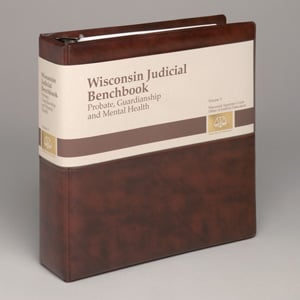
Wisconsin Judicial Benchbook Volume V: Probate, Guardianship, and Mental Health, published by State Bar of Wisconsin PINNACLE®, encompasses the multiple aspects of these areas of the law in six major sections. Written from the perspective of judges and court commissioners with extensive experience in probate court, as well as guardianship and protective placement services and mental health commitment cases, this Benchbook delivers the essential rules, citations, and commentary in a handy, easy-to-use format.
Topics include the new patient representative law; how protective services and protective placements work in guardianships; conventional probate procedures and probate alternatives, such as the formal termination of a life estate; basic rules of intestate succession and the modification of trusts; and the rules for involuntary and voluntary mental commitments and commitments for alcoholism. Helpful charts illustrate the key time periods for specific steps in guardianship and protective placement and protective services cases.
With this resource, you’ll know better what to expect in your case and be able to accurately inform your clients about what they should expect, what options may be available, and how the court may look at specific facets of their case.
To Order: Visit wisbar.org/AK0029
CLE: Guardianship After the New Patient Representative Law

Join authors Alicia Ratajczak and Reg P. Wydeven for “Wisconsin’s New Next of Kin Law,” a CLE webcast examining guardianship and protective placement practice before and after Wisconsin’s new patient representative legislation. This 50-minute session covers changes to medical care decision-making, when a protective order is still required, and how the new law interacts with existing guardianships of the person or estate.
Webcast Seminar: Programs begin October 14, 2026
To Register: Visit wisbar.org/CA4022
Endnotes
[1] These three options are still available with Act 115 in effect. ^
[2] Wis. Stat. § 50.06(5)(ar). ^
[3] Wis. Stat. § 50.06(4)(a). ^
[4] Wis. Stat. § 50.06(8). ^
[5] See id. ^
[6] Wis. Stat. § 50.06(1)(d) (cross-referencing Wis. Stat. § 50.06(3)). ^
[7] Wis. Stat. § 50.06(8)(b). ^
[8] Wis. Stat. § 50.06(8)(a)2. ^
[9] Id. ^
[10] Wis. Stat. § 50.06(5)(am). ^
[11] Wis. Stat. § 50.06(5)(e). ^
[12] Id. ^
[13] Id. ^
» Cite this article: 99 Wis. Law. 22-27 (October 2026).
