
June 10, 2026 – Legal research, a cornerstone of law practice, has the irritating ability to constantly change as the platforms and resources evolve while simultaneously retaining a core set of fundamental best practices that are necessary to locate relevant resources.
As with any exercise, legal research is a muscle that you need to practice and revisit to stay sharp, but the tools that you use will be different as more materials and AI-driven tools are added.
What’s a busy lawyer to do?
As with all things, efficiency is the key. Beginning with smart research approaches, you can map out and refine your research results by tracking the plan and your initial approaches, all without typing a single word into a search bar.
This strategy allows for a richer set of results that arrive much more quickly than stabbing in the dark with a hastily thrown together set of concepts or terms entered into a single search bar.
Best of all, taking time for initial work and planning before starting an actual search allows you to connect with powerful second (or third) opinions, since you won’t be shackled to a single platform’s set of results.
However, if you keep in mind the tips that translate well across these different tools, then your work will be much more efficient and competently researched.
Before You Start: Create a Record of Strong Keywords and Appropriate Strategies
Just like many aspects of personal and professional life, research tools are quickly moving to integrate AI features. This can lead to overreliance on these imperfect tools when a practiced researcher may be able to surface relevant and accurate resources in a shorter period.
 Kristopher Turner, U.W. 2020, is Associate Director of Public Services at the University of Wisconsin Law Library, Madison.
Despite these technological advances, a seasoned researcher will not dive straight into either GenAI (generative AI) or traditional digital research right away.
First, ask three crucial questions:
(1) How familiar am I with this area of law? Are you starting from scratch and need to understand terms of art and leading cases? Or are you on well-trod ground that may just require checking for any new cases or updates?
(2) What is unique about this particular scenario that may set it apart from common cases? Finding those facts very early in the research journey will send the research down different paths.
(3) Are you casting a wide net or looking for one good resource? Just like the facts that will send you down different routes, this will determine the type of approach that is necessary to quickly make your search an efficient success.
Much like a “Choose Your Own Adventure” book, these questions set the tone and how your search will be dictated.
These steps should be completed before you put any terms into a legal research database. Leaving a trail of research breadcrumbs that includes a list of needs from the research session (question #1), relevant and unique keywords (question #2), and the preferred research approach (question #3) will allow you to revisit and retrace your steps as needed without going down repetitive dead-ends.
Beginning your work on any research platform – be it Westlaw, Lexis, VLex/Fastcase or Google – without having these initial guardrails in place invites a waste of time. This is a mistake that new lawyers and experienced partners make in equal measures.
Research is an easy step to rush through as drafting, client communication, or case strategy may seem more urgent. However, your foundation will be rotten without initial care given to these critical areas of research.
Write down your goals for the research session to keep yourself focused. Also write down any keywords, concepts, facts, or statutes that will impact your research, and start to form your search strategy from there.
Lastly, set the final guardrail for how you will approach this problem. Do you need to find those new edge cases that may be a bit off the beaten research path, or are you looking to gather the most highly impactful and cited resources to better bolster your argument? This step is completely platform-agnostic and will put you ahead of those who dive in without making these first thoughtful notes on the research plan.
Save Time with Segment Searching and Boolean Operators
With a plan in place, we can now actually proceed with our search and, if needed, easily crosswalk it to another platform.
In today’s digital world, nearly every platform looks the same: A Google-esque search bar, possibly with an option to integrate an AI assistant.
If possible, avoid the temptation of the search bar and instead try an advanced search that integrates segment searching. Segment searching creates a more tailored set of search results by focusing your keyword searches in particular fields.
For example, you may only want cases from a particular judge, after a given year, that do not include a certain word. Google’s Advanced Search provides powerful options such as limiting when a page was last updated or searching for a particular type of file, such as a PDF.
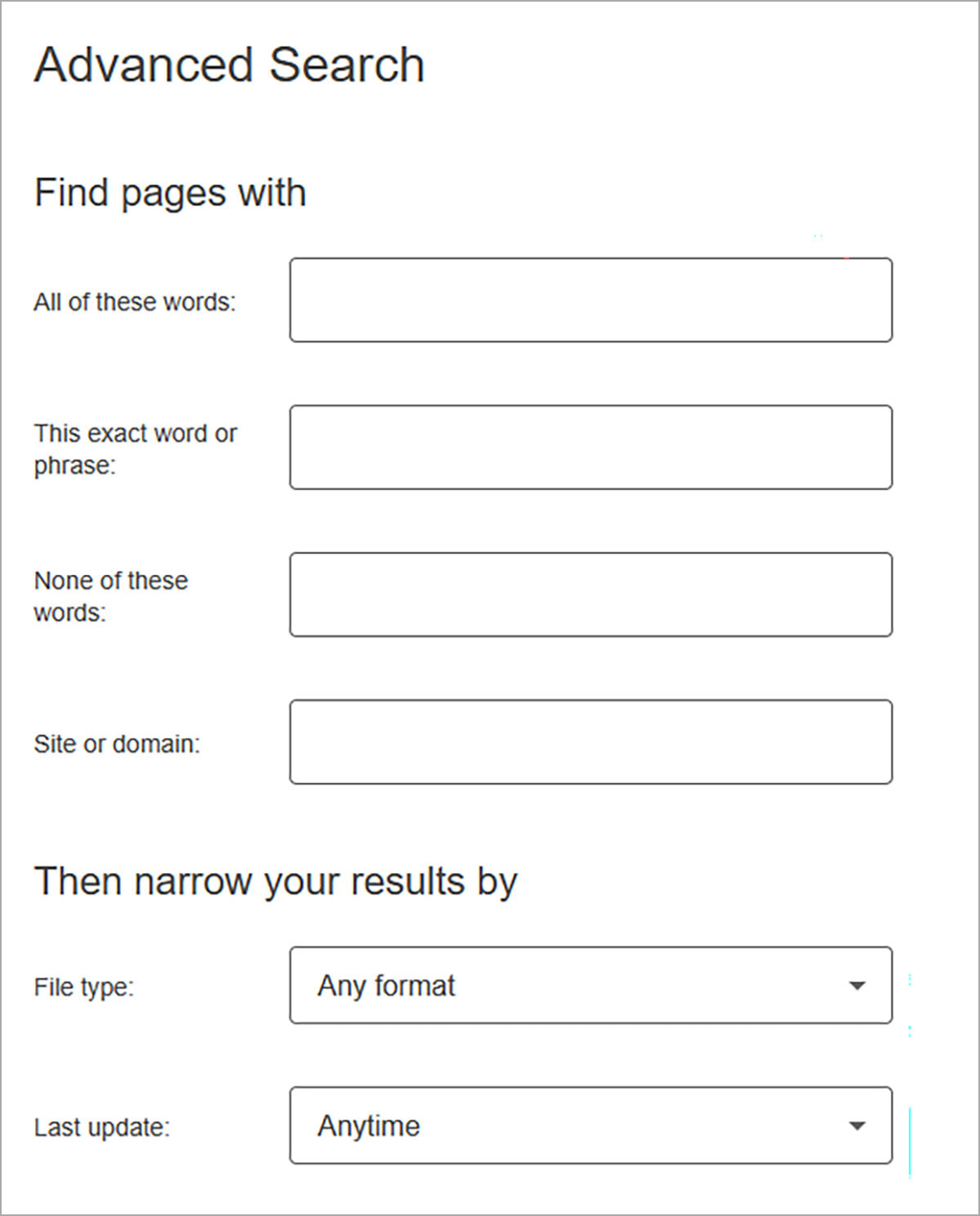
Figure 1: An Advanced Search on Google
The amount of useless “white noise” that this search eliminates is tremendous.
All search platforms allow for some form of advanced searching that is typically designed for the type of content they cover. This means you can narrow down to dissenting opinions in a case law search in Lexis or Westlaw, or inventor and assignee in Google’s Patent Search.
An excellent time to use the main search bar is when you are looking for a highly specific resource and are well-versed in Boolean operators. These powerful and underutilized tools enhance any given search by narrowing down the parameters you are providing to the research platform.
For example, a poor search is Dog Bite Liability Neighbor. The most popular research platforms will read this as Dog or Bite or Liability or Neighbor, and while they will try to return the most relevant results that feature the selected keywords, the researcher should opt to control the results instead of ceding that control to the platform’s algorithm.
A better search is “Dog Bite” w/s Neigh! AND liability. That search tells the platform to exclusively return results that include the phrase “dog bite” within a sentence of any word that starts with “neigh” (of neighbor or neighbors) and also includes the term “liability.”
The former search brings back 322 case law results in Westlaw, while the latter narrows that down to a much more manageable 77.
This basic example can be expanded upon with practice. An expert with Boolean operators can integrate several different terms to quickly cut out extraneous results with only a few thoughtful additional terms. For a list of common Boolean operators, see this helpful Michigan State Law School guide.
How to Know When Your Research Is Complete
When it comes to legal research, there always seem to be more rabbit holes to investigate, more cases to read. It can be difficult to know when you have successfully located the most relevant resources.
One strong signal that you are at the end is when you see the same cases cited, the same concepts defined, and the same conclusions reached. Once you have the leading cases in terms of citations and the newest cases that ensure nothing new has been determined, you are likely on safe research ground.
The research map you created at the outset will remain a good guide to keep you grounded and focused, and the search strategies you used for your search will help you quickly get the lay of the land no matter which platform you are using.
The small voice in the back of your mind that whispers “just one more look” will get quieter as you continue to develop your research prowess with the skills outlined above.
Tips for Integrating AI
Another new tool that can impact every facet of legal work is Generative AI (GenAI). While the best practices for prompting GenAI tools have been discussed in detail previously, it should be noted that GenAI can be used effectively in research so long as ethical and practical principles are kept in mind.
GenAI can help you locate initial leading cases or distinct concepts as a starting point. Take what looks like a useful lead and investigate it for yourself using the strategies listed above. This can create further efficiencies for a GenAI-savvy lawyer while also minimizing the risks of bad AI results.
GenAI can also help lock the door as you wrap up your research. Asking any legal-specific GenAI to locate cases can help assuage concerns that nothing was missed, or potentially, open new avenues to revisit your research map and go a different route with your strategy.
While the limitations of these tools are now well known, they can still be used to make your research process go more smoothly.
Conclusion
Legal research can be intimidating and stressful, but it can also be too easily skimmed over in the work of a lawyer.
By first creating your research map strategy, you can efficiently ensure your searches will remain laser focused. After you’ve established the research guidelines, you can then take advantage of the built-in tools (Boolean operators, segment searching, GenAI) on any given platform to become a more efficient researcher.
When all else fails, you can always reach out to research professionals, be they a research attorney at Lexis or Westlaw, or a law librarian at your firm, at the State Law Library, or at a law school.
With these resources, your legal research skills will remain sharp as the law and technology continue to change.
Need Help? Ask a Law Librarian
Have questions about research child labor laws, or wage and hour laws more generally? Don’t hesitate to reach out to a friendly law librarian – we’re experts at navigating the ins and outs of legal research and are happy to help! You can find law librarians ready to assist you at these Wisconsin libraries:
