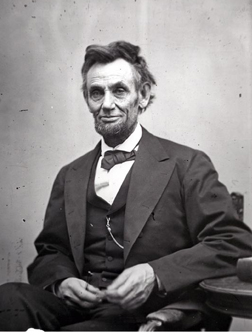
Abraham Lincoln is popularly thought of as a champion of racial equality far ahead of his time. It does no dishonor to Lincoln to point out that this is an exaggeration. Lincoln grew up in an era when virtually all white Americans, even opponents of slavery, considered black men and women inherently inferior to whites. Traces of this sentiment made their way into Lincoln’s political thought. In his 1858 debates with U.S. Senator Stephen Douglas, Lincoln stated: “I am not, nor ever have been in favor of bringing about in any way the social and political equality of the white and black races … [T]here is a physical difference between the white and black races which I believe will forever forbid the two races living together on terms of social and political equality.”1 Lincoln viewed emancipation primarily as a war measure and rejected the call of Radical Republicans for rapid amendment of federal and state laws to give blacks full civil and political equality.2
But Lincoln in his heart never accepted the premise of black inferiority. He consistently expressed his racial views in tentative terms and altered those views when the crucible of war and emancipation showed that alteration was warranted. Lincoln worked hard to bridge the divide between himself and the Radicals. They were “the unhandiest devils in the world to deal with,” said Lincoln, “but after all their faces are set Zionwards.”3 In the last major speech of his life, Lincoln left the door open for black suffrage at a time when Wisconsin and most other northern states had rejected it.4
One of Lincoln’s most brilliant insights was that great social movements, once launched, often spill beyond their original borders: that the Civil War would trigger an equal-rights revolution that would not be limited to black Americans. In the Gettysburg Address he described this as “a new birth of freedom” advancing the ideal of “government of the people, by the people, for the people” – all of the people.5
Civil Rights in Wisconsin During the Emancipation Era
How have these cross-currents affected Wisconsin law? At first, Wisconsin, like the Radical Republicans, seemed to be on the cutting edge of civil rights law. Nearly all Wisconsinites vehemently opposed slavery during the years before the Civil War, and in 1854 Wisconsin became the first and only state to openly defy the federal Fugitive Slave Act of 1850.
The 1850 Act, which Congress had passed in an effort to avoid Southern secession, was hugely unpopular in the northern states because it required local law enforcement officials to assist in the capture and return of fugitive slaves. The U.S. Supreme Court had rejected constitutional challenges to a predecessor fugitive law, and the Massachusetts and Ohio supreme courts reluctantly held that despite doubts that the high Court was correct they must defer to its decisions and enforce the 1850 Act.6 But when Sherman Booth, a Waukesha abolitionist, was prosecuted under the 1850 Act for his role in helping Joshua Glover, a fugitive slave, break out of a Milwaukee jail and escape to freedom in Canada, Booth’s lawyer, Byron Paine, tried a new constitutional attack on the 1850 Act. Paine invoked the doctrine of states’ rights, arguing that Wisconsin was not bound by the U.S. Supreme Court’s decisions and could make an independent determination of the Act’s constitutionality. Justice Abram Smith of the Wisconsin Supreme Court accepted Paine’s argument and ordered federal officials to release Booth.7
Learn More
Abraham Lincoln’s Legacy to Wisconsin Law
Lincoln arguably has done more than any other individual to shape America. He influenced and was influenced by powerful legal and political currents that continue to play a vital role in shaping American law, including the law of Wisconsin.
“Abraham Lincoln’s Legacy to Wisconsin Law, Part 1: A New Birth of Freedom – Civil Rights law in Wisconsin,” Wisconsin Lawyer, December 2008
“Abraham Lincoln’s Legacy to Wisconsin Law, Part 2: Inter Arma Silent Leges: Wisconsin Law in Wartime,” Wisconsin Lawyer, February 2009
“Abraham Lincoln’s Legacy to Wisconsin Law, Part 3: The Free Labor Doctrine,” Wisconsin Lawyer, April 2009
Smith’s opinion was an unusual mix of close legal reasoning and vigorous antislavery rhetoric. Smith denounced the 1850 Act as “a wicked and cruel enactment” and warned that until the federal government “return[ed] to the exercise of the just powers conferred by the Constitution … agitation, acrimony and hostility will mark our progress, even if we escape a more dread calamity, which I will not even mention.”8 Smith’s colleagues later affirmed his opinion, but in 1859 the U.S. Supreme Court, speaking through Chief Justice Roger Taney, reversed the Wisconsin court.9
Wisconsinites were in no mood to accede to Taney, the author of the infamous Dred Scott decision. The Wisconsin Legislature passed a resolution stating that “a positive defiance … is the right remedy,” and one newspaper, alluding to Taney’s statement in Dred Scott that black people “had no rights which the white man was bound to respect,” argued that Taney’s new decision meant “the free states have no rights which kidnappers are bound to respect!”10
States’ rights sentiment peaked in 1859 when the Wisconsin Supreme Court refused to accept and file Taney’s decision. Recently appointed Chief Justice Luther Dixon was the lone dissenter. Dixon explained that although he personally agreed the 1850 Act was unconstitutional, Wisconsin must defer to the federal high court and look to the ballot box rather than the courts for an end to slavery. Dixon pointed out that Booth and Justice Smith would “place it in the power of any one state, beyond all peaceful remedy, to arrest the execution of the laws of the entire union, and to break down and destroy at pleasure every barrier and right given by the constitution.” Wisconsin Republicans responded by denying Dixon renomination to the court in 1860. Dixon then ran as an independent and narrowly won. His victory, coupled with the Republicans’ national victory in the fall of that year, caused states’ rights sentiment to recede.11
The Booth cases were the last time Wisconsin took a civil rights leadership role on the national stage. As Lincoln prophesied, the end of the Civil War brought a new birth of freedom not just to the emancipated slaves of the South but to the North as well. All Midwestern states except Wisconsin had established “black codes” before the war, severely restricting black immigration and civil rights; those codes were promptly repealed after the war ended.12 Before the war, black men were allowed to vote only in a handful of New England states; after 1865, some Midwestern states followed suit, and in 1870 the 15th amendment to the U.S. Constitution nationalized suffrage for black men.
Wisconsin adopted male black suffrage in a highly unusual manner. In 1849 a suffrage referendum was held as required by the state’s new constitution and a majority of the people voting on black suffrage approved it, but Wisconsinites universally believed that suffrage had failed because the constitution required approval by a majority of all individuals voting at the election, not just those voting on the suffrage question. In 1866 Ezekiel Gillespie, a leader of Milwaukee’s black community – again represented by Byron Paine – persuaded the supreme court that a majority of those voting on the suffrage issue sufficed. The court ruled that legally, black Wisconsin men had been entitled to vote since 1849.13
Wisconsin and the Struggle to Implement Civil Rights
During the century after the Civil War, civil rights progress was painfully slow in Wisconsin as reformers gradually shifted their attention from de jure to de facto equality. As one Wisconsin historian has stated, “Benevolent paternalism and street-nodding familiarity that … once seemed to characterize relations between blacks and whites … [gave] way to a cold and formalized pattern of race relations. Negroes were amusing – in their place – was the message.”14 Wisconsin never enacted discriminatory laws – for example, it consistently refused to enact antimiscegenation laws, which were universal in the post-Civil War South and common even in the North – but neither did it take an affirmative stand against discrimination. After the U.S. Supreme Court struck down in 1883 a federal law guaranteeing equal access to places of public accommodation, many northern states quickly passed laws to take the place of the federal law. But Wisconsin waited until 1895 to do so and it enacted an employment antidiscrimination law only in 1945, well after the federal government had enacted such regulations to meet the pressing need for defense workers of any race in World War II. The legislature did not give black Wisconsinites a private right of action under the employment law until 1957.15
 Joseph A. Ranney, Yale 1978, is a trial lawyer with DeWitt Ross & Stevens S.C., Madison and Brookfield. He is the author of Trusting Nothing to Providence: A History of Wisconsin’s Legal System (1999) and In the Wake of Slavery: Civil War, Civil Rights and the Reconstruction of Southern Law (2006). He also is an adjunct professor at Marquette University Law School and a member of the Wisconsin Abraham Lincoln Bicentennial Commission.
During recent decades advances in civil rights law have taken place largely at the federal level. Those advances have triggered a national debate over the extent to which racial disparity is linked to poverty and the extent to which law should be used to remedy past racial and economic discrimination. Wisconsin’s contribution to this debate has come mainly out of the struggle to reduce residential and school segregation in Milwaukee.
Wisconsin has had a long tradition of neighborhood schools and local control over education.16 When Milwaukee first acquired a numerically significant (and very segregated) black population in the 1940s and 1950s, the local-schools tradition resulted in a severely segregated school system. In 1964, state representative Lloyd Barbee filed a desegregation suit against the Milwaukee Public Schools (MPS) to eliminate school segregation. Barbee, reflecting prevalent attitudes of civil rights supporters in the mid-20th century, argued that black Wisconsinites could enjoy their constitutional right to equal protection only if a racial balance was struck in the schools. Equal opportunity and facilities were not enough, said Barbee, and MPS must be held responsible even though it had not caused the residential segregation that resulted in school segregation. Federal judge John Reynolds agreed. “The Constitution,” said Reynolds, “does not guarantee one a quality education; it guarantees one an equal education, and the law in this country is that a segregated education that is mandated by school authorities is inherently unequal.”17
But Barbee’s and Reynolds’s hopes for thorough-going integration were not realized. Despite efforts by local officials and the legislature to enact desegregation measures with teeth, during the 1980s many Milwaukee whites migrated to the suburbs, and MPS became a heavily minority school district burdened by an increasingly shaky tax base. Sentiment for integration dropped, and Americans both black and white increasingly came to view liberty and justice in terms of the right to individual self-fulfillment rather than promotion of a common good.18 These forces gave rise to the school voucher movement.
In 1990, Wisconsin became the first state in the nation to enact a voucher law. The law provided that up to 1,000 MPS students could attend nonsectarian private schools of their choice, and money from the MPS budget would be set aside to pay their expenses up to $2,500 per year.19 Opponents challenged the law but in Davis v. Grover (1992), a deeply divided Wisconsin Supreme Court upheld it.20
Justice William Callow, speaking for the majority, expressed a view of equal protection almost diametrically opposite to Judge Reynolds’s view. The Wisconsin Constitution, said Callow, “does not require the legislature to ensure that all the children in Wisconsin receive a free uniform basic education” but only requires the legislature “to provide the opportunity for all children in Wisconsin to receive a free uniform basic education.”21 Justice Shirley Abrahamson, dissenting, charged that the voucher law “subvert[s] the unifying, democratizing purpose of public education by using public funds to substitute private education for public education without the concomitant controls exerted over public education.”22 The tide continued against traditionalists: In 1995 the legislature expanded the voucher program dramatically and allowed sectarian schools to participate for the first time, and the supreme court also upheld this law.23 The debate over the proper balance between public and private schools, between communal and individualized education, continues.
The New Birth of Freedom for Wisconsin Women
The “new birth of freedom” Lincoln prophesied extended to women as well as black Americans. The years following the Civil War were an important period in the history of women’s rights, both nationally and in Wisconsin. Lincoln paid little attention to women’s rights: His only public commentary was a hint at the beginning of his political career that he might favor suffrage for women, and he never followed up on the hint.24 But Congressional debate over extension of basic civil rights and of suffrage to black men through the 14th and 15th amendments prompted Susan B. Anthony and other leaders of the national women’s movement to demand that those rights be extended to women as well. Some legislators agreed, but most did not. In 1869 Olympia Brown and her colleagues founded the Wisconsin Women’s Suffrage Association (WWSA). They would meet with mixed success over the next 50 years.
Before the Civil War, in 1850, Wisconsin struck a modest blow for women’s rights by enacting one of the nation’s first married women’s property acts, giving married women for the first time the right to control property they brought to the marriage and sharply modifying the common-law “marital unity” doctrine that had given husbands virtually complete control of their wives’ assets and wages.25 But the supreme court consistently interpreted the 1850 law in a narrow manner, refusing to construe it to give women control of their wages and business profits. In 1872, shortly after the WWSA was founded, the legislature passed an amended property act that unequivocally gave married women control over their wages and business profits.26 In 1879 Wisconsin became one of the earliest states to admit women to the practice of law – but only after Chief Justice Edward Ryan had rejected an admission application from Lavinia Goodell of Janesville. Ryan declaimed that “callings … inconsistent with [the] radical and sacred duties of their sex … for the bearing and nurture of the children of our race and for the custody of the homes of the world … are departures from the order of nature and … treason against it,” but the legislature and Ryan’s colleagues on the court overrode him.27
In 1884 the WWSA persuaded the legislature to enact a limited suffrage law allowing women to vote in school elections (that is, elections for superintendent of public instruction and local educational offices). But in 1888 the supreme court again interpreted the law in a pinched manner, ruling that women could vote only if special ballots limited to such offices were provided. The legislature did not provide for such ballots until the dawn of the Progressive era in 1901.28 The WWSA and its allies persuaded the legislature to allow a referendum on full women’s suffrage in 1912, but the measure went down to defeat. Wisconsin women did not gain the vote until the 19th Amendment to the U.S. Constitution, providing for national suffrage, was ratified in 1919.29 Wisconsin was not alone in its reluctance to embrace full women’s rights during the decades following the Civil War, but it certainly was not a leader in the movement for such rights.
Conclusion
There is a distinctly Lincolnesque element in Wisconsin’s approach to new births of freedom for its black and women citizens. Lincoln was seldom radical and always pragmatic and cautious about reform, but he viewed expansion of rights as a never-ending process and always kept an open mind as to new rights. With the notable exception of the Booth controversy, Wisconsinites have seldom been in the forefront of civil rights reform; but they have never closed their minds to reform either, and as a result, Wisconsin, like the nation, has gradually come to match and even exceed the fondest hopes of Lincoln’s radical allies. Lincoln might well view the controversy over school choice as merely one chapter in a long evolutionary process, and it is certain that he would welcome the debate as necessary to that process.
Endnotes
